


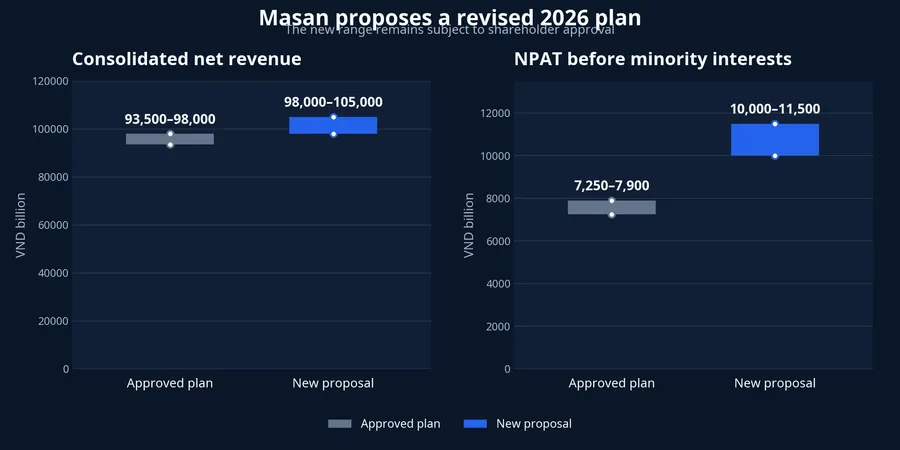
When a company raises its plan in the middle of the year, it is tempting to assume the hard part is already behind it. Masan deserves a more careful reading. Its board has proposed increasing the 2026 consolidated net-revenue range from VND 93,500–98,000 billion to VND 98,000–105,000 billion, while lifting profit after tax before minority interests from VND 7,250–7,900 billion to VND 10,000–11,500 billion.Masan
That is a substantial reset of expectations, not profit already recorded in the accounts. For new investors, the useful question is not what the share price may do next. It is where the extra earnings are expected to come from, and which reports will be capable of proving that the plan is on track.
A proposal, not an achieved result
The July 22 resolution explicitly calls the revision a proposal. It says the revised plan will be submitted to shareholders at the nearest general meeting, so the process is not complete. The prior plan is the benchmark already approved by shareholders; the new range is the board's proposed revision.Masan
That distinction may sound procedural, but it matters when reading a listed company. Three layers of information often sit side by side: management's plan, the target approved by shareholders, and actual performance. The first shows where the company wants to go. The second establishes the target through corporate governance. Only the third shows how far the business has actually travelled.
Even if shareholders approve the full VND 10,000–11,500 billion range, it remains a full-year objective rather than a guaranteed outcome. VietnamBiz reported that Masan revised its expectations as several business lines improved and tungsten prices became more favourable.VietnamBiz That gives investors a starting point for scrutiny, not a reason to add the increase directly into valuation.
First-quarter operations are stronger
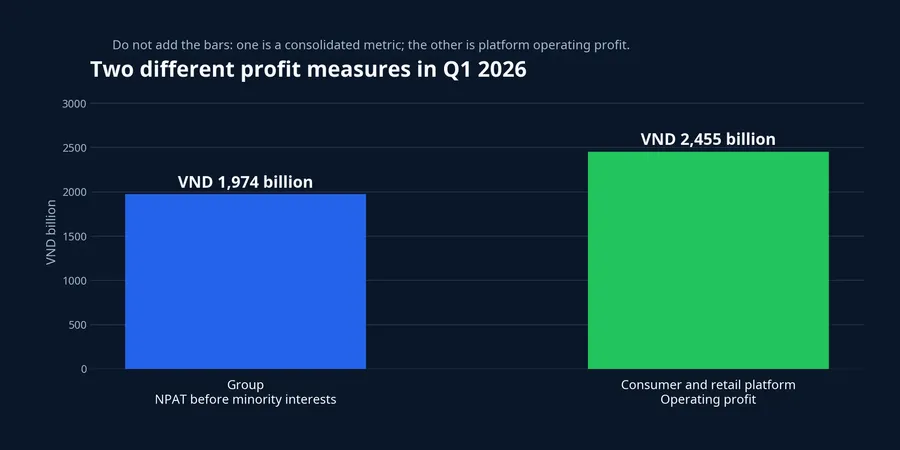
Masan did not make the revision in a data vacuum. In the first quarter of 2026, group profit after tax before minority interests reached VND 1,974 billion, double the year-earlier figure. Operating profit at the consumer and retail platform was VND 2,455 billion, up 23.6% year on year.Thanh Niên
Those figures should not be added together. One is a consolidated group-profit measure; the other is operating profit for a business platform. But their simultaneous improvement suggests that consumer and retail operations made a more constructive contribution to the wider picture. This is the difference between reading figures for their structure and hunting for a quick total.
At WinCommerce, first-quarter profit after tax before minority interests was VND 204 billion, 3.5 times the year-earlier level, with a 1.8% margin.Thanh Niên Thin margins are normal in grocery retail. A positive result therefore matters, but investors should still test whether that margin can hold as the network expands and store costs move.

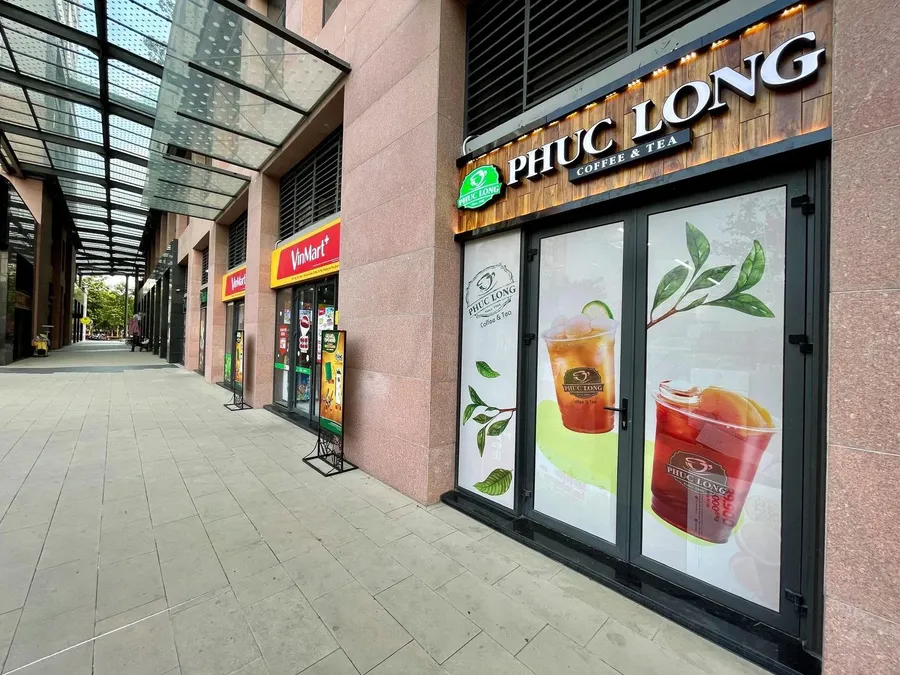
Masan Consumer provides a larger earnings base. Its first-quarter revenue was VND 8,472 billion, up 13.1% year on year, while profit after tax before minority interests was VND 1,800 billion, up 11.5%. Phuc Long Heritage posted VND 569 billion of net revenue, up 34%, and its profit after tax before minority interests increased 1.6 times.Thanh Niên The issue for later quarters is not merely growth speed, but the relationship between sales, selling expenses and margins.
Subsidiary profits cannot be added mechanically
This is the point most likely to confuse a new investor. A subsidiary reporting strong profit is positive, but it does not mean that every dong of that profit belongs to MSN shareholders. Consolidated accounts also reflect ownership percentages, non-controlling interests, intercompany transactions, financing costs and other consolidation adjustments.
That is why investors should not add the profits of WinCommerce, Masan Consumer and other units to arrive at Masan's earnings. Part of a subsidiary's result may already be included in the consolidated number, and part may belong to non-controlling shareholders. The safer approach is to follow the group-level measure used in Masan's plan, then compare it with the explanation provided in each quarterly report.
Tungsten can accelerate earnings and raise sensitivity
Masan High-Tech Materials is an important variable in this revision. It delivered VND 537 billion of first-quarter profit after tax, reversing a VND 222 billion loss a year earlier. Thanh Niên identified three factors alongside the turnaround: more favourable commodity prices, better operating efficiency and lower net interest expense.Thanh Niên
VietnamBiz said the initial plan used an assumed tungsten price of approximately USD 385 per MTU, while the level cited by the company in early May was approximately USD 3,000 per MTU.VietnamBiz That gap helps explain why expected profit can move more sharply than consolidated revenue. It also shows that part of the revised outlook rests on a commodity variable that can move faster than store productivity or brand strength.
Not all profit growth should be treated as having the same quality. More repeat customers, stronger store productivity or a sustained reduction in funding costs are operational signals of a different kind from a favourable commodity price environment. The available reporting does not allow a precise allocation among these drivers. It is therefore more accurate to monitor them in parallel than to assign the entire increase to one cause.
Four tests for the next reports
First, group-level operating profit needs to keep improving. That helps distinguish progress in core operations from a short-lived benefit or a commodity-price movement. Second, WinCommerce needs to sustain a positive margin as it expands. Rising revenue accompanied by shrinking margins because of heavy opening costs would tell a different story from revenue growth paired with better store economics.
Third, Masan Consumer and Phuc Long need to show that sales growth is not being bought with an outsized rise in selling expenses. Comparing expense ratios and margins quarter by quarter is more informative than viewing revenue alone. Finally, investors should watch operating cash flow, debt and interest expense.
Accounting profit is more persuasive when cash generated from operations also rises. If inventory, receivables or expansion costs absorb most of the cash, earnings quality deserves a more cautious assessment. Likewise, if lower interest expense is part of the high-tech-materials story, the consolidated debt trend becomes necessary evidence of how durable that improvement is.
Conclusion: the higher plan is a testable hypothesis
The current conclusion is straightforward: Masan's new profit range has an initial basis in first-quarter results and favourable tungsten conditions, but it is not yet confirmed by full-year execution. Shareholder approval is the needed governance milestone; the following reports are the economic test of how persuasive the plan really is.
The signals to monitor are consolidated operating profit, WinCommerce's margin, margins across the consumer businesses, cash from operations and borrowing. If they improve together, the higher target will have stronger support. If the outcome mainly reflects elevated tungsten prices, Masan may still enjoy a favourable year, but the quality and durability of its earnings will remain open questions.