

A lower revenue line is not always the most important message in a company's results. For Duc Giang Chemicals Group (DGC), the more useful Q2 2026 question is how much profit remained from each unit of sales after production costs. That answer deteriorated markedly from a year earlier, which is why net profit fell much faster than revenue.
DGC reported consolidated revenue of VND 2,416.2 billion, down 16.55% year on year, while net profit fell to VND 440.77 billion, down 50.52%.Tin nhanh Chứng khoán The figures point to more than lower sales volumes. The company also retained less profit from every dong of revenue, magnifying the effect on the bottom line.
Cost of goods sold matters more than the topline
For a manufacturer, cost of goods sold covers the direct inputs required to make products: raw materials, energy and production-related expenses. Revenue less those costs is gross profit. When costs do not fall in step with revenue, gross margin comes under pressure almost immediately.
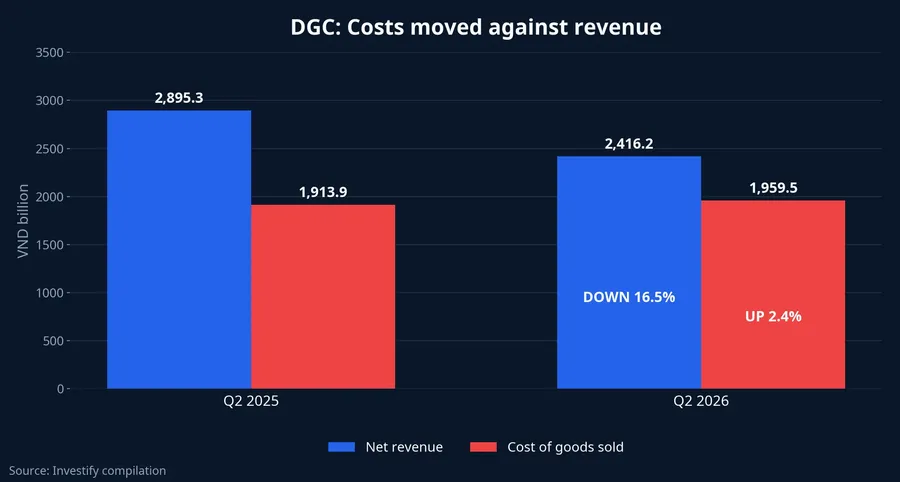
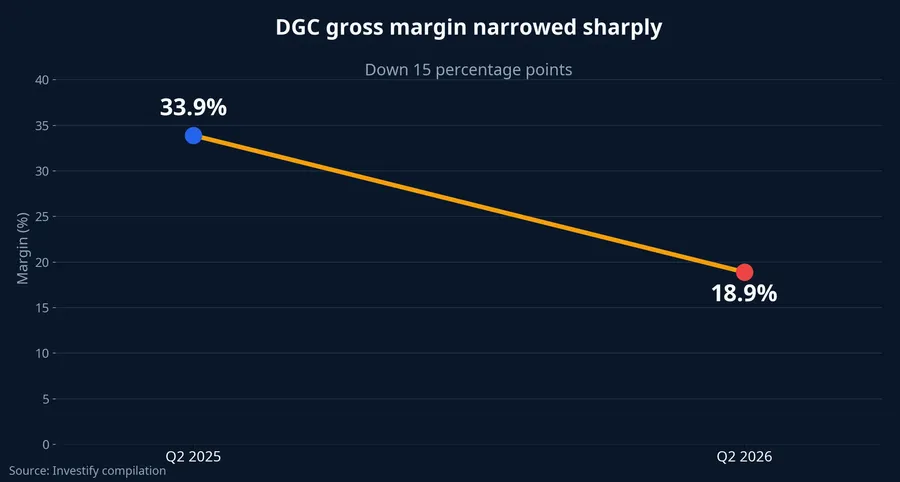
In Q2, DGC's net revenue declined 16.5% but cost of goods sold rose 2%. Gross profit consequently fell 54% to nearly VND 456 billion, and gross margin narrowed from roughly 33.9% to 18.9%.CafeF That mismatch directly explains why net profit contracted much more sharply than revenue.
Put simply, DGC previously kept nearly VND 34 of gross profit from every VND 100 of sales; this quarter it kept less than VND 19.CafeF A 15-percentage-point change is not a minor accounting detail. It signals that the earnings power of each unit of output weakened during the reporting period.
Financial income rose 5% to more than VND 194 billion, while financial expenses fell 63% to more than VND 16 billion.CafeF Those items softened part of the impact, but they could not offset the decline in gross profit. This distinction matters: a weak quarter driven by financing costs is different from one in which the core manufacturing operation produces substantially less value.
Ore supply is part of a broader cost chain
According to DGC's explanation cited by Tin nhanh Chứng khoán, Mining Area 25 was temporarily suspended for an investigation. The company had to rely entirely on imported and externally purchased ore, raising the cost of yellow phosphorus. It also cited higher sulphur, electricity, coke and ammonia prices as factors affecting the quarter's result.Tin nhanh Chứng khoán

The important point in the financial statements is the cost mechanism, not simply the name of one mining site. Self-mined materials can give a producer more control over purchase costs and supply timing. When a company shifts to imports or outside suppliers, its unit cost may become exposed at the same time to market prices, logistics and foreign-exchange movements. Its internal cost advantage shrinks just as several other inputs are becoming more expensive.
Still, it would be inaccurate to assign the entire profit decline to the suspension of Mining Area 25. DGC also cited lower revenue and a range of higher input costs, while the available disclosure does not quantify each factor's separate contribution to cost of goods sold. The evidence supports treating self-mined ore as an important link in the cost chain, not as a single measured cause of the quarterly outcome.
The margin trend extends into the second quarter
DGC's gross margin was 23.0% in Q1 2026 and then fell further to 18.9% in Q2.CafeF One quarter cannot establish how long the pressure will last, but two quarters with weaker margins make production costs an independent variable to watch. Revenue alone does not reveal the quality of that revenue.
For the first half, DGC posted revenue of VND 4,541.66 billion, down 20.42% from a year earlier, and net profit of VND 870.82 billion, down 49.6%.Tin nhanh Chứng khoán The half-year figures reinforce the view that the gap between revenue and earnings is not simply a one-month distortion at the end of the quarter. They do not, however, provide enough evidence to assign the decline to one cause or to forecast the timing of a recovery.
The stock-price move also needs to be read against the correct timing. DGC closed on July 22 at VND 40,500 per share, down 5.81% for the session. The detailed Q2 report was published after the market closed, so that single-session move cannot by itself show that investors had fully absorbed the earnings release. Timing coincidence is not proof of causation.
What would show that margins are improving
First, investors need formal information on the operating status of Mining Area 25. A restart would clarify whether DGC can recover part of its internal ore-cost advantage. Until then, assigning a specific timetable for a recovery would go beyond the available evidence.
Second, the relationship between revenue and cost of goods sold will be critical. More stable sales with costs still rising would indicate that input pressure remains unresolved. By contrast, a recovering gross margin alongside controlled costs would be more direct evidence that the core operation is improving.
Third, sulphur, electricity, coke and ammonia should be monitored alongside yellow-phosphorus selling prices. Cheaper inputs may not lift reported margins immediately if inventory was purchased at higher prices, or if output prices also decline. A single commodity quotation is therefore insufficient evidence for a margin conclusion.
Finally, DGC's ability to pass higher costs through to customers matters. A producer with pricing power can limit the damage from more expensive inputs. If weak demand prevents selling prices from rising in line with costs, profit can remain under pressure even if revenue stops falling sharply.
The Q2 report supports a clear thesis: DGC's more immediate issue is the quality of its revenue, measured by the profit left after cost of goods sold. Ore supply and input costs are not caveats that undo that thesis; they are the indicators that will test it. Subsequent quarterly reports should show whether gross margin recovers alongside better cost control.