

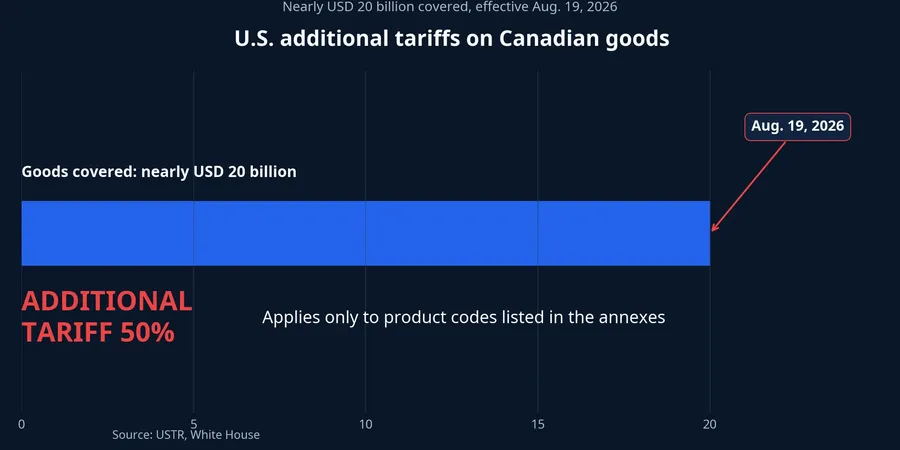
The United States’ new 50% additional tariff on selected Canadian goods invites an overly simple conclusion: every Canadian product entering the U.S. will cost 50% more. The orders do not work that way. They target specific product codes listed in annexes, and that legal detail will determine whether the shock is contained in a handful of companies’ margins or reaches U.S. consumers through higher prices.White House
The larger picture is about cost transmission, not a headline number that can immediately explain inflation or equity prices. The central thesis is straightforward: before the August 19 effective date, the product annexes, Canada’s response and companies’ ability to reprice matter more than the 50% headline rate.
A large tariff with an uneven reach
U.S. President Donald John Trump of the U.S. Government signed the orders under Section 338 of the Tariff Act of 1930. The U.S. Trade Representative says the measures cover nearly USD 20 billion of imports from Canada. They apply to goods entered for consumption in the United States from August 19, 2026 and are additional to other applicable duties, fees and charges except where an order provides an exclusion.USTR
The dispute names are not the same as the list of covered goods. The alcoholic-beverages annex includes beer, wine and spirits; the dairy annex includes concentrated milk, milk powder, whey, lactose and milk proteins. The annex associated with the vehicle dispute reaches much further, spanning honey and flowers, cement, plywood, apparel, telecommunications equipment, furniture and sporting goods.White House
Energy, potash, fish, critical minerals and goods already subject to Section 232 tariffs are among the exclusions described by the White House. The orders also exclude some other groups, including vehicles and parts under separate arrangements, lumber, semiconductors, patented pharmaceuticals and most civil aircraft. A company selling wood products or equipment may therefore be exposed on one code but not another.White House
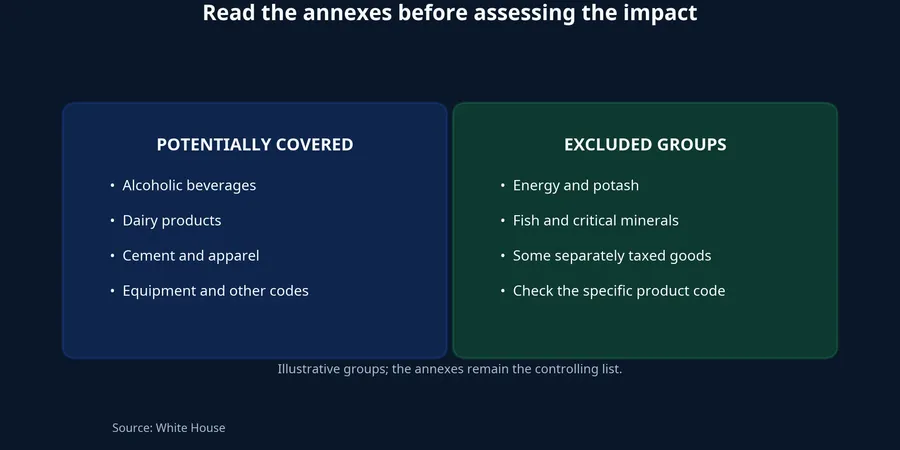
That is why an industry label is not a final answer for investors. Checking the annexes for vehicles, alcoholic beverages and dairy is what establishes whether a revenue line is actually in scope. A product can still face the new duty if its code is listed even when it qualifies under the U.S.-Mexico-Canada Agreement.
That distinction changes the first screening question. Rather than asking whether a company is “Canadian” or whether it belongs to a named industry, investors need to identify the exact U.S. customs code attached to the product and the share of U.S. sales it represents. A diversified exporter may have only a limited affected line, while a smaller specialist may have a much larger concentration of risk.
The annexes also make timing important. Goods already in inventory, goods shipped before the effective date and goods entered for consumption afterwards can have different commercial consequences. Neither a broad tariff headline nor an early company comment replaces the underlying customs classification and the terms under which a shipment is entered.
Why the disputes do not define the impact
The U.S. administration cited an approximately 22% decline in U.S. vehicle exports to Canada between April 2025 and March 2026. For alcoholic beverages, it said Canada’s imports from the U.S. fell approximately 81% between March 2025 and February 2026; for dairy, Washington objected to Canada’s allocation of cheese import quotas for U.S. products relative to European Union goods.White House
Those figures explain the U.S. case for imposing tariffs. They do not show that every Canadian exporter will lose the same share of revenue. Actual exposure depends on the U.S. sales mix, the substitutability of the product and contract terms. A supplier with a strong brand or a hard-to-replace product may pass through more cost, while a supplier of standardised goods is likely to face stronger pressure to cut prices.
It would also be an unsupported leap to attribute an immediate stock-price move solely to the orders. Investors may simultaneously be repricing growth prospects, currencies or the risk of retaliation. The evidence establishes the legal scope and possible channels, but not the precise contribution of each factor to market moves.
The policy case and the investment case therefore have to be kept separate. The administration’s stated grievances explain why the orders were issued; they do not settle how much of the duty will be paid by a Canadian producer, a U.S. importer or a final consumer. That allocation is negotiated through market power and contracts, and it can differ materially across products in the same annex.
Three cost-transmission paths to watch
The first path is partial absorption by companies. The U.S. importer pays the tariff at the border, then may negotiate a lower supplier price, accept a lower margin or change sourcing. This outcome is more likely when goods have many substitutes. Supplier discounts, amended purchasing contracts and retail prices that do not rise in step with the tariff would be confirming signals.
The second path is pass-through to U.S. buyers. If replacement supply is difficult to find and margins are already thin, higher import costs can flow through wholesale prices to the retail shelf. Alcoholic beverages, apparel, furniture and sporting goods offer more visible transmission than inputs or equipment, which pass through another production-cost layer. Investors should watch price-list announcements, import surcharges, gross margins and producer-price data after August 19, rather than a single trading session.
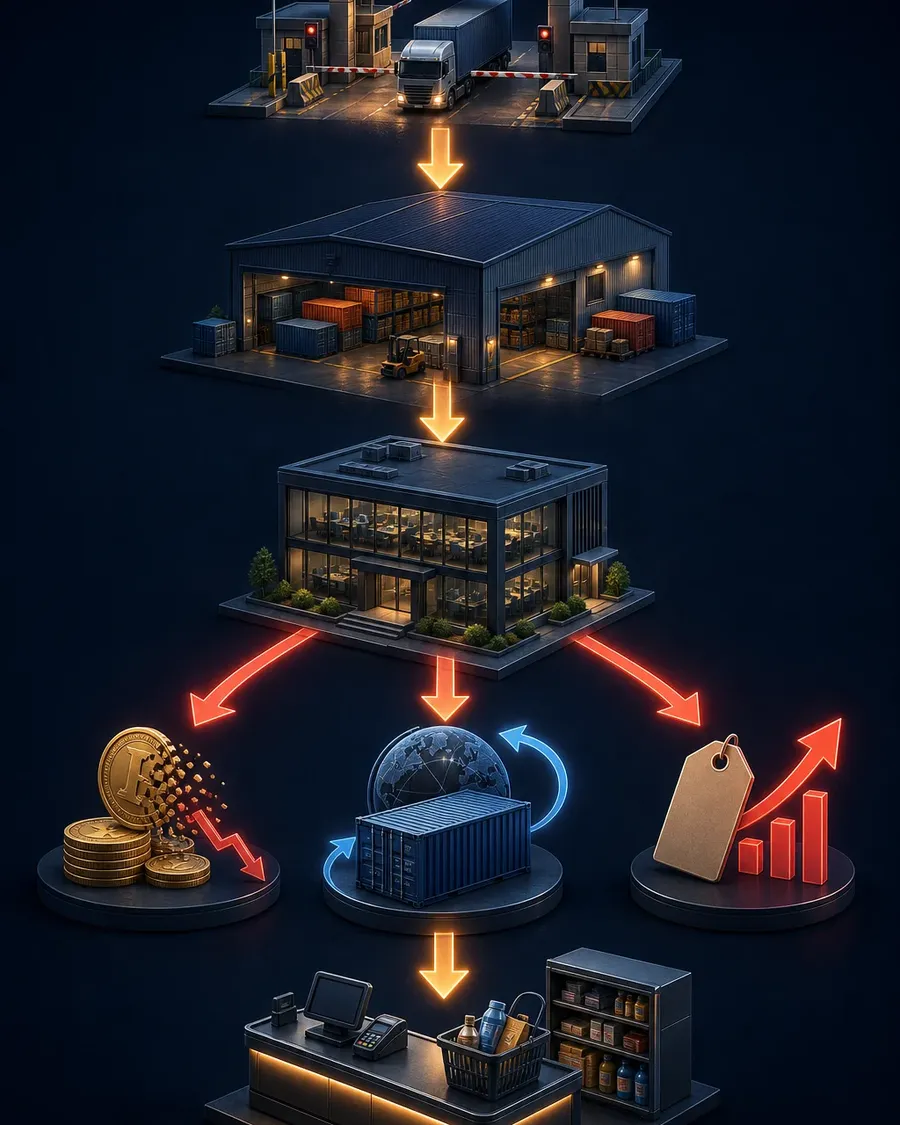
The third path is trade escalation. Canada may negotiate, introduce countermeasures or combine both approaches. A forceful statement, however, is not itself retaliatory tariffs. Only a legal document with a product list and an effective date will identify which U.S. businesses face a direct counter-shock.
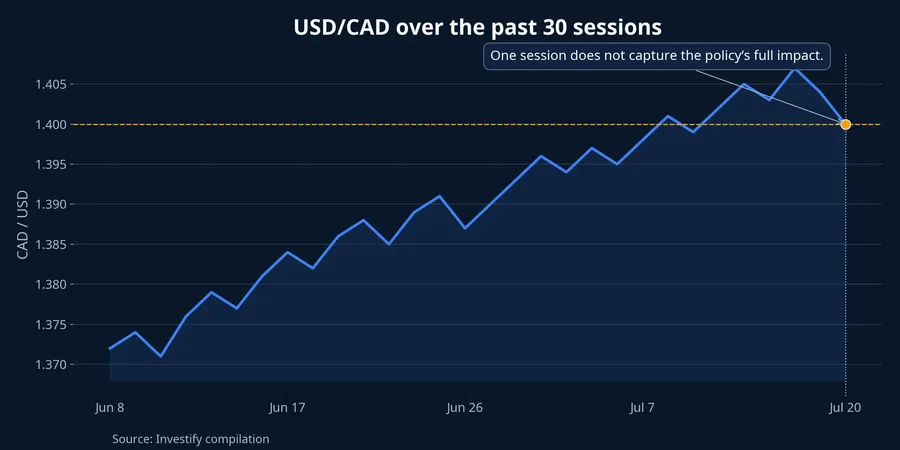
Exchange rates can reflect early expectations but cannot confirm a single path by themselves. At the end of July 20, USD/CAD was around 1.40 and the pair was down 0.22% on the day. The move occurred around the announcement while the policy was not yet in force, so it does not demonstrate that the market has fully priced the next-stage effects.
The watch list through August 19
For Vietnamese investors following international markets, the useful sequence starts with the company and the product code before moving to macroeconomic indicators. A company with substantial U.S. revenue but products outside the annexes can have less direct exposure than a smaller company whose key product line is fully covered. Contracts also matter: who can change prices, how quickly customers can switch suppliers and how long U.S. inventories can last.
At the macro level, pricing announcements and margins will show whether the tariff is absorbed or passed on. If selling prices rise while volumes fall, nominal revenue can hold up even as output weakens. If prices remain stable, the pressure may sit in importer or exporter margins. Those outcomes have very different implications for inflation and earnings.
The conclusion is not that the United States has imposed a uniform tariff on Canada. A 50% rate is substantial for covered codes, but the shock takes shape only when the annexes are matched with revenue, pricing decisions and Canada’s policy response. Through August 19, retaliatory product lists, import surcharges and margin changes are the signals that will show whether pressure stops at corporate profits or moves into prices.