


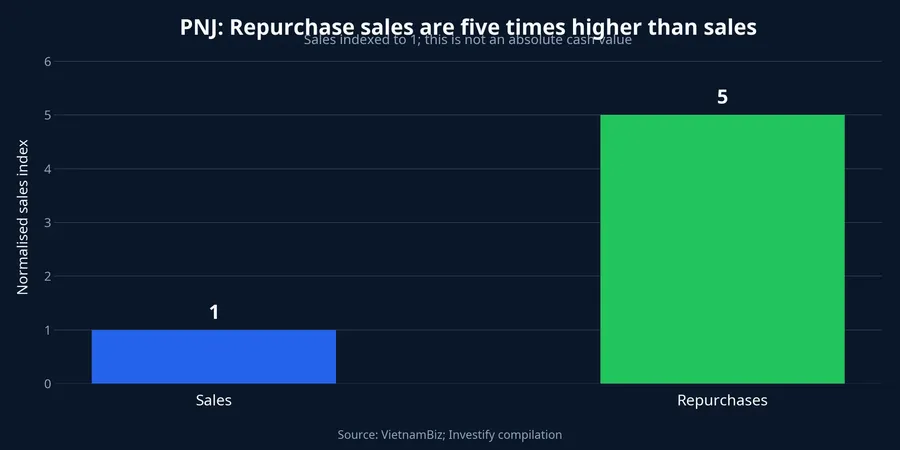
PNJ faces a very concrete test, not a blanket verdict on its financial health. Since the incident at the P-Lab testing unit, the company's sales have been one-fifth of its repurchase sales. Put differently, for every unit of new sales, the system has been taking back five units of product.VietnamBiz
The numbers point to a question beyond whether PNJ intends to honour its commitments. The company has pledged to fulfil 100% of its repurchase obligations; the market now needs evidence of the pace at which that commitment becomes paid cash and of how returned inventory is handled. PNJ closed on 21 July at VND 38,150 per share, down 6.95%, with 9,632,600 shares traded. That response signals concern about execution risk, rather than proof that the company cannot pay.
Five units repurchased do not mean five units of cash leave at once
The ratio of repurchases to sales is an operating signal. With sales normalised to 1, repurchases equal 5; the difference of 4 describes the net flow of products into the system, not the amount of cash that has already left PNJ. When products are received, assessed, valued and paid for determines the daily cash requirement.
At a 21 July media briefing, Phan Quốc Công, General Director of Phu Nhuan Jewelry Joint Stock Company (PNJ), said the company had prepared “several trillion dong” for the repurchase programme. He also reiterated PNJ's commitment to meet all of its obligations to customers.VietnamBiz Those statements address the scale of resources and the scope of responsibility, but they do not create a payment timetable for each transaction.
Before a product can return to a saleable state, PNJ must inspect it, establish its value, allocate funding and process it through the capacity of the wider system. Reporting from the briefing indicates that these steps have slowed the capital cycle versus normal conditions.Đại biểu Nhân dân In simple terms, paying in full defines the obligation; paying quickly depends on appraisal capacity, approval flows and cash being available in the right place.

The financial buffer must be read in layers
PNJ reported approximately VND 4,510 billion in highly liquid assets at the end of March 2026. Cash and cash equivalents accounted for VND 924 billion, while short-term financial investments totalled VND 3,586 billion.VietnamBiz This is a meaningful buffer, but it should not be treated as cash instantly available at every store and at every moment.
Most of those short-term financial investments are bank deposits with terms. They can be an important liquidity resource, yet their availability depends on maturity, early-withdrawal conditions and the company's other payment schedules. A sound balance sheet therefore does not eliminate timing risk: assets can be adequate while cash at the point of payment still needs to be moved and allocated.

The short-term balance-sheet data further supports the view that PNJ retains financial capacity. As of 31 March, current assets were VND 18,163 billion against current liabilities of VND 5,277 billion. Short-term borrowings stood at VND 2,894 billion, down from VND 4,223 billion at the start of the year.VietnamBiz These are, however, a snapshot from the end of the first quarter. They describe the buffer available going into the repurchase episode, not cash paid after 21 July.
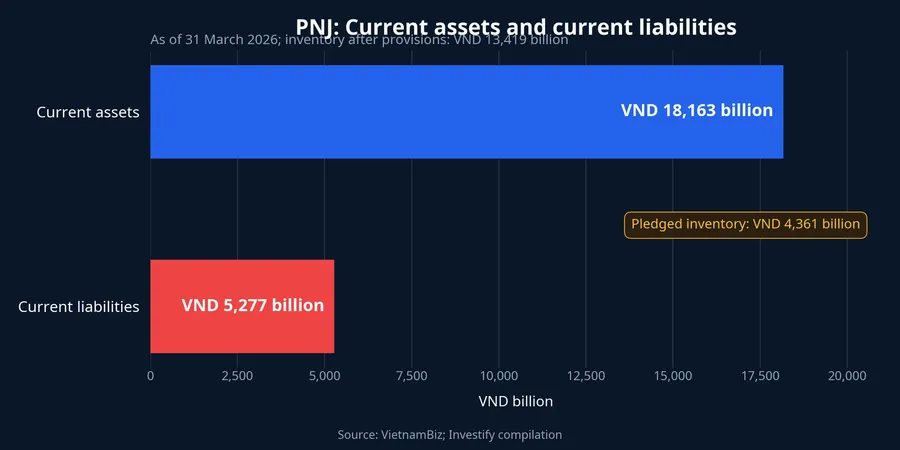
Inventory should be separated from immediately usable cash. Inventory after provisions was VND 13,419 billion at the end of the first quarter, and PNJ had pledged VND 4,361 billion of it as collateral for borrowings.VietnamBiz Gold and jewellery are generally more convertible than many kinds of goods, but book value, processing time and resale price do not always align. Pledged inventory is also less flexible than assets without constraints.
Why the share price is not yet an answer
A limit-down session can capture caution over repurchase demand, but it cannot establish a single cause for the share-price move. Broad market sentiment, stop-loss selling and valuation changes after a period of volatility are all plausible contributors. There is no investor-group trading breakdown or other sufficiently granular information to assign a precise share to each factor.
Likewise, a rebound would not establish that the cash cycle has normalised. Share prices respond instantly to expectations, whereas operating data takes time to accumulate. Reading PNJ's liquidity solely from the board therefore risks two opposite errors: treating one down day as a crisis, or treating one recovery day as proof that the issue has passed.
That distinction matters because liquidity is not a single line item. It is the relationship between cash on hand, assets that can be mobilised, the timing of incoming products and the pace at which claims are settled. A company can retain substantial resources while still facing a temporary operational bottleneck. Equally, a smooth payment process is more informative than an abstract balance-sheet total when an unusual volume of repurchases reaches the system.
The data that will decide the thesis
The first measure is payment progress. Regular disclosure of cases received, value paid, cases awaiting payment and average waiting time would let investors follow the pressure with evidence rather than conjecture. A declining backlog alongside stable payment times would indicate that the timing mismatch is being managed.
The second is the route taken by repurchased products. The repurchase-to-sales ratio needs to narrow toward normal conditions, but the more important question is how rapidly assessed products can return to sales channels. If processing takes longer or recovery values weaken, inventory will rise and working capital will be tied up for longer.
Finally, the composition of funding matters. A need to increase short-term debt, withdraw term deposits ahead of plan or extend payment times would be stronger signals than an intraday price move. Conversely, an improving case-resolution pace without additional borrowing would reinforce the value of the existing financial buffer.
The present thesis is that PNJ has the financial base to meet its repurchase obligations, while the risk lies in converting that base into cash at the required pace. It needs to be revisited only if waiting times lengthen, the backlog continues to build, or the company must add leverage to keep paying. The next operating disclosures, rather than another up or down session, will provide the more reliable answer.