


Vietnam’s securities-market margin debt exceeded VND 446,000 billion at the end of June. At the same time, average daily trading value in the second quarter fell 54% from Q1.VnEconomy That pairing is unsettling, but it is not proof that a forced-selling wave is waiting around the corner. The missing information is where the loans sit, what backs them, and how much equity cushion borrowers still have.
The core view is straightforward: the new margin-debt peak is a signal to monitor concentration and collateral quality, not a reason to declare a market-wide margin call. For newer investors, that distinction matters far more than trying to predict the next down day.
An end-period balance is not daily trading flow
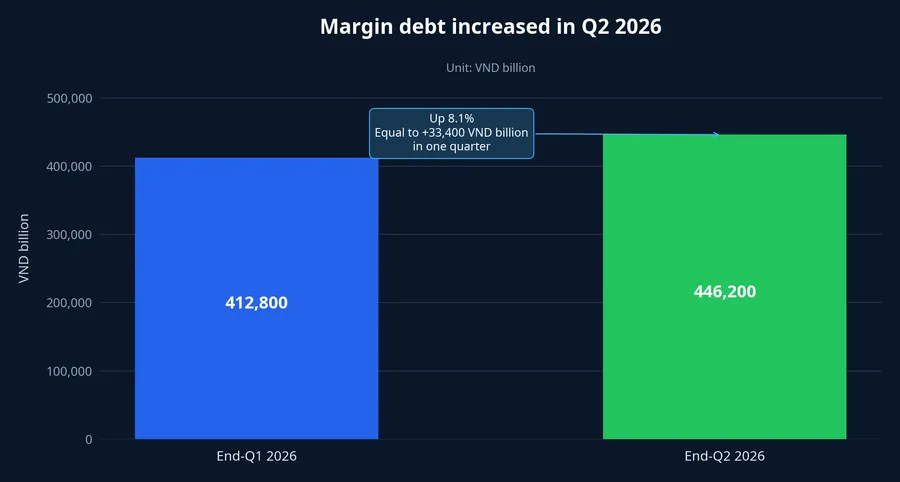
FiinTrade data covering 80 of 85 securities firms, representing 99.95% of the industry’s equity, put margin debt above VND 446,000 billion at the end of June 2026. The balance was up nearly VND 33,400 billion, or 8.1%, from the end of Q1, and nearly VND 45,000 billion from the end of 2025.VnEconomy It is a large amount of borrowed capital, but first and foremost it is a snapshot at the reporting date.
Average matched trading value measures how quickly shares change hands in a session. A borrower can hold a margin position for weeks, leaving the loan on a broker’s balance sheet even if they trade very little. Lower turnover therefore does not mechanically require end-period margin balances to decline at the same pace.
The quarter’s price action offers one plausible explanation, though not the only one. The VN-Index rose from 1,674.49 at the end of March to 1,860.01 at the end of June, a gain of 11.1% in Q2.VnEconomy As collateral values rise, investors may keep positions longer or expand borrowing without generating the same amount of day-to-day turnover.
It would still be an unsupported leap to treat the index gain as the sole cause of higher debt. Privately arranged loans, a changing client mix, and each broker’s lending policy may also have contributed. Public data cannot allocate the contribution of each factor, so the defensible conclusion is simply that these measures can move in opposite directions.
The loan structure is the layer that matters
BSC, as quoted by VnEconomy, says much of the present margin balance is concentrated in privately arranged lending. Such facilities are commonly tied to an individual borrower or a specific transaction, unlike a large number of small retail trading loans generated continuously on the screen. Their balances can therefore be substantial while their turnover differs from ordinary margin lending.VnEconomy
Discipline matters here: the source does not disclose borrowers, collateral, or the exact share represented by each privately arranged facility. Investors cannot infer that money is concentrated in one stock, one shareholder group, or that all retail investors are borrowing to trade short-term swings. The market-wide number describes scale, not the risk map at account level.
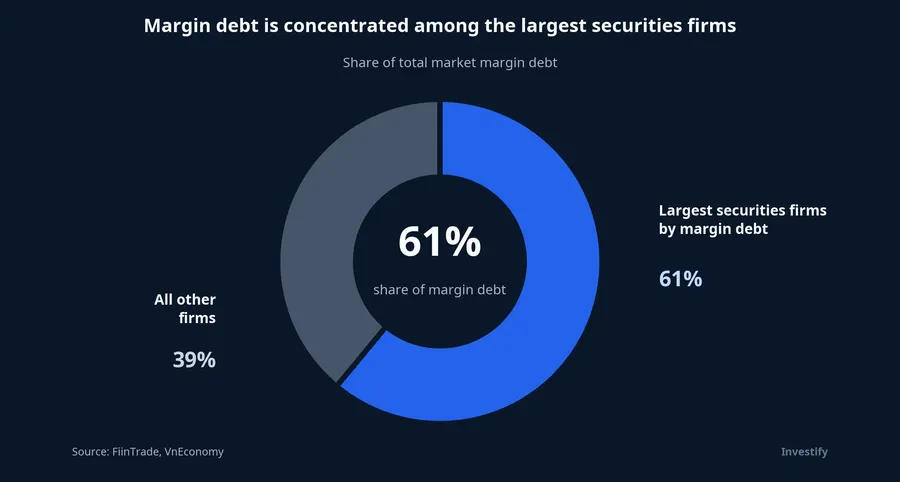
Concentration by broker is a clearer layer of the data. The group of securities firms with the largest balances accounts for 61% of total market margin debt.VnEconomy That does not automatically mean collateral is concentrated in a handful of stocks, but it does show that credit risk is not distributed evenly across firms.
Another FiinGroup-based tally puts TCBS first at VND 51,522 billion, while TCBS, SSI, VPBankS, VPS, and HSC each had more than VND 26,300 billion in outstanding balances.DNSE The list helps identify where credit scale is greatest; it does not reveal the quality of each loan. A large book can coexist with sound risk controls, while a smaller book concentrated in illiquid collateral can be more fragile.
Even the labels on company disclosures need careful reading. VPBankS reported margin lending and advances against sold shares of VND 38,177 billion at the end of Q2, up 12% from the end of 2025.VPBankS Because that line includes sale advances, it is not directly interchangeable with a figure that counts margin loans alone. Comparing unlike measurement scopes can turn correct numbers into a faulty conclusion.
When high margin becomes forced-selling pressure
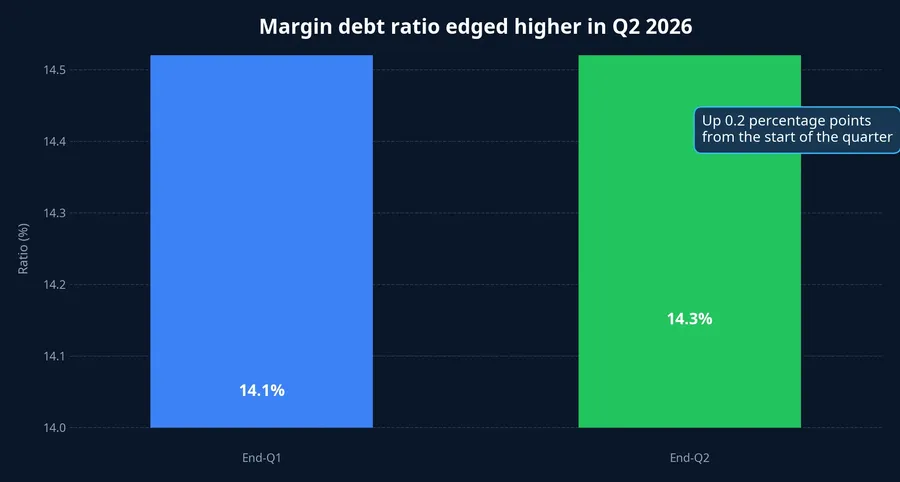
FiinTrade’s ratio of margin debt to free-float-adjusted market capitalization edged from 14.1% at the end of Q1 to approximately 14.3% at the end of Q2.VnEconomy That indicates slightly higher leverage at market level, not a safety ratio for every account. An individual account can be under severe pressure even as the aggregate ratio looks stable, and the reverse is also true.
Forced-selling risk needs a chain of conditions to appear together. Collateral prices must decline enough to erode the equity cushion; brokers must cut lending ratios or demand additional collateral; then liquidity in the pledged stocks must be too weak to absorb sell orders. Once those links connect, falling prices can shrink collateral, trigger mandatory sales, and add further pressure to prices.
The alternative is also important. A large balance backed by liquid assets, spread across borrowers with adequate equity buffers, does not necessarily become systemic stress. Markets can fall for other reasons, including discretionary stop-loss selling, shifting capital flows, or a weaker earnings outlook. It is premature to label every red session a margin event without evidence of widespread lending cuts or collateral liquidation.
The July 21 session shows why those signals should be separated. The VN-Index closed at 1,730.56, down 12.95 points or 0.74%, while matched trading liquidity on the two exchanges fell 23.3% from the prior session.VnEconomy These data show cautious support, but they do not establish broad-based forced selling.
Watch conditions, not one headline number
For a newer investor, the practical question is not the market’s total margin debt but how much volatility their own account can absorb. Check the current borrowing ratio, the distance to any collateral top-up requirement, the liquidity of the shares held, and the ability to add funds if the market moves the wrong way. Those facts are closer to personal risk than an industry-wide headline.
At market level, VND 446,000 billion should be watched beside three signals: the price action of collateral assets, changes to eligible-margin lists, and broker notices on lending ratios. If these deteriorate together, the story shifts from a broad warning to specific pressure. Without that convergence, high outstanding debt is a yellow light: a reason for closer observation, not a market-wide alarm.
The conclusion remains the same. Large borrowed capital and meaningful concentration warrant monitoring, but the available evidence does not support the claim that all retail investors are trapped in margin positions. In the sessions ahead, the revealing signals will be liquidity in stocks used as collateral and brokers’ reactions when prices fall. Those two variables distinguish a normal correction from forced-selling pressure.