


A door is about to open in SpaceX’s share structure. After the company reports second-quarter results, some stock that had been subject to lockup restrictions may become tradable. The headline maximum is about 1.37 billion shares, far larger than the 639 million shares sold in the IPO. But those numbers do not produce an automatic verdict that the stock must fall. What matters is not merely how much stock can be sold, but how many holders choose to sell, how quickly they do it, and how much demand is willing to meet them at prevailing prices.For a newer investor, that distinction is worth holding on to: the end of a lockup changes the ability to sell. It does not automatically create sell orders. SpaceX’s first major unlock is therefore more than a date on a calendar. It is an early test of how well the market can absorb supply after the IPO.
Three numbers that can mislead when placed side by side
Axios reported that SpaceX sold about 639 million shares to the public in its IPO. After second-quarter earnings, as many as 911.5 million shares held by employees and some early investors may become eligible for sale. That figure could rise to roughly 1.37 billion if a price-based condition is also met.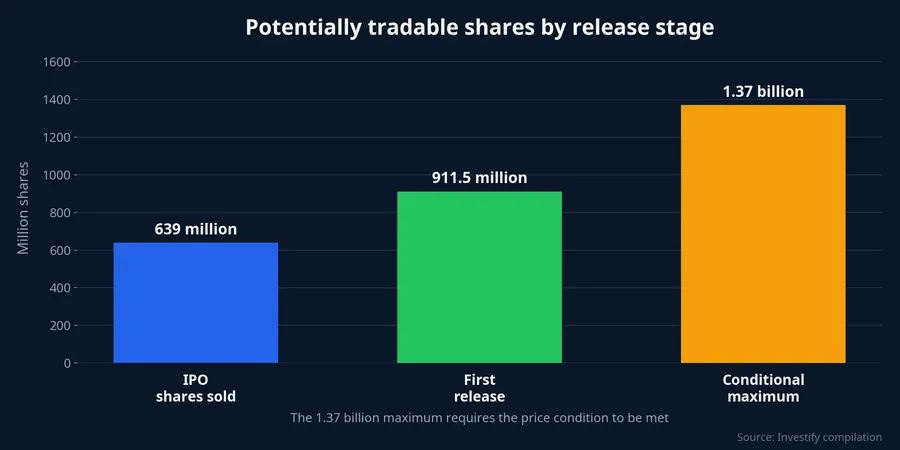
At first glance, a potential release larger than the IPO itself looks like an incoming flood of supply. Yet “eligible for trading” is a technical ceiling, not a forecast. It is like a withdrawal limit on a bank account: the account holder has the right to withdraw up to that amount, but is not required to withdraw all of it on the same day.
The 1.37 billion figure is conditional, too. The prospectus says the additional early release applies only if the shares close at or above USD 175.50 in at least five of the ten consecutive trading days ending on the earnings-release date. If that test is not met, the number eligible immediately after results will be below the widely quoted maximum.## A staggered schedule changes how supply should be read
SpaceX’s filing does not release every locked-up share on one day. The initial release covers up to 20% of the ordinary lockup pool on the second full Nasdaq trading day after results for the quarter ended June 30, 2026. The dates of August 20, September 9, September 24, October 9, and October 24 each release up to another 7%; a further portion follows third-quarter results, and the remainder of this pool leaves lockup on December 8, 2026.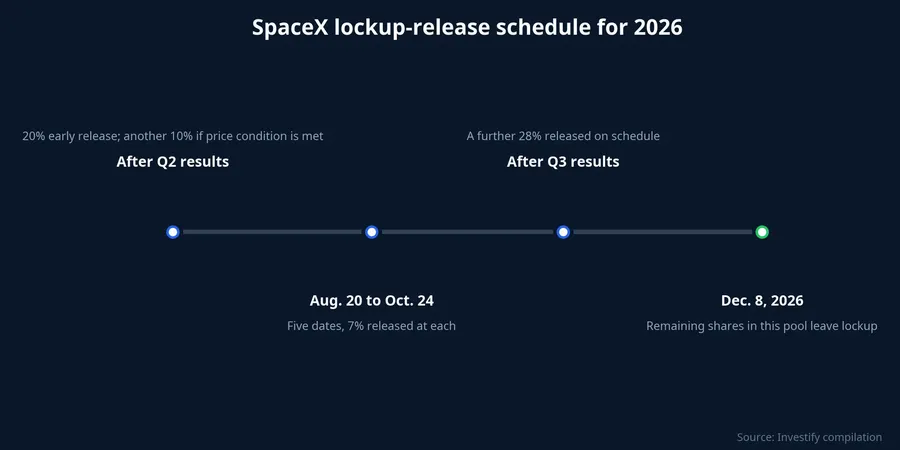
Staggering does not eliminate supply risk. It simply prevents every holder in this group from gaining selling rights in a single session. The market impact still depends on whether selling decisions cluster in the same period. A block of stock dispersed over several weeks presents a very different liquidity challenge from the same block arriving over a few trading days.
Not every insider is in this early schedule. The founder’s shares are locked for 366 days with no automatic early-release clause, while some other large holders follow a longer schedule that extends into 2027. “More than a billion shares unlocked” therefore does not mean all insider stock, or the founder’s stake, is about to enter the market.
A selling right says nothing about the reason to sell
The holders gaining this right do not all have the same objective. An employee might sell part of a holding to diversify personal wealth or fund a tax bill. An early investor may choose to realize some gains after a long holding period. Another holder may prefer to remain invested because the current valuation does not yet match their expectations.
That difference is central to interpreting supply. If many holders decide to sell at once, offers can build quickly and buyers need time to absorb them. If only a small part of the newly eligible pool sells, or if orders are spread out, the headline number may never turn into commensurate pressure. Markets do not react to an option written on paper; they react to executed orders.
This is also why the lockup calendar should not be used to explain every move after second-quarter results. Earnings, management’s outlook, valuation expectations, short selling, and demand from index-tracking funds may all affect the stock in the same window. A decline would not be enough evidence to assign a single cause to the lockup release. Equally, price resilience would not prove that supply risk has disappeared.
Read price and volume as a pair
Outside investors cannot observe every employee’s or early investor’s decision in real time. Trading data after each release date are the closest available evidence, but volume must be read alongside price. High volume is not inherently bullish or bearish because every trade contains both a buyer and a seller.
If volume rises sharply while the price weakens persistently, it suggests that new supply may be outweighing demand at that price range. If volume rises while the price establishes a base or recovers, buyers appear to be absorbing offers more effectively. If both volume and price move little, the newly available selling rights may not yet have become meaningful actual supply.

Pace is the missing piece. The same number of shares sold over a month and over two sessions creates two very different liquidity conditions. Since SpaceX’s schedule is divided into stages, the practical question is not simply, “How many shares unlock?” It is, “How much does volume change after the unlock, and what does the price do?”
That approach also protects investors from a common timing error. Earnings and an unlock can occur in the same observable window, but that does not establish that one caused the other. A strong report can attract demand just as a release date increases the number of potential sellers; a weak outlook can do the reverse. The useful task is to observe the evidence after the event, rather than treating the calendar as a ready-made explanation.
The comparison should be made against the stock’s own recent trading pattern, not against a single quiet session. One unusually active day may reflect news or index flows. Repeatedly heavier volume accompanied by price weakness is more informative because it suggests a sustained mismatch between offers and demand. Conversely, persistent high turnover without a breakdown would show that the market is finding buyers, even if the ownership base is changing.
Conclusion: an absorption test, not a price ruling
The core case is straightforward: SpaceX’s potential supply has increased, but the evidence does not yet show that selling pressure has occurred. The release schedule changes the trading structure and deserves close attention, but it cannot predict the choice of each holder. A headline that treats the 1.37 billion maximum as proof of a price decline skips both the price condition and actual investor behavior.
The most useful signals in the weeks after second-quarter results are the combination of three factors: whether volume spikes, whether price weakens persistently, and whether the same pattern recurs at later release dates. If all three appear together, the case that supply exceeds absorption becomes stronger. If they do not, the market is showing that new selling rights have not yet become decisive selling pressure.