


SHBFinance has cleared a new legal milestone: its conversion from a limited liability company with two or more members into a single-member limited liability company. For a new SHB shareholder, that headline can sound like the deal is done. It is not. The approval opens the way for the final stage, while the payment and SHB's financial-statement impact have yet to be confirmed.
Think of the transaction as a home sale. Permission to change the title is essential, but it is not a signed completion document, a receipt for payment, or an accounting entry. Keeping those milestones separate prevents investors from adding an expected capital surplus to SHB's profit before the evidence exists.
What has happened: SHBFinance's legal form has changed
Recent disclosures say the State Bank of Vietnam has approved SHBFinance's conversion into a single-member limited liability company. This provides the legal basis for Krungsri to move toward full ownership, replacing the previous two-member structure. SHB and Krungsri still need to complete procedures to transfer the remaining stake under the approved roadmap.Mekong ASEAN
The crucial point is that the approval concerns SHBFinance's legal form. It is not an announcement that SHB has transferred its final ownership interest, received full payment, or booked a gain. The events are connected, but they are not interchangeable.
The operational distinction matters to borrowers too. A change in ownership structure does not automatically erase outstanding contracts. The legal entity continues to operate; what changes is the ownership structure once the remaining steps are completed.

The path from approval to profit has several stops
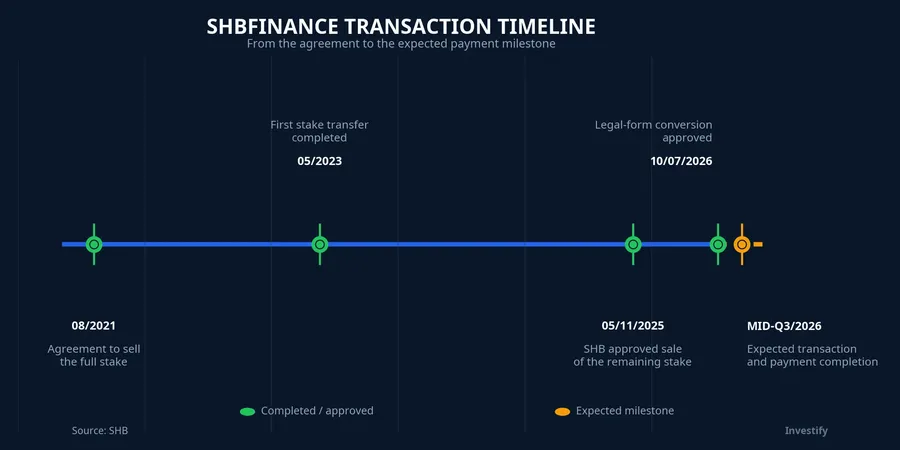
The transaction's history shows why the verbs matter. SHB and Krungsri signed an agreement to transfer the full SHBFinance stake in August 2021. In May 2023, SHB completed the first 50% transfer, with the remaining stake scheduled to follow after three years. The latest report says the parties expect to complete the final 50% transfer in mid-Q3 2026; it does not say that this has already happened.Mekong ASEAN
“Expected” is not a minor wording choice. It leaves open the possibility that the actual completion date changes as the parties handle documentation, transaction conditions and payment. A headline saying that SHBFinance has changed its legal form may be correct; inferring that SHB has already sold the entire company goes beyond the available facts.
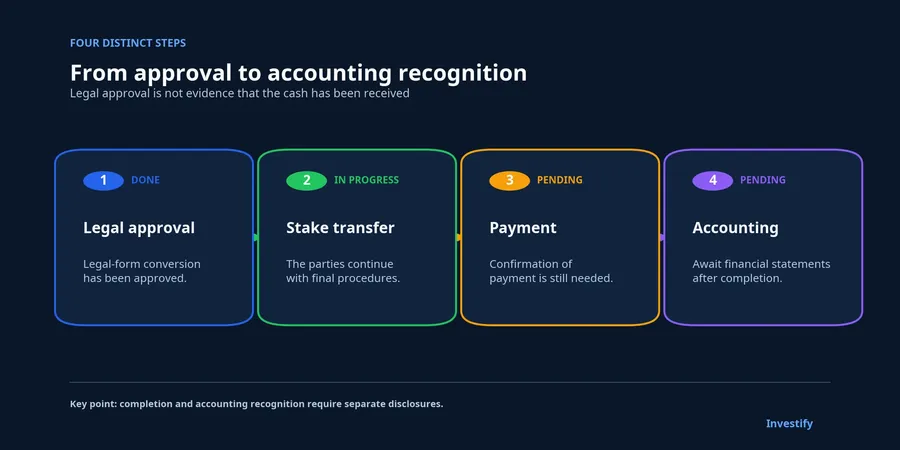
Viewed in sequence, investors need to separate at least four layers of information. The first is legal approval. The second is the stake transfer itself. Then comes confirmation of payment. Only after that can financial statements show which period carries the accounting impact and in which line items.
This is more than a semantic distinction. A bank may be permitted to execute a transaction yet still be unable to recognise a gain if control, payment obligations or other accounting conditions have not been met. Conversely, once the deal closes, cash proceeds and accounting profit are not automatically the same amount.
Capital surplus is not the same as profit
SHB expects completion of the remaining stake transfer to generate a capital surplus, strengthen its financial base and create room for strategic business areas. That is the company's stated direction. The current disclosure, however, does not give investors a price for the final 50%, an expected payment amount, or an expected booked gain.Mekong ASEAN
Put simply, proceeds from a stake sale are transaction cash flow. Reported profit depends on the investment's carrying value, related costs, the timing of transfer of control and presentation in separate or consolidated statements. Without those inputs, turning “a significant capital surplus” into a profit figure is speculation.
That is why the same deal can produce two different stories. If the selling price exceeds carrying value, SHB may recognise a disposal gain once recognition conditions are met. The cash could then strengthen capital buffers, fund technology investment or support core operations. Long-term value is not only a one-off receipt; it also depends on what the bank does with the capital after allocation.
There is a corresponding trade-off. Once Krungsri owns the whole company, SHB will no longer have a direct economic interest in SHBFinance. Investors should therefore ask not only how much SHB receives, but also which future interest it gives up and how it deploys the proceeds. The available disclosure does not yet answer either question conclusively.
A verification checklist for SHB shareholders
During the morning session on July 20, SHB traded at VND 12,300, down 2.77%. That is an intraday snapshot, not a closing price, and it does not establish how the market has valued the transaction.
Rather than trying to decode one trading session, a new investor can follow disclosures in order. First, a completion announcement should state whether the remaining stake has been transferred. Second, payment confirmation turns an expectation into actual cash flow. Third, the first financial statements after completion should show any disposal gain or loss, the cash movement and how the investment has been removed from the consolidated structure.
One more signal is a specific capital-use plan. Digital transformation and expansion of strategic areas are objectives, not yet a quantifiable allocation plan. Investors should look for the scale of deployment, the execution timetable and associated return metrics before assessing the long-term impact.
This sequence also explains why a short-term share-price move cannot, by itself, settle the argument. A price may react to the prospect of an eventual cash receipt, to broader banking-sector flows, or simply to intraday supply and demand. The evidence available here does not isolate those forces, so it would be wrong to attribute a single session's movement to the SHBFinance process.
The practical benefit of the checklist is discipline. It turns a broad phrase such as “capital surplus” into observable questions: Has the stake changed hands? Has payment been completed? What carrying value and gain or loss appear in the accounts? Has management set out a measurable use of proceeds? Each disclosure reduces uncertainty without asking investors to fill the gaps with optimistic assumptions.
For long-term shareholders, the final question is quality rather than speed. A disposal gain, if one is recognised, belongs to a particular reporting period. Its usefulness depends on whether the resulting capital improves resilience or is allocated to activities that earn an adequate return over time. That assessment begins after completion, not at the moment the legal approval appears.
Conclusion: wait for transaction and accounting evidence
The thesis is straightforward: SHBFinance has passed an important legal step, but the financial benefit to SHB is not yet an accomplished event. The risk in reading too quickly is confusing legal approval with cash received, then confusing cash received with accounting profit.
The mid-Q3 2026 target is worth monitoring, but it is not enough to reach a conclusion in advance. The necessary evidence will be a completion announcement, payment confirmation and subsequent financial statements. Once those three layers are available, investors can quantify the impact instead of valuing the deal from a headline.