

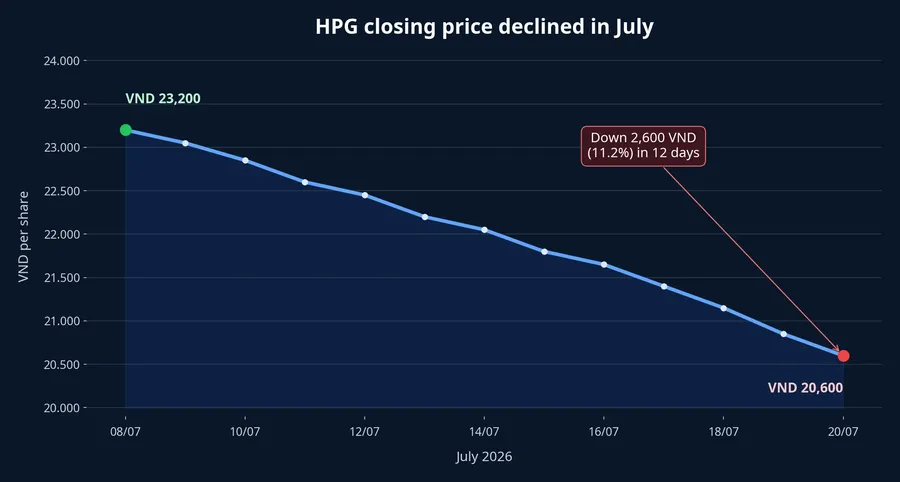
Hoa Phat has released a strong operating datapoint: Q2 hot-rolled coil sales reached 1.9 million tonnes, up 64% year on year and 31% from Q1. Yet HPG fell from VND 23,200 on July 8, when the information was released, to VND 20,600 at the close on July 20, a decline of 11.2%. Both facts can be true at once. Their gap is a useful lesson for newer investors: higher volume is not a conclusion about profits, and certainly not a conclusion about a share price.
The central point is straightforward. Dung Quat 2's volume growth confirms that Hoa Phat is scaling up, but the quality of that growth will only be established when the financial statements show comparable profit and cash generation per tonne. Until then, a weaker share price does not automatically disprove the plant's prospects. It says the market needs more than a volume headline.
What the volume data actually confirms
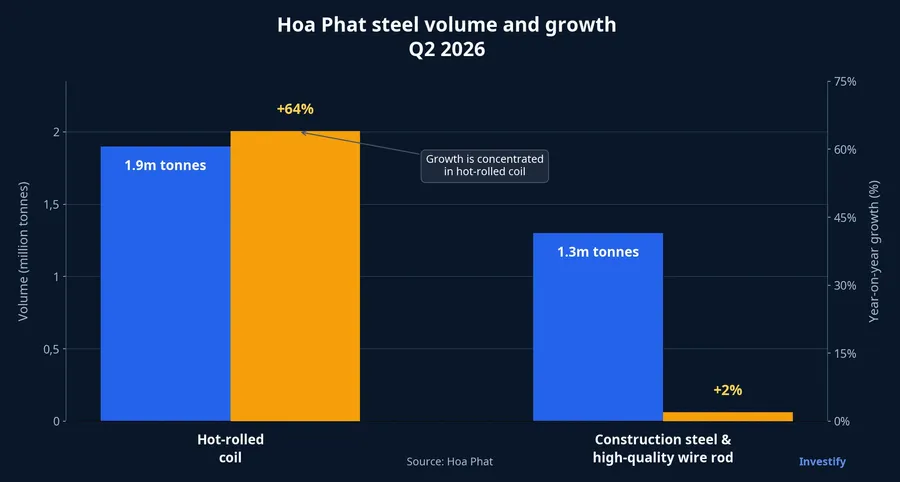
Hoa Phat sold 1.9 million tonnes of hot-rolled coil in Q2 2026. About 80% was consumed in the domestic market, indicating that the new capacity has real outlets rather than merely existing in a plan. Operationally, that matters: a blast furnace or rolling line only creates economic value when its output reaches customers.VNIndustry
The growth driver was not evenly spread across product lines. Construction steel and high-quality wire rod totalled 1.3 million tonnes, up 2% year on year but down 9% from Q1. It would therefore be misleading to treat HRC's 64% rise as the growth rate for the entire steel business. Investors should distinguish between the product adding volume, the product slowing down, and the margin each product can earn.
Across the business, Hoa Phat produced more than 3.6 million tonnes of crude steel in Q2, up 48% year on year and 9% quarter on quarter. Sales of its main steel products reached 3.5 million tonnes, up 35% year on year. Those figures validate a larger operating scale; they do not reveal how much value remains after costs.VNIndustry
The distance from tonnes to profit
Volume is simply the quantity sold. Profit is what remains after iron ore, coking coal, power, transport, labour, depreciation and interest expense. An extra tonne can produce a very different financial outcome when average selling prices fall or input costs rise faster. The reverse is also true: stable selling prices, a more favourable mix and efficient commissioning can lift margins on the same volume.
This is where “more” can be confused with “better.” Revenue may rise because more goods are sold while profit per revenue dollar falls. Reported profit may rise while cash is tied up in inventories or receivables. Looking only at volume is like counting trucks leaving a factory without knowing whether each trip is profitable.

When the Q2 accounts arrive, three lines deserve to be read together: revenue, gross profit and operating cash flow. Revenue moving broadly with volume indicates that average selling prices have not weakened too sharply. Gross margin shows whether the gap between selling price and production cost is widening or narrowing. Operating cash flow is the final test of whether accounting profit becomes cash.
A share price measures the gap versus expectations
The market did not wait for this volume release to start valuing Dung Quat 2. As the new capacity came online, some of the higher-volume outlook may already have been reflected in the shares. On release day, the market's question is usually whether the result beat prior assumptions, not merely whether it increased.
VCBS had forecast Q2 2026 revenue of approximately VND 59,628 billion and after-tax profit of VND 5,335 billion for Hoa Phat, up 66% and 25% year on year, respectively. This is an analyst estimate, not a result released by Hoa Phat. It provides a benchmark for expectations, while the actual financial statements will show how effectively volume converted into profit.Người Quan Sát
That is why HPG's fall should not be assigned to one cause. The gap against profit expectations is one plausible explanation; short-term supply, portfolio reductions in large-cap names and broader risk aversion may also have contributed. The available information shows that these developments coincided, not the precise contribution of each one.
The wider market is context, not a complete answer
On July 20 alone, HPG lost 5.72% on trading volume of more than 53.2 million shares. The VN-Index also fell 2.46% that day. It would therefore be inaccurate to present all selling pressure in HPG as a direct reaction to the production release. A weak market can pull down many companies even when their operating indicators are positive.
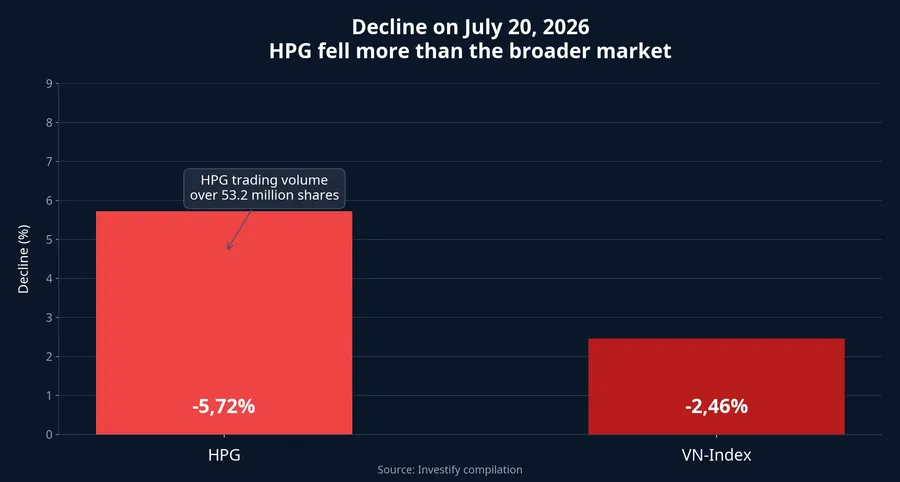
HPG nevertheless declined more than the index. That does not prove the market has rejected Dung Quat 2, but it does justify a closer look at profit quality and what is already priced in. The sensible framework has two layers: the general market accounts for some of the day's pressure, while HPG's relative move raises a company-specific question that Q2 earnings and the subsequent price reaction will test.
This distinction avoids a common analytical error. A broad sell-off can amplify a company-specific concern without creating it, while a positive operating release can soften concern without resolving it. The relevant evidence is neither one red session nor one encouraging production figure. It is whether the next reported margins, working-capital movements and cash generation alter the earnings assumptions investors are using.
A practical Q2 checklist
| Data point | Investor question | Constructive sign |
|---|---|---|
| Average selling price | Did higher volume come with adequate pricing? | Revenue rises broadly in line with volume |
| Gross margin | How much remains after cost of goods sold? | Margin is stable or improving |
| Finance costs | Is new capacity pushing interest expense up too quickly? | Costs rise more slowly than operating profit |
| Operating cash flow | Does profit turn into cash? | Cash flow moves with profit |
| Product mix | Is growth dependent on one product only? | Several product groups improve |
The conclusion is not that volume is unimportant. On the contrary, 1.9 million tonnes of HRC is evidence that Dung Quat 2 is achieving scale and finding demand. It is a necessary condition, however, not a sufficient one. A quality-growth case requires margins, cash flow and actual earnings relative to expectations.
The Q2 report is the next test. If revenue, gross margin and cash flow improve together, the volume headline will have a clearer financial foundation. If profit fails to keep pace with sales, the market will have grounds to reassess how quickly new capacity is being monetised. Rather than treating an attractive volume number as a buy-or-sell signal, investors can follow the evidence from the factory through the financial statements and only then to the valuation on the screen.