


An annual rate of 12.5% naturally draws a new investor’s eye to one word: high. For the CIC12601 corporate bond, however, that is only the first question: what coupon would a holder receive if the issuer performs as promised? The more important questions are which cash flows will service interest and principal, when they will arrive, and what a holder can do if that plan breaks down.
This is not a verdict that CIC12601 is good or bad. The public information confirms several terms of the bond, but it is not enough for an outside investor to assess the issuer’s full repayment capacity or the ease of enforcing collateral. The central point is simple: a high coupon is the start of due diligence, not its conclusion.
What has been disclosed about CIC12601
According to Stockbiz, citing disclosures to HNX, Crystal Infrastructure Construction Company Limited completed a VND 2,000 billion CIC12601 bond issue on July 17, 2026. The bonds were issued on July 16, 2026, carry a five-year tenor, and mature on July 16, 2031.Stockbiz Those dates matter because a buyer is not simply buying a headline rate. They are lending to a legal entity over a long period.
The bonds are non-convertible, carry no warrants, and are secured. The first two coupon periods pay 12.5% per year. Later periods use a reference rate plus 4 percentage points per year, subject to a floor of 12.5% per year; the reference is based on 12-month retail deposit rates at BIDV, Vietcombank, VietinBank, and KienlongBank.Stockbiz
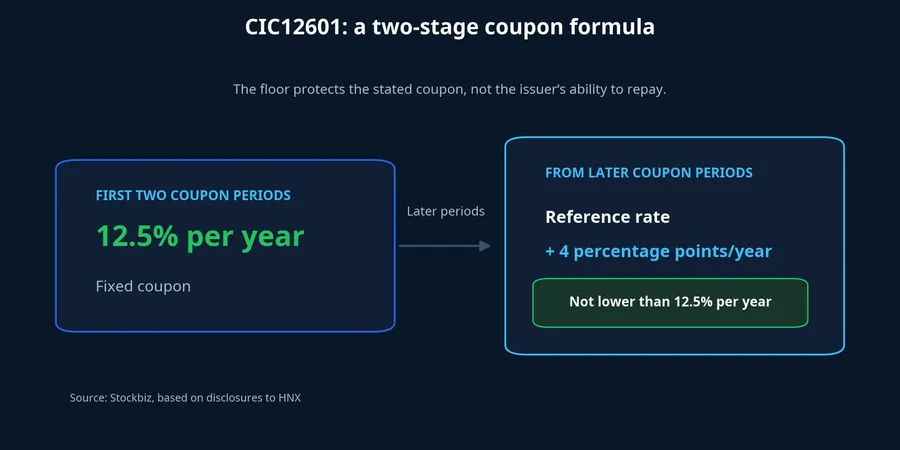
Put simply, the formula begins with a fixed coupon and then moves to a floating coupon with a floor. If the reference rate rises, later coupons may rise as well. If it falls, the floor keeps the stated annual coupon from dropping below 12.5%. The formula describes how money is calculated if payment obligations are met; it does not generate the cash needed to make those payments.
What the floor does and does not protect
The floor addresses a narrow risk: a lower stated coupon when deposit rates fall. It does not address the risk of the issuer lacking cash on an interest-payment date, projects being delayed, or collateral taking time to sell. A “minimum coupon” should therefore not be confused with a minimum amount that is certain to be received.
One scale calculation makes the obligation easier to picture. If the full VND 2,000 billion principal remained outstanding for a year and the 12.5% floor were used, annual interest would be approximately VND 250 billion. This is not the contractual payment schedule and not a forecast of what the issuer will spend. It is simply a reminder that a high rate must be matched with a practical question: is the source of interest payments recurring and verifiable?
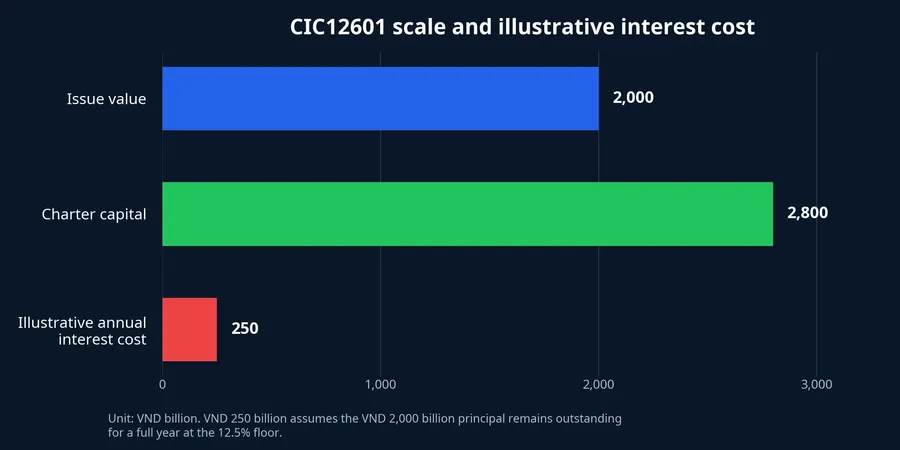
Stockbiz reports that Crystal has charter capital of VND 2,800 billion.Stockbiz Charter capital is not, however, a cash balance ring-fenced for bondholders. It may be represented by property rights, projects under development, receivables, or other assets. Investors should look at financial statements, debt structure, and the schedule of incoming cash rather than treating charter capital as a substitute guarantee.
A young issuer requires deeper checking
Stockbiz reports that Crystal was established in June 2025 and operates in construction and real estate.Stockbiz A short operating history does not prove that a company is weak, nor does it automatically mean it cannot repay debt. A young company may be a project vehicle with identifiable assets or legally documented support from related parties.
It does make the necessary file longer. A buyer should request audited financial statements, a project list, existing borrowings, related-party transactions, and a specific use-of-proceeds plan. Without those materials, an investor lacks the evidence to distinguish a plan with identifiable cash flows from one whose most visible feature is an attractive coupon.
That also prevents a rushed inference: 12.5% by itself does not prove Crystal’s risk is higher or lower than another issuer’s. The coupon may reflect tenor, collateral structure, funding needs, and market conditions. Public evidence is not sufficient to allocate the contribution of each factor precisely. The sensible reading is to treat the rate as a signal to investigate further.
“Secured” is not yet an answer
In bond investing, collateral is not a shield that automatically turns into cash. The term only says that a security arrangement has been designed. The investor still needs to know what the asset is, who owns it, its appraised value, what other obligations it secures, and where bondholders rank in priority.
If the collateral consists of project-related property rights, ask what conditions must be met before those rights arise and can be monetised. If it belongs to a third party, check that party’s authority to pledge it. If the asset already secures another obligation, the residual rights available to bondholders may be very different from the first impression created by the word “secured”.

The file should include security documents, valuation certificates, evidence of security registration, information on the asset manager, and an enforcement process for a breach. These are not secondary documents. They are what can turn a promise to repay into an enforceable claim. Without them, an investor sees the label of a security mechanism rather than its quality.
A repurchase right is different from an exit
The disclosed terms say that the issuer may offer to repurchase bonds by agreement, while holders may accept or reject a voluntary offer. Certain breaches can trigger a mandatory repurchase at a holder’s request. That is an important right, but a right to demand payment does not mean the cash arrives immediately. In a stressed situation, repayment capacity and the speed of collateral enforcement determine recovery.
Transferability is also not the same as the liquidity of a listed share. For a privately placed bond, buyers should confirm their eligibility, the conditions for transfer, and whether a qualified buyer would be available when they need to exit. The time to ask who might buy an unexpired bond is before, not after, cash is needed.
A framework before looking at the yield
You can follow a short sequence. First, confirm that you are eligible to buy and have received a complete offering file. Next, build a cash-flow calendar: coupon dates, principal repayment date, the coupon formula, and the anticipated funding source for each milestone. Then compare that calendar against financial statements, project progress, and other debt obligations.
Finally, assess collateral as a recovery process rather than a slogan. What is the asset, how is it valued, who ranks ahead of you, and how long could enforcement take? If those questions do not have document-backed answers, the evidence is not yet enough to judge recovery of both principal and interest. For CIC12601 today, that is the most useful conclusion: wait for the complete file before turning a 12.5% annual floor into a decision.