


Brent crude moved above USD 90 a barrel before Vietnam's market opened on 20 July. It was quoted at USD 90.79 a barrel at 6:43 a.m. Vietnam time, up 3.05% from the prior session.Bitget That round number will naturally pull attention toward oil and gas shares. For a new investor, though, the more useful first step is to pause: how does a higher oil price reach a company's profits, and is that route already evidenced or merely expected?
The central point is straightforward. Brent above USD 90 widens the list of variables to watch; it does not automatically benefit an entire equity sector. The same oil move can support the economics of offshore services, create a working-capital problem for fuel distributors, and raise costs for airlines. Until those mechanisms are separated, a move on the screen can too easily be mistaken for an earnings story.
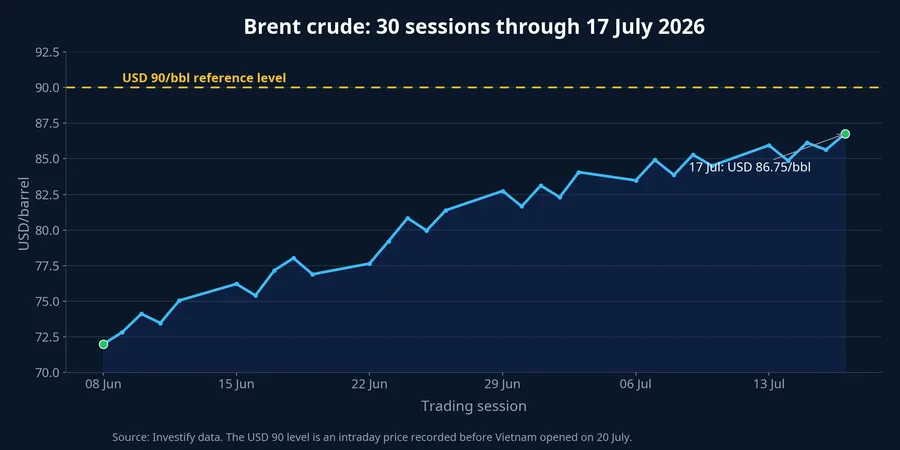
What USD 90 signals and what it does not
Think of Brent as an input-price board for a great many industries. When the risk around energy transport through the Strait of Hormuz rises, the market is not only considering barrels currently unavailable. Prices can also reflect longer delivery times, higher insurance costs and buyers' risk protection. A sharp intraday move therefore signals that the market is pricing supply risk more highly.
That is different from evidence that supply has been completely disrupted. Inventories, strategic reserves and demand in large consuming markets can still change the price direction quickly. This is why USD 90 alone should not be treated as a conclusion about any company's quarterly profit. The oil price is the start of analysis, not its endpoint.
A disciplined reading uses two layers of information. First comes the commodity move: does Brent hold at a higher range for several sessions, or is it simply reacting to weekend news? Second comes physical evidence: are vessel schedules, freight rates, insurance and production operations changing at the same time? When both layers are present, the price move has a stronger foundation. When only the first is visible, the reaction remains largely an expectation.
One oil price, several profit paths
For oilfield-service companies, a higher oil price can improve a project's economics. Field operators may then have more reason to review drilling plans, rig hires or additional technical services. “May” matters here: the benefit reaches financial statements only after a project is approved, contracts are signed and work begins. Today's oil price does not become this quarter's revenue automatically.

In Investify data from 6 to 17 July, PVS rose from VND 36,400 to VND 38,300 per share, or about 5.2%. GAS rose from VND 74,000 to VND 76,200, close to 3.0%. Those parallel moves fit the expectation that higher oil prices could support exploration and service activity, but they do not establish causation. Trading liquidity, company-specific news and sector flows are also plausible explanations.
Fuel distribution works differently. Inventory bought at a lower cost can support margins for a period, but the distributor then needs more capital to replenish the next shipment. Domestic retail prices, regulated cost allowances and the timing of price adjustments also matter. Revenue rising with the selling price is therefore not enough to conclude that profit is rising. PLX edged from VND 35,100 to VND 35,200 in the same window, a reminder that the market does not assign the same expectation to every oil-related business.
Fuel-intensive industries sit on the other side. HVN fell from VND 25,350 to VND 23,800, while VJC declined from VND 140,600 to VND 131,300 over that period. Higher jet fuel prices are a clear cost pressure. Still, oil cannot be named as the only cause of the share-price changes: foreign exchange, earnings, broader market supply and demand, and company-specific news may all contribute.
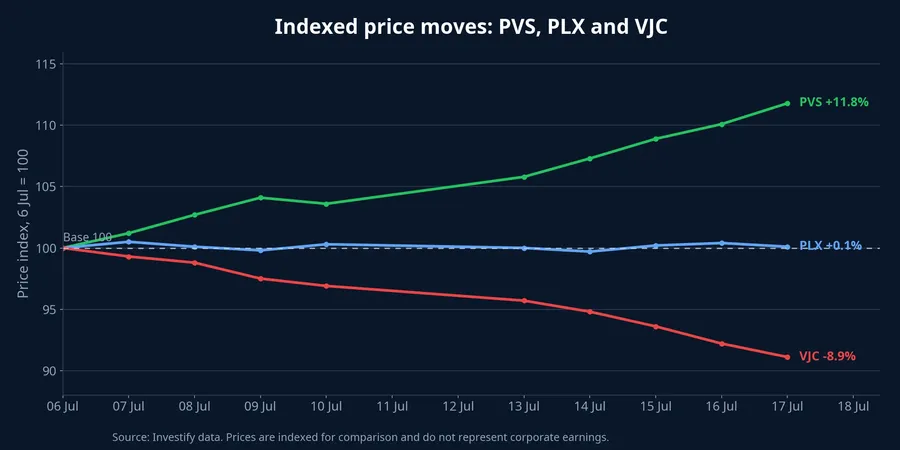
Do not confuse a price move with an earnings result
In simple terms, the stock market forecasts the future; financial statements test that forecast. The gap between the two can be wide. A group of shares rising in a session when Brent crosses a round number shows that investors are revising expectations. It does not prove that a company has won new orders, raised rig rates or passed higher costs through to customers.
This is where prices need to be read after removing noise. Before comparing a stock with oil, check ex-rights dates, dividends, share issues and company-specific disclosures. Comparing unadjusted prices after a technical event can turn a mechanical change into a false conclusion about economic loss.
A short checklist keeps the analysis in the right order. First, where does the company earn money: services, refining, distribution or fuel consumption? Next, what evidence exists for the transmission channel: contracts, inventory, product spreads, hedging or ticket pricing? Only then should price charts and trading liquidity be considered. Reversing that order often makes the share-price move the proof of a story it has not yet proved.
Domestic fuel prices form a separate channel
From 3 p.m. on 16 July, the maximum price of E5 RON92 gasoline rose by VND 635 to VND 19,826 a litre, while diesel rose by VND 1,584 to VND 23,329 a litre.Báo Chính phủ Diesel's larger increase is important because it shows that domestic effects do not move in a straight line from one Brent session. Road transport, logistics and some manufacturing activities have a different sensitivity from airlines or fuel retail.
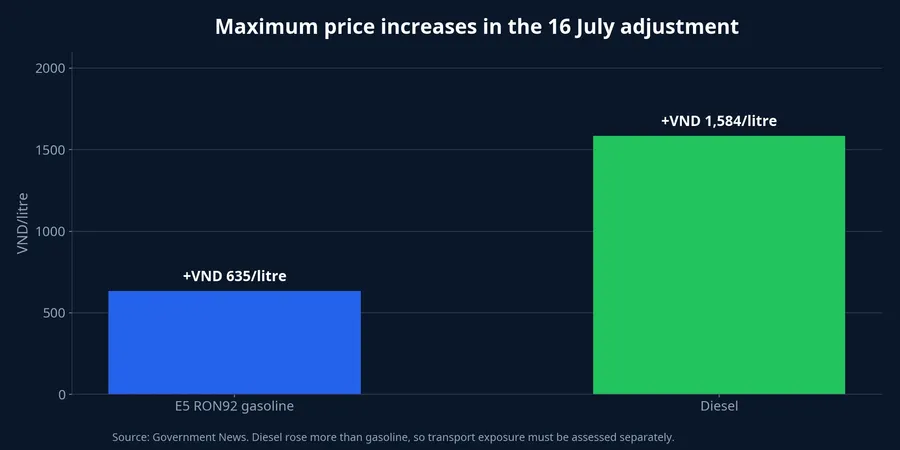
This adjustment alone does not show that inflation will change direction or that interest rates must move. That argument would require several indicators to appear over time: sustained increases in freight and goods prices, broad-based pressure in CPI, and rising bond yields. Until those signals converge, inflation risk should be treated as a scenario to monitor, not as an outcome that has already occurred.
A pre-market checklist for new investors
Before interpreting a stock as moving with oil, begin with four questions. How long does Brent hold its higher range, and is there evidence of a real supply disruption? Where is the company positioned in the value chain, and does higher oil affect its revenue or its costs? Can that channel be observed in contracts, margins or inventory? Finally, have technical events and company-specific news been excluded from the share-price move?

Answering these questions helps avoid the most common error: treating a commodity threshold as a uniform signal for an entire sector. The thesis is not that high oil is simply good or bad for the market. The key issue is whether supply risk persists long enough to move from a commodity quote into contracts, margins and actual operating costs. Upcoming earnings releases, Brent's action in the next sessions and domestic fuel-price adjustments are the three places where that thesis can be tested.