
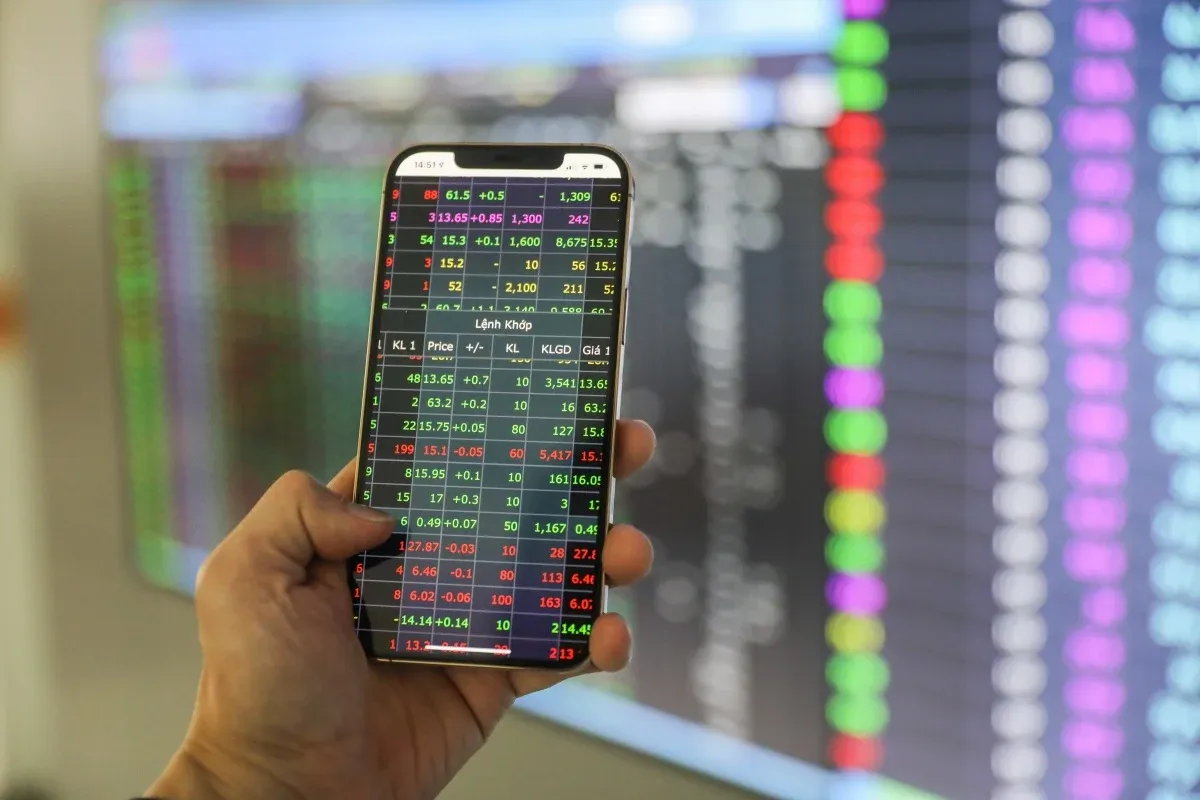

Vietnam’s Q2 reporting season is becoming more active, bringing profit figures that naturally draw attention. By July 19, around 100 companies had released financial statements or estimates for the second quarter and first half; 36 securities firms alone had reported by the afternoon of July 18.VietnamBiz VietnamBiz For a new investor, that can make it tempting to assume that good earnings will lift both the stock and the market.
The distinction matters. A strong report card belongs to one company; a market-wide return of capital reflects the behaviour of many buyers. A few excellent results can be important without proving that risk appetite has returned. The question for the July 20–24 week is therefore not where the VN-Index will finish, but what would genuinely move the market from testing to confirmation.
The starting point: capital remains cautious
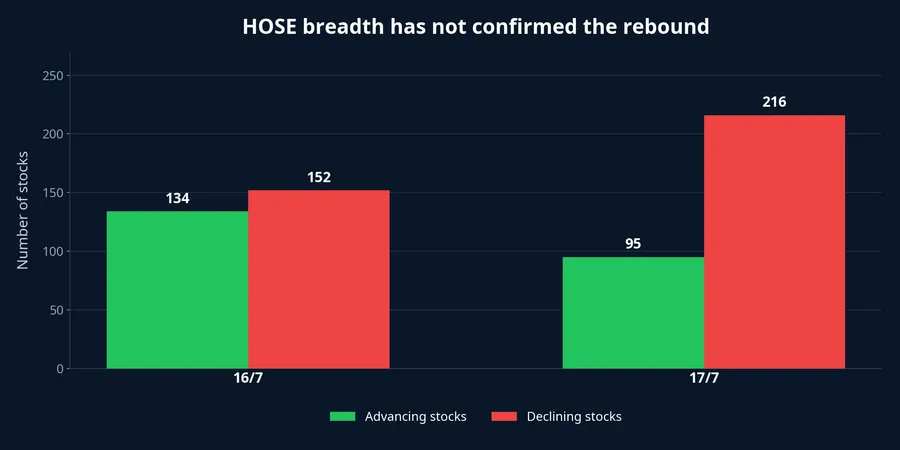
The VN-Index closed July 17 at 1,787.45 points, down 16.79 points on the day. On HOSE, 95 stocks advanced while 216 declined, meaning selling pressure was still more widespread than buying.Vietnam News This is not a prediction of another decline. It simply says buyers still need stronger reasons to pay higher prices.
Over July 13–17, the index fell 40.89 points, or 2.23%. Average daily turnover on HOSE was VND 16,541 billion, nearly 6% lower than the prior week and almost 17% below the 20-week average.Tin nhanh Chứng khoán When turnover contracts, a price rebound deserves more scrutiny: it may represent new demand, or merely a temporary shortage of sellers.
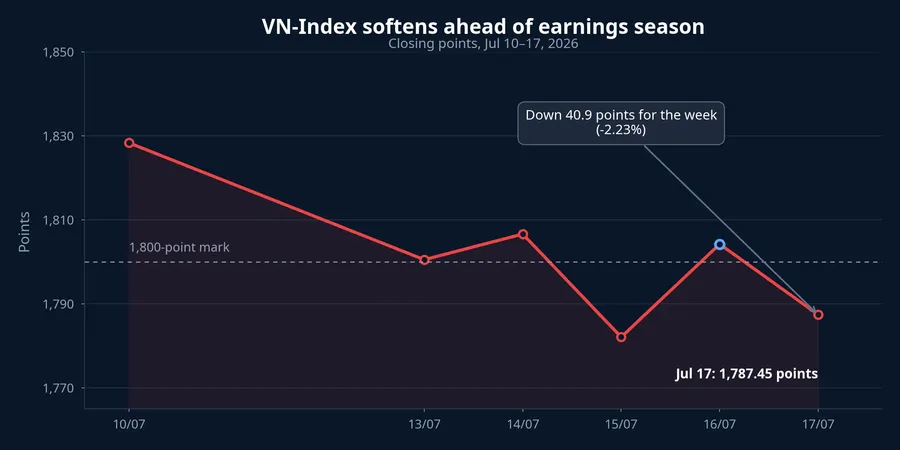
The July 17 session made that caution clearer. Turnover was VND 11,717 billion, down 39.41% from the preceding session.VietnamBiz Foreign investors also recorded net sales of more than VND 2,104 billion across the market during July 13–17.Tiền Phong Foreign flows should not be treated as the sole cause of every price move, but they are part of the backdrop that raises the bar for confirmation.
What a return of money flow would look like
The first signal is durable price action after results are released. A share can rise on the announcement day because the news is fresh or because expectations have been building beforehand. A more meaningful signal is an advance that holds over subsequent sessions, especially if the price does not quickly slip back to its pre-release level. That suggests the market is reassessing the outlook rather than reacting to a headline.
The second is breadth. If the VN-Index rises while declining stocks still outnumber advancing ones, the move may be concentrated in a few large-cap names. July 16 offered a recent example: the index gained 1.24% to 1,804.24 points, but 134 stocks rose against 152 that fell. The imbalance was sharper a day later, at 95 gainers and 216 losers. These figures do not rule out opportunity in individual shares; they show that a green index is not the same as broadly improving opportunity.
Third, turnover should rise with prices. An advancing session is more persuasive when traded value improves and the number of rising shares expands. By contrast, an index increase on thin turnover may lack buyers willing to accept a higher price range. For newer investors, this is a useful way to distinguish an attractive screen from a genuine change in risk appetite.
These three signals need to appear together rather than one at a time. Sustained prices, broader participation and stronger turnover form a chain of confirmation. It also keeps a reader from treating a single strong session as proof that every stock, and every sector, has acquired a durable new buyer base. If only one signal is visible, the more disciplined conclusion is that the market is testing a reaction, not that it has changed state.
What TCX shows about good earnings
TCBS reported Q2 pretax profit of VND 2,097 billion, up 21% year on year, while revenue reached VND 3,745 billion, up 41%.TCBS TCX rose 2.03% on July 15 to VND 42,800, added 1.64% on July 16 to VND 43,500, then eased 0.92% to VND 43,100 on July 17.
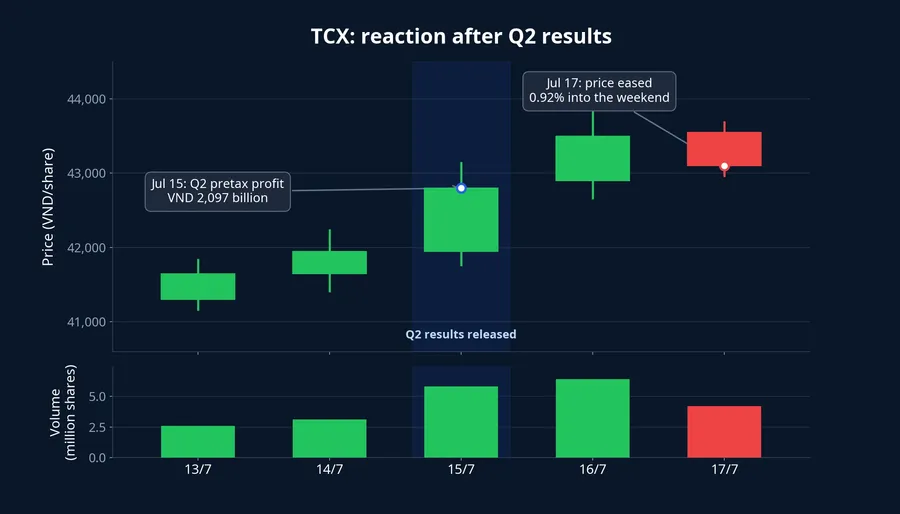
This is the healthiest mechanism earnings season can offer: new figures can create demand and change how investors value a business. Still, the available evidence does not justify assigning all of TCX’s weekly movement to the report. A stock’s price also responds to the broader tape, investor trading and its own supply-demand conditions.
TCX should therefore be treated as an observation point, not a template for the entire securities sector or the market. To turn one company’s reaction into a market-level conclusion, investors would need to see other companies with strong earnings hold their gains while breadth and turnover improve. That spread of participation is what separates new money from capital rotating among a few bright spots.
When a good report still cannot lift a share
Another possibility is that a company reports solid results but its share price does not rise, or even falls. That does not automatically mean the report was weak. The market may have expected more, the earlier valuation may already have incorporated most of the good news, or broader conditions may be pushing investors toward lower risk. These explanations can coexist; only further evidence from price, volume and comparable stocks can help distinguish them.
If many companies beat expectations while prices broadly weaken, the evidence would lean toward a market-wide valuation reset or a defensive preference. If prices initially pause but then establish a base as turnover rises, buyers may instead be absorbing the information over time. The coincidence of a report and a price move is not enough to select one explanation in advance.
For a new investor, it also helps to keep two tasks separate. Q2 results help test whether a company on the watchlist is generating profit from its core operations. Judging how much market exposure to take requires additional evidence from price action, breadth and turnover. Combining those questions is a common reason investors chase a share after an upbeat number.
Conclusion: earnings filter, money-flow confirmation
The thesis for the new week is straightforward: Q2 earnings can produce differentiated opportunities in individual companies, but they cannot alone confirm a market-wide advance. The available evidence still favours a testing phase because breadth is weak, turnover has not improved and foreign selling remains a background pressure.
What could change that picture is not a single profit headline. Watch whether companies with strong results can hold their gains over several sessions, whether advancing stocks sustainably outnumber decliners, and whether turnover recovers on rising sessions. That is the practical test ahead. When all three improve together, the evidence would support a return of money flow. Until then, Q2 reports are best used as a filter for understanding companies, not as a promise about the direction of the entire market.