

A 35% dividend headline is designed to catch the eye, especially for a first-time investor. For DBM, however, the detail that determines whether an investor receives the cash is the trading calendar: 20 July 2026 is the final day to buy with entitlement, while purchases from 21 July do not carry this dividend. That distinction separates reading an announcement from understanding the right attached to a share.VietnamBiz
Put simply, a cash dividend is not extra money created outside the share price. It is value transferred from the company and embedded in the share to cash owed to shareholders on the record. DBM's thin trading adds another check: a quoted price may not be a price at which an investor can buy or sell the desired quantity.
Turn the 35% rate into an actual cash amount
The announcement states a 35% payout on a VND 10,000 par value. The correct calculation is VND 10,000 multiplied by 35%, or VND 3,500 for each DBM share. The 35% figure does not mean that someone buying the stock today earns 35% on the money invested.VietnamBiz
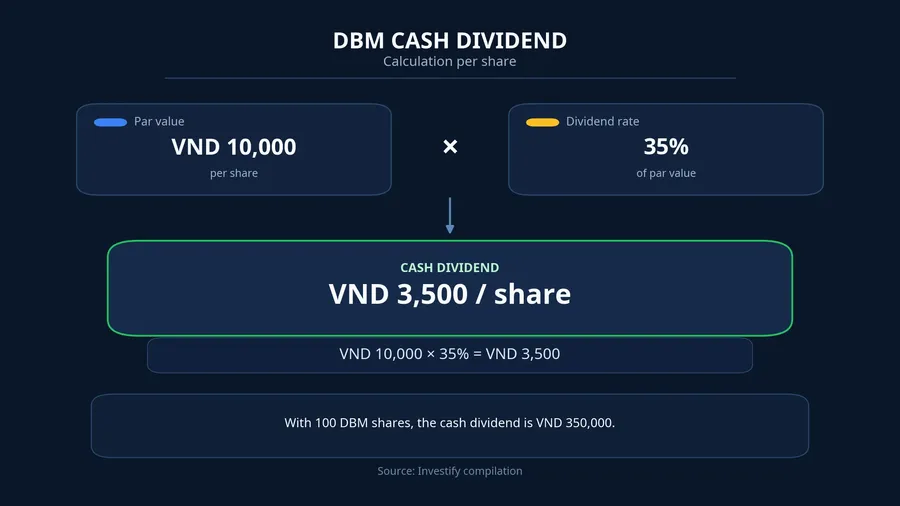
To compare the payment with a purchase price, divide VND 3,500 by the actual market price paid. DBM closed at VND 30,000 per share on 17 July, so that level produces an illustrative pre-tax dividend yield of about 11.67%. It is only a calculation at a past price, not a guaranteed return and not, by itself, a reason to buy the stock.
New investors should keep two numbers separate. The first is the cash dividend per share: VND 3,500. The second is the dividend yield on their own purchase price, which changes with every executed order. Confusing these numbers is a common error whenever a corporate announcement uses a large percentage.
The deadline is 20 July, not the 22 July record date
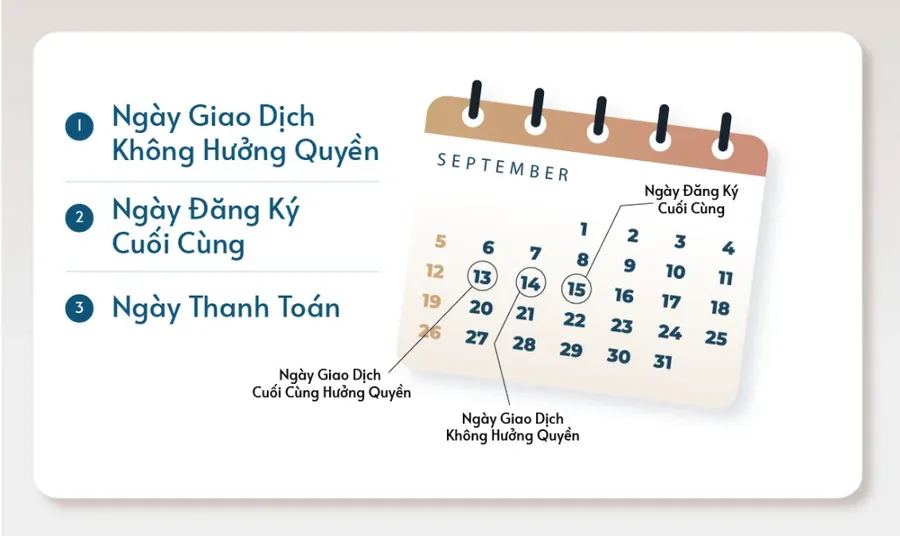
DBM's ex-rights date is 21 July 2026, with the record date on 22 July. Under the current T+2 settlement cycle, a purchase executed on 20 July is still recorded in time for the shareholder list. A purchase from 21 July onwards is ex-rights and does not receive this cash dividend.VietnamBiz VSDC
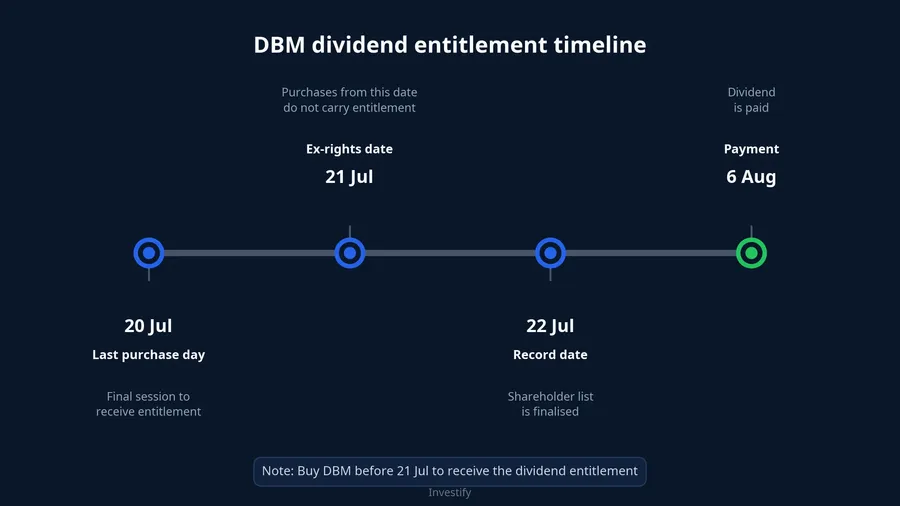
Think of 21 July as a gate. A shareholder who owned DBM before the gate opened keeps the entitlement even if they sell on that day. A buyer in that same session receives shares without the entitlement because the trade is already ex-rights. VSDC's guidance on corporate actions follows this principle.VSDC
The useful calendar entry is not merely “record date: 22 July.” Write down all four milestones: last purchase day on 20 July, ex-rights trading on 21 July, record date on 22 July, and expected payment on 6 August. Reading the sequence prevents the frustrating mistake of buying one session too late.
An ex-rights date does not create free money
The reference price on an ex-rights date is generally adjusted for the value of a cash dividend or other entitlement. HOSE's price rules describe the principle of starting with the most recent closing price and adjusting it for the value of the attached right; the precise implementation also depends on the market and rounding rules.HOSE
Using DBM's 17 July close as a purely illustrative example, VND 30,000 less a VND 3,500 cash dividend equals VND 26,500. This is not a forecast of DBM's reference price on 21 July. The real starting point will be the 20 July close, and the stock can still move afterwards with supply and demand.
The economic point matters more than the arithmetic. Before the ex-rights date, part of the value is in the share. After it, the corresponding amount becomes a cash payment due to the eligible holder, while the reference price is adjusted for the separation. Passing the record date does not automatically increase an investor's total wealth.
Cash is due on 6 August, after withholding tax
DBM is expected to start paying the dividend on 6 August 2026. Investors holding the shares through a depository participant receive the cash in the account held with that participant, provided they were entitled on the record date. They do not have to keep holding DBM until payment day to receive the dividend.VietnamBiz
The Personal Income Tax Law effective from 1 July 2026 retains a 5% tax rate for income from capital investment. For 1,000 shares, the gross dividend is VND 3,500,000. With VND 175,000 withheld, the net cash received is VND 3,325,000. The tax is deducted before the money reaches the account.Công báo
The cash calculation answers only half of the question. The other half is the purchase price, price movement after the ex-rights date and trading costs if the investor buys and then sells. Adding the dividend cash to an account is not the same as proving a short-term trade was profitable.
Liquidity is part of the calculation
The 17 July closing price is useful for illustrating the dividend-yield formula, but it should not be treated as a standing offer. Only 500 DBM shares changed hands in that session. In a thinly traded stock, an order can move to a less favourable price or remain unfilled, and an investor may face the same issue when attempting to exit a position. The yield calculated from a displayed close can therefore differ from the yield that was actually obtainable.
This does not make the dividend invalid. It changes the question an investor should ask. Instead of stopping at “How large is the announced rate?”, ask whether there is sufficient trading depth at a reasonable price and whether holding the share after the ex-rights date fits the intended time horizon. The corporate-action calendar tells you who receives the cash; it does not solve the execution risk in the market.
There are also several possible reasons why a share may trade at a particular level around an entitlement date, including ordinary supply and demand, the size and timing of investors' orders, and views on the company's business. The announcement alone does not establish which factor will drive DBM's subsequent price. That is why a dividend calculation should remain a tool for reading the notice, rather than a prediction of the next trade.
A checklist before buying for a dividend
First, turn the stated percentage into cash per share. Then divide that cash amount by a price that can actually be executed to estimate a pre-tax dividend yield. For an illiquid stock, review trading volume and the gap between bid and offer before treating a screen quote as an achievable price.
Next, locate the ex-rights date and use the preceding session as the purchase deadline. Do not treat the record date as the last day to place a buy order. Finally, check the payment date, withholding tax and reference-price adjustment so that the dividend is not mistaken for free money.
The central point is not that DBM is attractive or unattractive because the stated rate is 35%. This notice is most useful as a repeatable process: know that 20 July is the deadline for entitlement, convert the rate into VND 3,500 per share, then put the after-tax cash beside price and liquidity risk. For dividends, understanding the mechanism matters more than chasing the percentage.