


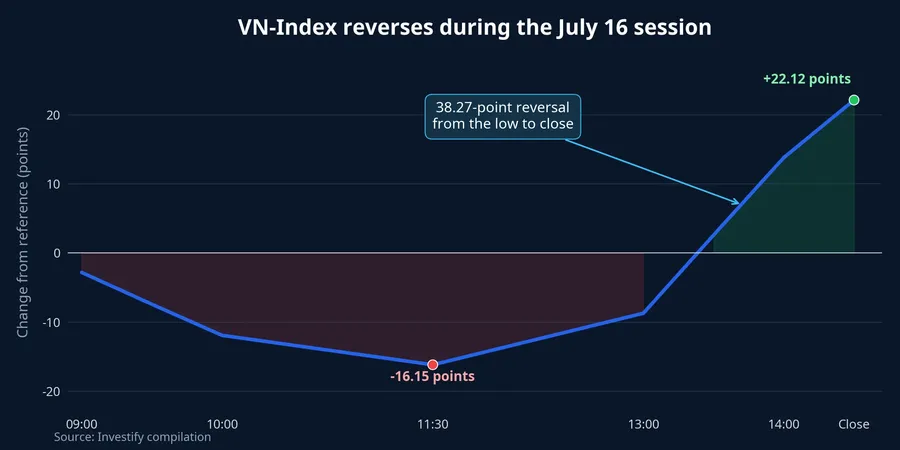
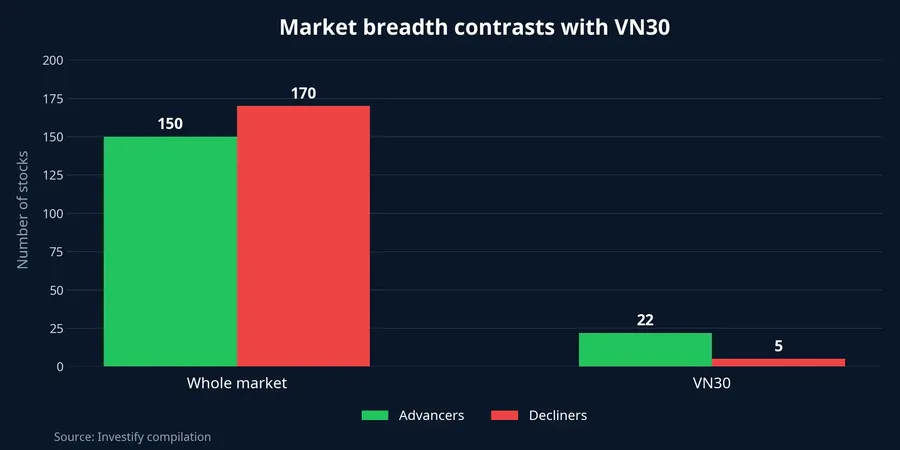
VN-Index ended the July 16 session at 1,804.24, up 22.12 points after being down 16.15 points late in the morning. That was a 38.27-point intraday reversal, large enough to completely change the closing-screen mood.VnEconomy Yet the market recorded 150 advancers and 170 decliners. A portfolio that did not turn green alongside the index was therefore not at odds with what actually happened in the market.VietnamBiz
The important distinction is that VN-Index is weighted by market capitalization, while a personal portfolio rarely mirrors that structure. A simultaneous rise in a handful of very large companies can lift the index materially even as many other stocks remain lower or recover only part of their losses. July 16 confirmed that buyers returned to the heavyweights. It did not confirm a uniform upswing across the market.
One session, two legitimate readings
Market breadth was weak late in the morning, when there were 45 advancers against 260 decliners. After the lunch break, buying became more concentrated in the VN30 basket and prices recovered quickly. The VN30-Index closed 25.60 points higher, or up 1.34%, with 22 gainers and five losers.VnEconomy
For a simple analogy, think of VN-Index as a scale with weights of different sizes. Large-cap stocks are the heavier weights. When several of them move up together, the index can rise decisively even if many mid-cap, smaller, or less influential shares have not recovered. That is why an investor holding mainly stocks outside VN30 can still see a negative account on a day when the benchmark rises by more than 1%.
The difference is not about one observer reading the market correctly and another incorrectly. The index answers a question about the exchange’s market capitalization; breadth answers how many individual stocks are being bought up or sold down. Reading both together helps newer investors distinguish a session powered by a few heavyweights from one in which buying is genuinely spreading.
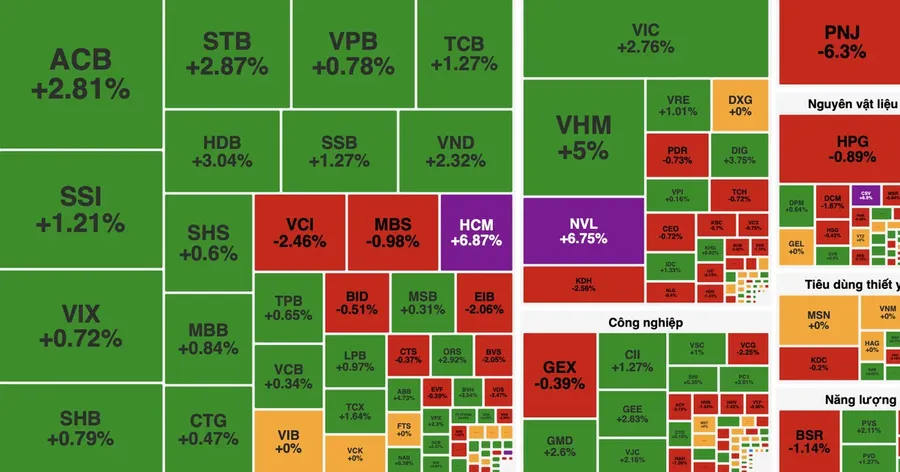
This distinction is especially useful when a strong closing headline encourages an all-or-nothing interpretation. A green index is meaningful: it says the aggregate value of listed shares, weighted by size, rose during the day. It does not promise that every sector participated, that every portfolio has recovered, or that a broad trend has already been established. Conversely, a red balance in an individual account does not erase the information contained in an index reversal. The practical task is to separate the signal from the scope of the signal. On July 16, the signal was a clear return of demand in large-cap shares; its scope was narrower than the index’s 22.12-point rise might initially suggest. That framing also prevents a common mistake: treating a benchmark level as a verdict on every share, rather than as one measurement within a much wider market.
Where did the buying concentrate?
The standout afternoon signal was a 27% increase in VN30 trading value compared with the morning. It matters more than the final green screen because it shows that more money entered the very group capable of moving the index.VnEconomy That supports the view that the rebound had active buying behind it, rather than merely a temporary retreat in sell orders.
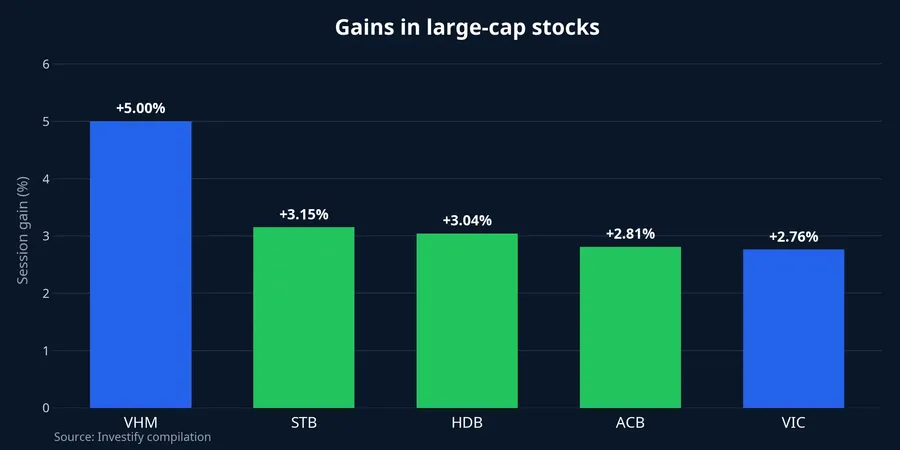
VIC closed at VND 223,000, up 2.76%, while VHM rose 5.0% to VND 142,800. Among banks, STB gained 3.15%, HDB added 3.04%, and ACB rose 2.81%.VnEconomyVietnamBiz Those moves do not establish each stock’s exact point contribution to VN-Index. They do show that large-cap property names and several banks were pushing in the same direction.
Several factors could explain the focus on large caps: bargain buying after the morning decline, a preference for highly liquid names, or foreign investors returning to net buying in the afternoon. The session data show foreign investors net bought VND 357.6 billion in the afternoon after net selling VND 383.6 billion in the morning, with VIC, ACB, and VHM among the strongest net-bought names.VnEconomy One afternoon is not enough to establish a longer-term reversal in foreign flows. Nor does the co-movement between foreign trading and large-cap prices justify assigning the entire rebound to a single source of demand.
What breadth says about rebound quality
More decliners than advancers does not make the reversal a false rebound. From the day’s low to the close, VN-Index recovered nearly 47 points, and many shares substantially narrowed their losses.VietnamBiz A stock that remains below its reference price can still show that buyers stepped in at lower levels. That is different from declaring that the entire market has entered a new trend.
What weak breadth limits is the scope of the conclusion. This session showed enough demand to reverse the heavyweights and return the index above 1,800. It did not show that most shares had formed a new price base or that money had moved beyond the largest names into the full range of mid- and small-cap stocks.
Liquidity should be read using the same logic. VN-Index trading volume reached 788,701,791 shares, higher than in the prior session.VietnamBiz But an elevated total does not say where the money went. If activity is concentrated in a small number of large-cap names, the index can look far healthier than the rest of the board. The quality of the rebound therefore depends on distribution, not only on one aggregate liquidity figure.
Three checks for the next session
New investors do not need to predict the next day’s direction immediately. Instead, these three signals can test whether the rebound is broadening.
Breadth: If VN-Index continues higher and advancers outnumber decliners, buying is moving beyond the heavyweights. If the index is green while breadth remains weak, the gap between the benchmark and many portfolios may persist.
Where liquidity appears: A constructive session does not have to produce an extraordinary total turnover figure. The more useful observation is whether activity improves outside VIC, VHM, and a few banks, and whether rising shares can hold their prices as supply returns.
The ability to hold 1,800: VN-Index closed only 4.24 points above this psychological level.VnEconomy Once the heavyweights cool, a small move can take the index below it again. Holding 1,800 alongside improving breadth would mean something very different from holding it through a few large-cap names.
Conclusion: real buying, still concentrated
The central conclusion from July 16 is straightforward: demand was strong enough to produce a genuine reversal in VN30 and return VN-Index above 1,800. But the split between 150 advancers and 170 decliners shows that the strength was not yet shared evenly across the market.VietnamBiz
An overly optimistic reading would treat the index gain as confirmation for every portfolio. An overly negative one would ignore the fact that money did return to the names with the greatest index influence. The next session needs to answer a narrower question: can buying move from the confined VN30 group into a wider range of stocks? Breadth, the location of liquidity, and the ability to retain 1,800 are direct signals to monitor for that answer.