

VND 9 trillion is a number that can invite the wrong conclusion: that PVcomBank has suddenly received a large new pool of money to lend or invest. What HNX approved is the registration for trading of 900 million existing common shares under the ticker PCB on UPCoM. The figure is the par-value capital represented by shares that already exist, not cash the bank has just raised from the market.PVcomBank
Think of it as an already-owned home being placed on a property marketplace. The marketplace helps a buyer and seller find each other, but the purchase money goes to the existing owner. The developer does not receive cash simply because the home has become easier to trade. PCB is similar: this event may create liquidity for existing shareholders; it is not yet a capital raise.
What exactly has HNX approved?
PVcomBank says it received HNX Decision No. 947/QĐ-SGDHN dated July 14, 2026, approving the registration for trading of all its common shares on UPCoM under ticker PCB.PVcomBank This is a legal step that brings existing shares into a public trading system. It does not, by itself, change who owns those shares when the decision is issued.
Multiplying 900 million shares by a VND 10,000 par value produces VND 9 trillion in charter capital. That calculation describes the share-capital structure; it does not describe a new cash transaction. Information published on July 16 said PVcomBank's VND 9 trillion charter capital has remained unchanged since 2013.Doanh nghiệp Kinh tế Xanh
There is a second distinction to make: approval for trading registration does not mean PCB is trading immediately. PVcomBank must coordinate with relevant parties to bring the shares into trading within 30 days of receiving the decision; the current disclosure does not state a first trading date or a reference price.CafeF Par value therefore cannot be used to infer either PCB's opening price or its market value.
Where does the cash go in a secondary trade?
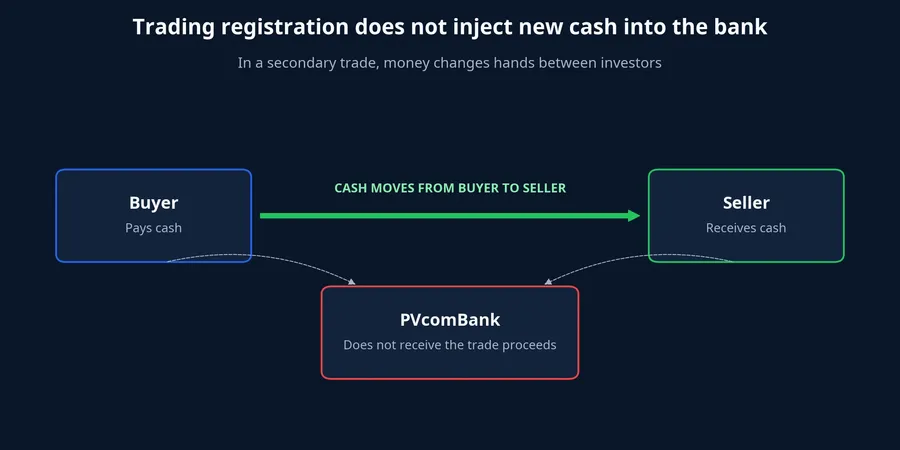
In a secondary transaction, an existing PCB shareholder is the seller and another investor is the buyer. Once their order is matched, the payment moves from buyer to seller while ownership changes hands. PVcomBank is the company whose shares are traded, not the recipient of that payment.
That is why a stock can have significant trading turnover without any change in the issuer's charter capital. Liquidity answers whether shareholders have an additional route to transfer ownership. A capital increase answers a different question: whether the company issues extra shares, receives cash from subscribers and records new equity.
The reference price, once published, will be a starting point for trading rather than a verdict on intrinsic value. Market price reflects the orders available at a given moment, while a bank's underlying value depends on assets, liabilities, earnings and risks that change through time. Treating the VND 10,000 par value as a target price would mix up an accounting denomination with a market assessment.
The distinction matters particularly for new investors because both phrases can appear in the same news item. “Joining UPCoM” describes the trading status of existing shares. A “private placement” describes a plan to issue additional shares, but it creates capital only when it is executed and investors have paid.
The planned 300 million shares are the capital-raise story
PVcomBank plans a private placement of 300 million shares to professional securities investors, with the aim of adding VND 3 trillion to charter capital. The plan is scheduled for the period from the fourth quarter of 2026 to the first quarter of 2027; the privately placed shares are expected to face a one-year transfer restriction, and the proceeds are intended to support lending activity.Doanh nghiệp Kinh tế Xanh
The word “planned” sets the proper reading. The offer price, precise timing, investors and completion are still matters of implementation. It would be a leap to treat the VND 3 trillion as money already on the bank's balance sheet, just as it would be inaccurate to say the additional 300 million shares are already outstanding.
If the placement is completed, the picture changes: the share count and charter capital rise, and cash enters the company. At that point, the issue price, dilution and use of proceeds become material. For now, PCB's trading registration and the planned placement share a context, but their cash flows are fundamentally different.
This sequence also helps keep headlines in proportion. The approval is real and consequential because it gives shareholders a potential public venue for trading. But it is not evidence that the planned placement has received payment, that extra lending capacity has already been created, or that a market price has been validated. Each of those would require a separate disclosure and should be read as a separate event.
A price screen does not value a bank on its own
Public trading can add a market-based signal of supply and demand, but a price screen cannot replace an assessment of asset quality. At the end of the first quarter of 2026, PVcomBank's standalone report recorded VND 545.1 billion of substandard debt, VND 669.6 billion of doubtful debt and VND 3,297.4 billion of potential-loss debt. The three buckets totalled approximately VND 4,512.1 billion, with the potential-loss category accounting for 73.1%.Tinnhanhchungkhoan
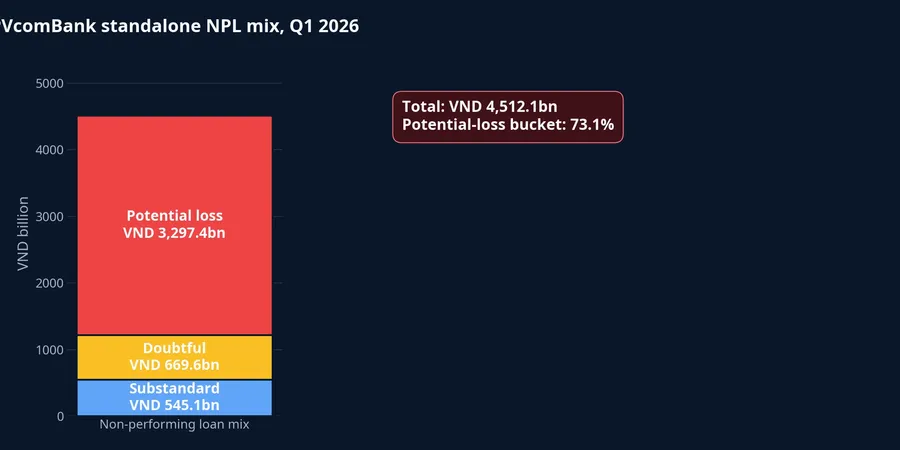
The composition matters as much as the total. A large potential-loss bucket means provisioning, debt collection and the disposal of collateral can materially affect earnings quality and book value. That is not a prediction of PCB's price direction. It is a reason not to value a bank from charter capital alone.
On the positive side, PVcomBank reported VND 659.81 billion in first-quarter 2026 net profit, up 36.1% year on year, while total assets reached VND 276,416.6 billion, up 4.9% from the start of the year.Tinnhanhchungkhoan Those figures show growth in scale and profit during the period, but they do not on their own settle the quality of those earnings. The previous year's audit report highlighted that certain items in the restructuring plan had not yet been fully classified, provisioned for or had accrued interest reversed; the bank said it was continuing remedial measures under applicable rules.Tinnhanhchungkhoan
Three updates that will clarify the picture
PCB's UPCoM registration is a meaningful change in transferability, not evidence that PVcomBank has raised VND 9 trillion. The central thesis is straightforward: par-value charter capital is a statement about the structure of share capital, while new capital arrives only after a new issue is completed.
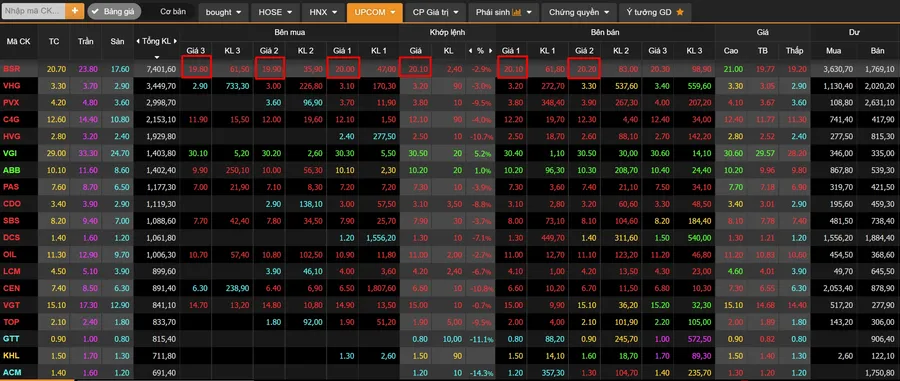
Three subsequent disclosures will turn that legal development into information that can be assessed more fully. First, the initial trading date and reference price for PCB. Second, progress on the 300 million-share private placement, including its terms and execution result. Third, later financial statements, particularly non-performing loans, provisions and the handling of restructuring-plan items. Together, these signals will show whether the new trading venue is accompanied by a clearer financial foundation.
That is the appropriate order of questions for PCB: first whether trading has begun and under what terms; then whether new shares and capital are actually issued; and finally whether subsequent financial reporting supports the market's assessment. The evidence today supports a conclusion about access to trading, not a conclusion about money already raised or a fair value for the shares.