

A rising price headline can make a housing market look hot. In Hanoi, that reading can send a buyer toward the wrong question. The average primary price reported by research firms describes the basket of homes currently being offered, not the price of every apartment in the city or the amount a buyer can reliably recover on resale.
The more useful reading puts three indicators together: the composition of new supply, the number of units absorbed, and conditions in the resale market. They point to a market that is differentiated rather than uniformly strong. Put simply, when the market brings more expensive homes into the basket, the average can rise even if buyers are becoming more cautious.
An average price is not the price of every apartment
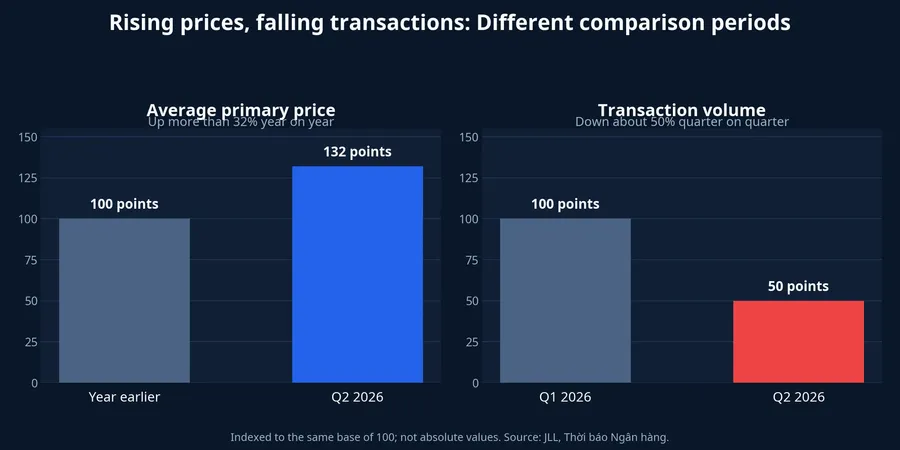
JLL data cited by Thời báo Ngân hàng put Hanoi's average primary apartment price at VND 101.5 million per sq m, more than 32% higher than a year earlier. The same dataset recorded Q2 transaction volume down by about 50% from Q1.Thời báo Ngân hàng The two movements can coexist because they measure different things: one is the asking price of new stock, while the other is the number of homes that actually found buyers in the period.
Think of a fruit stand. If it offers fewer inexpensive oranges and adds more imported grapes, the average price of the stand rises even when the price of an individual orange is unchanged. Apartments work through the same mechanism, although each home differs in location, fit-out standard, payment schedule and ticket size. That is why an average should not be projected onto every project, district or resale transaction.
The chart below indexes the two changes to a common base of 100 to illustrate their different comparison periods. It does not suggest that 132 price points and 50 transaction points can be added or subtracted. Its purpose is to keep two questions separate: how expensive is the newly offered basket, and how many homes are buyers actually taking up?
New supply is tilting toward higher-priced homes
JLL recorded approximately 8,100 officially launched apartments in Hanoi in the first half of 2026, with roughly 65% of new supply developed by major developers.Thời báo Ngân hàng This does not by itself establish that prices will keep rising. It does show that the composition of new supply can be heavily shaped by large projects, which often carry higher prices and a more premium market position than older stock.
CBRE data reported by VnEconomy sharpen that picture. Hanoi had 16,600 apartments launched in the first half, the highest first-half level since 2020. Q2 was also the second consecutive quarter without a new project offered below VND 60 million per sq m, excluding value-added tax, maintenance fees and pre-discount pricing.VnEconomy
Homes priced at VND 80–100 million per sq m made up 30% of new supply, while those above VND 120 million per sq m accounted for 35%. The most expensive group alone included more than 3,000 units across four projects in central and near-central locations.VnEconomy When high-ticket homes take up more of the basket, a higher average primary price is an expected outcome. That is a mix effect, not proof that the same apartment has appreciated at the same rate.
There is an important methodological caution. JLL and CBRE report different supply volumes, average prices and transaction counts, potentially because they cover projects or segment the market differently. Without enough public detail to reconcile their methods, it is not sound to divide a unit count from one dataset by transactions in another to create a seemingly precise ratio. A rate is meaningful only when its numerator and denominator share the same measurement basis.
Absorption points to more selective buyers
In CBRE's dataset, more than 5,800 apartments were sold in Q2, equal to 68% of newly launched supply. That absorption rate was materially below 2024–2025, when it frequently exceeded 90%.VnEconomy This is not a verdict that every part of the market is weakening: a well-located project with clear legal status and a workable payment schedule may still sell quickly. It is, however, a more direct signal than a list price of how quickly new inventory is becoming actual transactions.
Buyers should also ask what a developer or sales agent means by “sold.” A reservation, a signed contract and units that have met scheduled payments are not always the same thing. For an individual development, the number of units contractually committed, cancellation rates and remaining comparable supply matter more than a citywide figure.

Resale prices test a different layer of the market
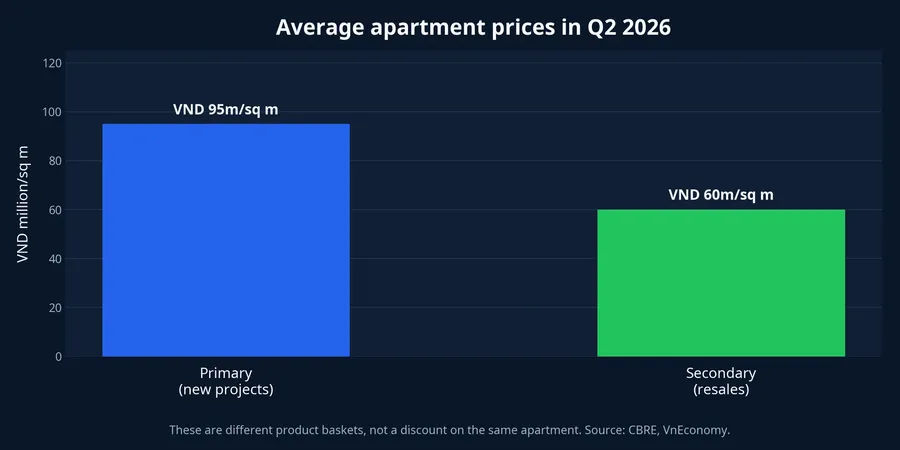
CBRE recorded an average secondary-market price of VND 60 million per sq m at quarter-end, down nearly 3% from the previous quarter. It was the first meaningful adjustment since late 2022.VnEconomy By contrast, its average primary price was approximately VND 95 million per sq m, up 12% quarter on quarter and 21% year on year.VnEconomy
Those two figures cannot be put side by side and treated as the discount on a single apartment. New launches and resale homes differ in age, location, quality, payment timing and incentives. Still, the opposite direction is meaningful: developers can keep published pricing high while sellers in the resale market have to become more flexible to meet buyers.
Rather than rely on listing prices alone, look for transactions that can genuinely be compared: the same building, similar floor area, comparable handover condition and a nearby listing date. Time on market, negotiated reductions and completed transactions are more practical signs of liquidity. A long list of asking prices with few completed deals is not an easy resale market.
Mortgage costs can change the entire calculation
CBRE said a high interest-rate environment is making buyers think more carefully about cash flow and timing, particularly for homes that require substantial borrowing.VnEconomy Published prices do not have to fall immediately when demand slows. Developers can use discounts, interest support or stretched payment schedules to reduce the initial outlay. These measures change the timing of payments; they do not erase principal and interest over the life of a loan.
For first-time buyers, the calculation should begin when the promotional rate ends, not with the lowest instalment in a brochure. Review the post-promotion rate formula, the length of principal grace, the early-repayment charge, and whether payment milestones align with construction progress. A home that is affordable at signing can become a burden if household cash flow cannot tolerate the period when borrowing costs reset.
Read the market through three questions
The central point is clear: a rising average primary price mainly shows that the launch basket contains more expensive homes. It is not enough to prove that demand across Hanoi's apartment market is healthy. Softer absorption and an adjustment in secondary prices belong alongside list prices, not behind a single impressive average.
Before making a specific purchase, three questions are worth following: how many units in this development have actually been sold under contract; on what terms are comparable homes being resold; and does household cash flow still work after interest support ends? The answers do not forecast with certainty whether prices will rise or fall next. They help a buyer assess the health of the particular apartment under consideration.