


VN-Index closed at 1,806.63, up 0.34%, after falling to 1,782.45 late in the morning. That means the index recovered 24.18 points during the afternoon and reclaimed 1,800. For a new investor, such a reversal can easily feel like proof that the morning’s risk has disappeared.
But a trading session should not be read from the closing price alone. July 14 delivered a specific improvement: selling pressure from very large-cap stocks eased, while oil and gas names and a handful of individual shares retained buying interest. Banking, financial services and real estate, however, remained weak and uneven. The most defensible conclusion is that a rebound has emerged, not that a new trend has been confirmed.
The morning explains why the index fell so far
Late in the morning, VN-Index was down 18.09 points, or 1%, at 1,782.45.Tuổi Trẻ That level matters because it is the starting point for understanding the afternoon rebound, rather than simply seeing the green close and assuming the market had risen throughout the day.
The pressure was concentrated in stocks with a large influence on the index. VIC fell 3.84% and subtracted 13.68 points from VN-Index, while VHM declined 2.94% and removed another 3.58 points.Tuổi Trẻ A simple way to think about this is a seesaw: when a heavyweight stock moves lower, many smaller gains may still be insufficient to steady the index.
Oil and gas was the bright spot in the morning. PVD gained 6.99% to VND 19,900 per share, BSR rose 5.24%, and BSR alone contributed 1.52 points to VN-Index.Tuổi Trẻ This showed real buying in selected names, but the initial support was still smaller than the drag from VIC and VHM.
The turning point was less drag from large caps
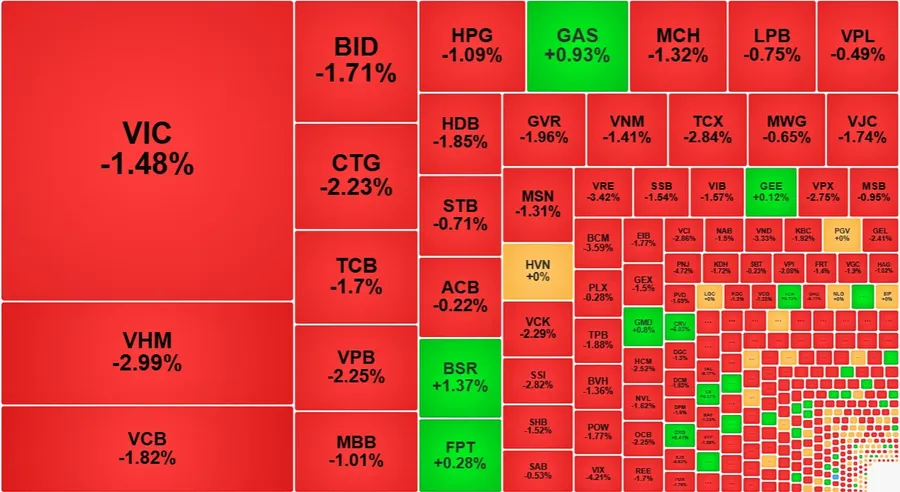
At the close, VIC was down only 1.13% and VHM 1.54%. Neither stock turned positive, but both had narrowed their losses substantially from the morning. For a heavyweight stock, simply falling less can return a meaningful number of index points.
That is why the rebound should not be assigned to one strong stock. BSR finished up 5.63%, GAS gained 4.11%, VCB added 0.51% and STB rose 2.77%. PNJ advanced 6.96% on volume of 5.62 million shares. These names provided lift while VIC and VHM applied less pressure. Both sides of that change are needed to explain the move from a deep loss to a positive close.
The chart below makes the shift clearer. The red bars show the late-morning declines, while the blue bars show the declines at the close. The larger gap for VIC indicates that its downward drag eased more during the afternoon.
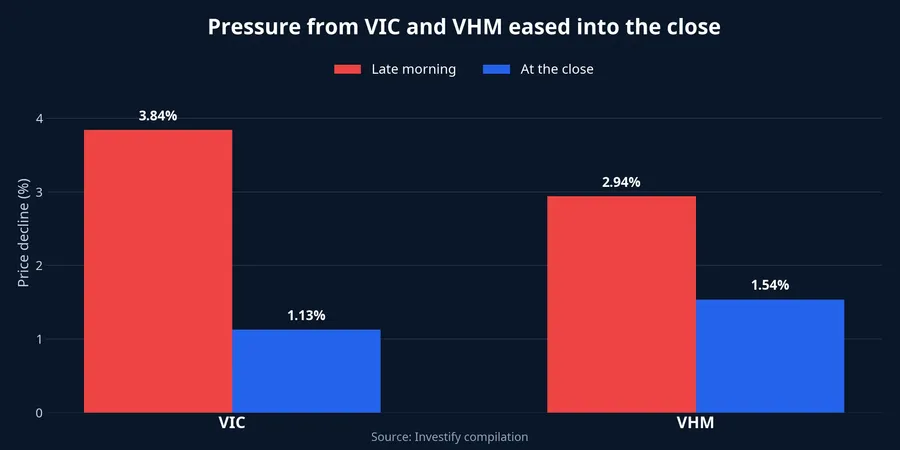
It is important to separate a shared timing from a proven cause. The rebound coincided with smaller declines in VIC and VHM, alongside gains in oil and gas, PNJ and a few banks. The session data do not establish precisely how much each share contributed to the reversal. The careful reading is that several observable forces supported the market, rather than a single stock acting as its sole hero.
Breadth improved, but not across major groups
At the close, HOSE recorded 199 advancers and 120 decliners, with six limit-up and seven limit-down stocks. That breadth was markedly better than the anxious picture in the morning. It indicates that green was not limited to a few index heavyweights.
Yet market-wide breadth is not a substitute for looking at each sector. In banking, 23 of 25 stocks declined. Financial services had 34 decliners against two advancers, while real estate counted 61 decliners and 14 advancers. These are sectors with a significant influence on investor sentiment and trading activity.
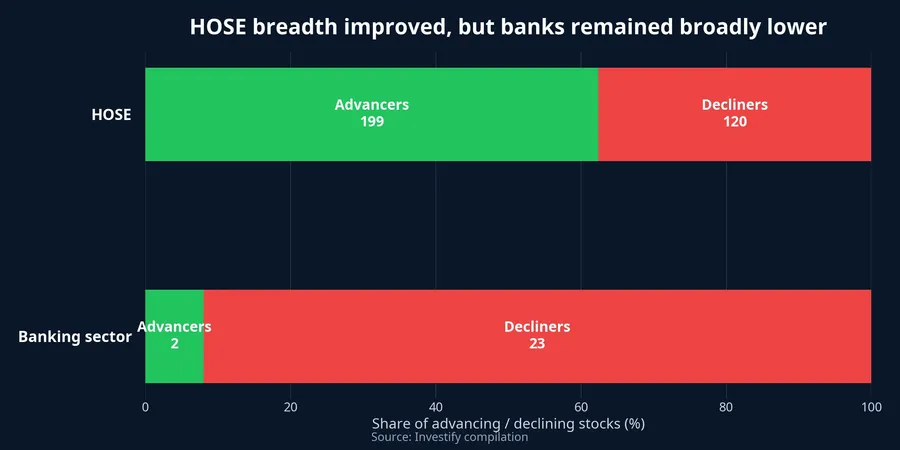
Put simply, the market became less red but not evenly green. This distinction matters for new investors. A rising index can mean that lifting forces have become stronger than downward pressure at that moment. A broader-based recovery, by contrast, requires more sectors to stop falling or to participate in the rise. This session only met part of that condition.
Volume does not yet confirm buyer control
HOSE trading volume was 564.8 million shares, 33.2% below the previous session’s 845.4 million shares. The lower volume does not negate the afternoon demand. It does mean that prices can rebound when sellers become less aggressive, when fresh buyers arrive, or when both occur together.
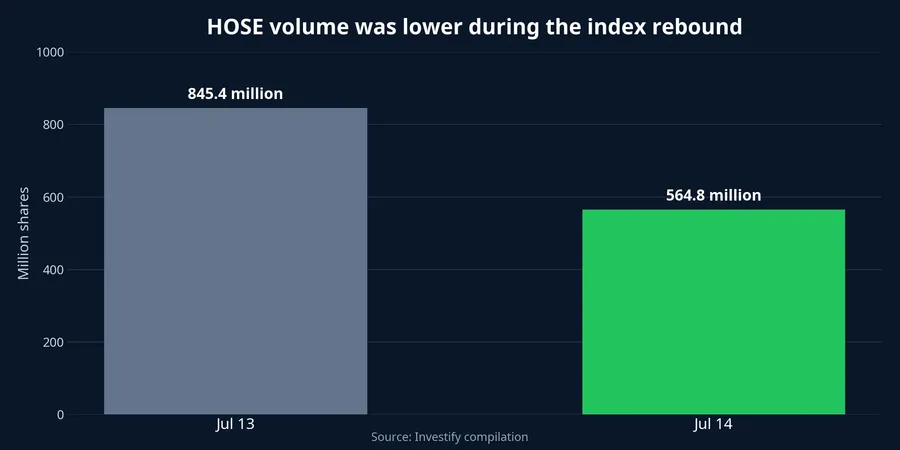
For that reason, one green close is not enough to say buyers have fully taken control. A following session in which prices rise alongside stronger volume would carry a different message from one in which the index rises while trading keeps shrinking. It also matters whether money spreads into weaker sectors rather than concentrating in the small group of stocks that remained positive.
Three checks for the next session
The first check is 1,800. Closing above it improves sentiment, but one close above that level does not make it durable support. If the index quickly drops back below 1,800 while large-cap losses widen again, the July 14 afternoon move will look more like a short-term response.
The second check is the quality of volume. Rising prices with improving volume usually signal broader participation. Conversely, high volume while banking, securities and real estate remain broadly lower may show selling pressure moving around the market, rather than fresh market strength.
The final check is participation. Oil and gas, PNJ, VCB and STB supplied visible support on July 14. For the rebound to become more convincing, more shares and sectors need to join in, especially the areas that are still weighing on broader sentiment.
July 14 was not evidence that risk has ended. It showed that buyers helped VN-Index out of a deep intraday decline while the drag from large caps cooled. The next session’s ability to hold 1,800, pair price gains with volume, and broaden participation into still-red sectors will determine whether the green close marks the start of a more durable rebound or merely a pause in a market that remains divided.