

USD 81.3 billion is the cumulative amount of US tariff refunds from the start of the fiscal year in October 2025 through the end of June. It is not a one-day stimulus payment, and it is not money wired directly overseas. The macro picture is a reversal in a fiscal flow: money that once entered the federal budget is returning first to the party that paid it at the border, the importer of record.US Treasury
That distinction matters for Vietnamese investors. “The US is refunding tariffs” can sound like a wholesale removal of trade barriers or an immediate cut in American retail prices. Neither conclusion follows. A refund is only the first link in a chain involving corporate cash allocation, retail pricing, and future orders. The central point is not that protectionism has ended, but that the short-term benefit is concentrated first among companies that bore the invalidated duties.

A legal ruling reversed the direction of cash
On February 20, 2026, the US Supreme Court held that the International Emergency Economic Powers Act did not give the president authority to impose the challenged tariffs. The ruling addressed the legal basis for broad reciprocal tariffs and tariff measures tied to drug trafficking that had been built on that emergency statute.US Supreme Court
The Court did not itself send payments to individual companies. Customs and Border Protection then opened a claims process, under which businesses must identify the relevant entries, duties, and entitlement to a refund. AP reported that approved claims were expected to be paid within 60 to 90 days. The amount returned will therefore grow with administrative processing rather than arrive all at once.AP
Two questions are often blended together here. One is whether a tariff had a valid legal basis. The other is who is entitled to recover money already paid. The answer to the second follows the customs entry and payment record, not the country where a good was made or the household that eventually bought it.
The legal recipient is the importer
The importer of record deals directly with customs. It may be a retailer bringing finished goods into the US, a manufacturer importing components and raw materials, a distributor, or a company handling clearance for a supply chain. It paid the duty at the point of entry, so it is the first recipient of any refund.
The scale of the process explains why a refund cannot be treated as a simple transfer. Court filings cited by AP say that more than 330,000 importers paid around USD 166 billion in duties within the group invalidated by the ruling, across more than 53 million shipments. The USD 81.3 billion refunded by the end of June therefore represents amounts processed so far, not the full potential obligation.AP
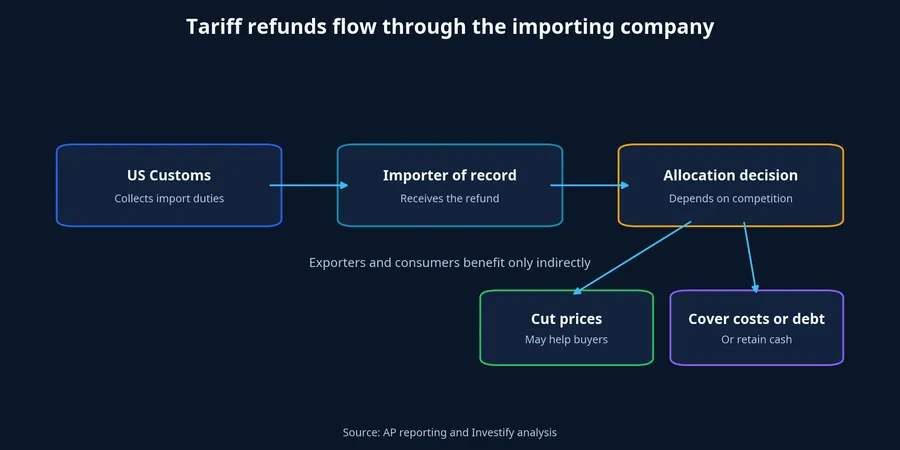
Foreign exporters can benefit only indirectly. They may see an effect if an importer uses the cash to place more orders, accept a higher purchase price, or retain a supply contract. Consumers likewise do not have an automatic refund claim. They benefit only if competition induces a company to turn part of its cash windfall into lower prices, promotions, or a steadier supply of goods.
Put simply, the same refunded dollar can produce very different outcomes. A retailer may cut prices to protect market share. A manufacturer may offset input costs already incurred. A cash-constrained company may pay down debt or retain liquidity. There is no universal formula that converts the aggregate refund into a direct benefit for shoppers.
June data shows the fiscal pressure
The June figures make the reversal tangible. Gross customs receipts were USD 23.63 billion, while refunds reached USD 49.18 billion. Net customs receipts were therefore negative USD 25.56 billion. This is a reversal of revenue already booked, rather than new spending that creates a public good or service.US Treasury
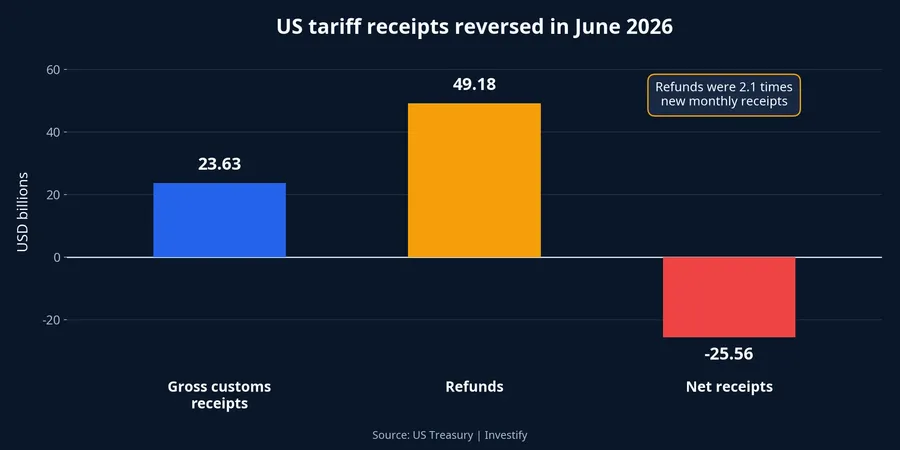
The federal budget posted a USD 120.31 billion deficit in June, compared with a USD 27.01 billion surplus in June last year.US Treasury It would be wrong to assign the entire swing to refunds because spending schedules and other receipts also move from month to month. Still, refunds reduce net revenue when the government recognizes the repayment, making them a fiscal variable to watch, not merely a story about importing companies.
The wider fiscal picture is not one-directional. Cumulative net customs receipts since the start of the fiscal year remained USD 163.02 billion, above USD 108.02 billion a year earlier. Refunds are reducing part of the additional tariff revenue, but they have not erased all of the accumulated net collections.US Treasury
Refunding old duties does not remove new barriers
The most tempting mistake is to read the ruling as the end of US tariffs. It only addressed measures based on the emergency law challenged in court. Duties imposed under other legal authorities remain, so companies cannot use a historical refund to assume that the cost of future imports will return to its earlier level.
Penn Wharton Budget Model analysis published on July 13 put the average effective US tariff rate at 7.2% in May, compared with 2.3% in January 2025.Penn Wharton The US also retains a 10% global import surcharge under another authority, scheduled to expire on July 24. Sectoral tariffs on steel, aluminium, and autos were not part of the ruling.The Guardian

The causal story needs to remain precise. A refund can improve working capital and margins for selected importers. That does not establish that long-term trade costs have fallen, because duties that remain in force and any replacement measures determine the cost of the next shipment. Both conditions can be true at the same time.
Reading the flow one link at a time
For US companies, the useful signals are the cash actually received, the pace of receipt, and management's stated use of that cash. Earnings reports may reveal whether the money is offsetting cost of goods sold, increasing cash balances, or reducing debt. If a company had already passed much of the tariff on through to prices, a refund could lift short-term profit; where competition is intense, some of that benefit may return to customers.
For companies exporting into the US, the question is not whether they “receive” USD 81.3 billion. The more useful question is whether their importing partners reopen orders, alter purchase prices, or loosen payment terms after receiving refunds. That is an indirect transmission channel, and it is fundamentally different from a direct subsidy to a foreign supplier.
The conclusion is straightforward: tariff refunds are a selective release of cash to the companies that paid the duties in the US, while also reducing revenue previously recorded by the federal budget. Trade risk has not disappeared. It has shifted toward other tariff authorities and the costs of future shipments. Over the coming weeks, the important signals are the processing pace for refund claims, the amounts recognized in company reporting, and the status of the 10% surcharge scheduled to expire on July 24.