


The VN-Index closed July 13 at 1,800.54, down 27.80 points or 1.52%. Trading volume reached 849,625,055 shares, 45.2% above the July 10 session; 55 stocks rose while 289 fell. Those numbers invite an appealing conclusion: dip buyers arrived as the index approached the psychologically important 1,800 level. But a price zone is not a bottom simply because money appears there. Buyers must first show they can hold prices against incoming supply.
Put simply, turnover is like the number of hands changing on a slope. Every matched trade has both a buyer and a seller. High volume therefore says that a large transfer is under way; it does not by itself identify the side setting the price. The evidence from July 13 points to heavy trading while sellers still held the upper hand, not yet to confirmed dip buying.
Heavy turnover is not automatically strong demand
Imagine holders progressively cutting their asking prices to exit. Buyers may be waiting at lower levels and take every share offered. Turnover can be substantial in that situation, yet falling prices show that sellers are still forcing the adjustment.
The more convincing absorption pattern is different: supply keeps arriving but the price stops making new lows. If sellers offer additional shares and the low does not persist, buyers are demonstrating that they can absorb supply. This is the distinction new investors should focus on. The key question is not whether money entered, because every trade requires it, but whether that money has changed the price floor.
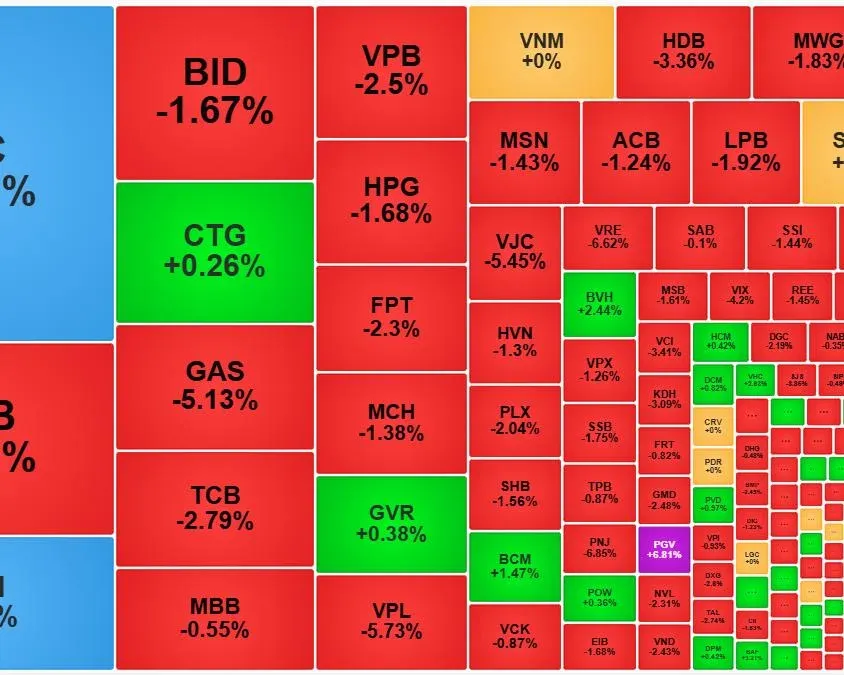
In the July 13 morning session, matched value on HoSE was nearly VND 8,010 billion, up 68% and the highest of the past 20 morning sessions. Prices weakened as trading increased, while 177 stocks down more than 1% accounted for 78.7% of the exchange's matched value. VnEconomy That combination is more consistent with shares changing hands in losing names than with broad demand lifting prices.
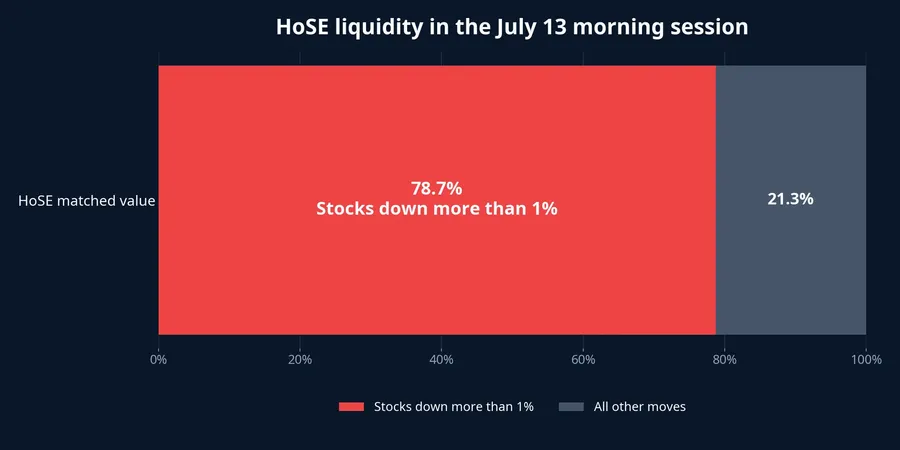
This does not mean buyers were absent. Every share sold found a buyer. But accepting stock at a lower price and wresting back control of the price are different states of the market. July 13 clearly showed the former, so calling volume a confirmation of a bottom would get ahead of the evidence.
That distinction matters especially after a sharp red session. A large print can look reassuring because it suggests that someone was willing to step in, but willingness at one lower price does not establish a durable floor. The useful follow-up is whether demand remains present after the first matching wave and whether it accepts progressively higher prices. Without that evidence, the market has demonstrated exchange, not reversal.
Breadth shows how far selling pressure spread
The VN-Index is capitalization weighted, so a small group of large companies can move it more sharply than the rest of the board. Breadth is the needed cross-check: how many stocks are rising, how many are falling, and whether that balance improves or deteriorates through the session. An index near a round-number level can feel stable even when most portfolios are not.
At 9:30 a.m., HoSE recorded 56 gainers and 166 decliners. By 10:30 a.m., decliners had risen to 236 while gainers stood at 53; at the end of the morning session, the count was 53 gainers versus 255 decliners. VnEconomy Rising turnover alongside deteriorating breadth matters because it indicates that pressure was not limited to a handful of names.
The VN30 basket did not provide broad support during the morning either: three stocks rose and 27 fell, with 20 of the declines exceeding 1%. VnEconomy By the close, 289 stocks had declined against 55 gainers, meaning decliners outnumbered gainers by roughly 5.3 times. That does not determine the next session's direction, but it limits how bullishly the 1,800 area can be interpreted.
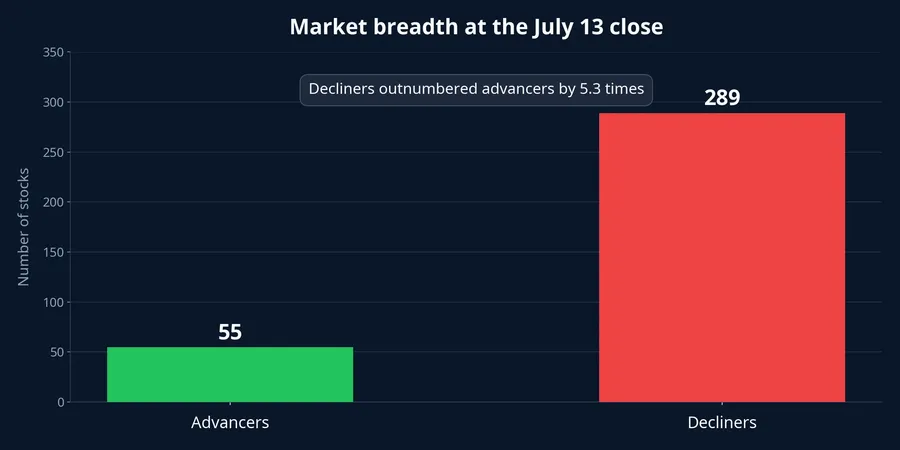
Breadth also guards against a common mistake: assuming that a pause in the index's decline means the market is healthy again. One or two large-cap stocks can slow their fall while many smaller and mid-cap names keep losing ground. The index rebound may then carry technical relevance without restoring the health of the typical portfolio.
1,800 is a trading zone, not a verdict
At the morning close, the VN-Index stood at 1,801.51, down 26.83 points. VnEconomy It ended the day at 1,800.54. The final level was not materially higher than the morning level, even though 849,625,055 shares traded during the full session.
The best description is therefore a large trading zone around 1,800. It shows that many investors were prepared to transfer ownership there, but not whether the weak supply had been fully absorbed. Several explanations can coexist: sellers may have temporarily stopped cutting offers, short-term trading may have dominated, short positions may have been closed, or genuine investment demand may have emerged. One session cannot allocate the contribution of each explanation with confidence.

A round number is not a promise. It often concentrates attention and standing buy orders, but only price stability when supply returns can test the quality of support. Reading the market this way keeps new investors from turning a high-volume session into a certainty about reversal.
This is also why a single intraday bounce deserves context. It can arise when sellers pause, when short-term traders cover positions, or when a small pool of buyers responds to the headline level. Those outcomes may look similar on a chart for a few minutes. The next sequence of trades, rather than the existence of the bounce itself, is what separates temporary relief from genuine absorption.
What to watch in the next session
The first signal is how price behaves after a rebound. A high-quality rebound does not need to be fast. More importantly, it needs to retain much of its gain when sell orders return. If green moves are quickly erased and many stocks make new lows, sellers are still using higher prices to exit.
The second signal is breadth. Decliners need to narrow before a VN-Index rebound becomes meaningful for most accounts. A move back above 1,800 driven by a few large stocks is fundamentally different from multiple sectors ceasing to decline together. The distinction may not dominate market headlines, but it shapes the actual experience of a portfolio.
Finally, consider where turnover occurs. Heavy volume becomes more constructive when it shifts into stocks that can hold flat or rise after selling pressure. If most matched value remains concentrated in deep decliners, turnover is primarily recording a transfer of risk. The three signs belong together: price holds, breadth becomes less negative and trading stops concentrating in losers.
The current conclusion is not a forecast that the VN-Index must move in one direction on July 14. There is not yet enough evidence to call 1,800 a confirmed bottom. The more useful framework is to wait for confirmation through price retention after rebounds, improving breadth and a shift in the composition of turnover. For new investors, the key lesson is that high volume is a question to decode, not a ready-made answer.