

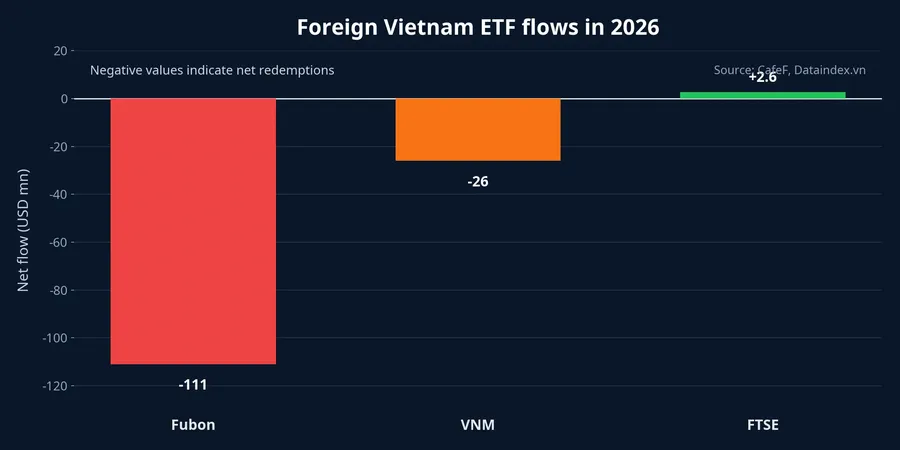
At first glance, the Fubon story looks like a contradiction. The fund has been the best performer among the three largest foreign ETFs investing in Vietnamese equities, up 4.8% year to date, yet it has also suffered the largest outflow at roughly USD 111 million.CafeF
For a new investor, that can feel backwards. If the fund is doing well, why would investors pull money out? The answer is that an ETF carries two different signals at the same time. One is portfolio performance. The other is investor positioning in the listed fund itself. Those signals can reinforce each other, but they do not have to move in sync.
That distinction matters in Vietnam because ETF flows are one of the fastest ways foreign money turns into visible pressure on large-cap stocks. If you read every redemption as a verdict on corporate fundamentals, you will often overreact. If you read it as a technical transmission channel first, the market starts to make more sense.
The contradiction is only superficial
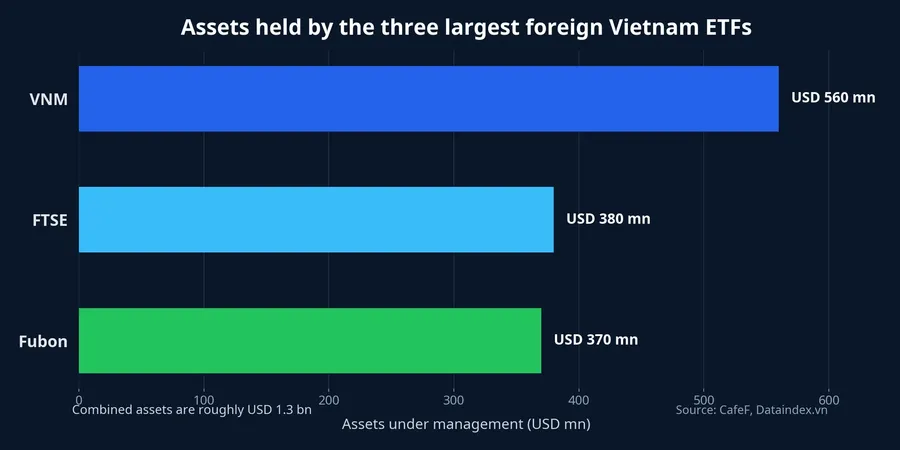
The three biggest foreign ETFs in this discussion are VNM ETF, Xtrackers Vietnam Swap UCITS ETF, and Fubon FTSE Vietnam ETF. Together, they currently manage about USD 1.3 billion in Vietnamese equities. VNM ETF remains the largest at roughly USD 560 million, followed by FTSE ETF at about USD 380 million and Fubon at around USD 370 million.CafeF
That is not large enough to dominate the whole market, but it is large enough to move supply and demand in the most liquid blue chips. When money leaves a foreign Vietnam ETF, the pressure rarely spreads evenly across the exchange. It tends to show up where the weights are biggest and execution is easiest.
That is why “the fund is up” and “the fund is losing money” should not be treated as mutually exclusive statements. One describes what happened inside the basket. The other describes what holders of the listed ETF units chose to do with their exposure to Vietnam.
Performance and flows are different layers
Fubon is the cleanest example. It has delivered the strongest return in the group this year, but it has also seen the largest redemptions.CafeF That does not automatically mean investors in Taiwan suddenly turned bearish on every Vietnamese company inside the basket. A more defensible reading is that they are adjusting allocation after a profitable stretch, locking in gains, or trimming emerging-market risk in a broader portfolio context.
This is where many retail investors blur a fund’s return with investor demand for the fund. In a single stock, those two ideas often travel together because buyers are making a direct bet on one company. In an ETF, buyers are choosing a packaged exposure to a market, an index, or a theme. They can like the return they just earned and still decide that the next incremental dollar belongs somewhere else.
Once that happens, the mechanics take over. Redemptions force the fund to shrink. A shrinking fund means the underlying basket has to be reduced according to index weights. That is a technical flow before it is a fundamental call.
The pressure usually lands on the biggest names
To see how that works, look at the holdings. As of July 8, 2026, VanEck’s VNM ETF had VIC at 8.98% of net assets, VHM at 8.15%, MSN at 5.62%, MCH at 5.34%, VCB at 4.99%, and HPG at 4.75%.VanEck
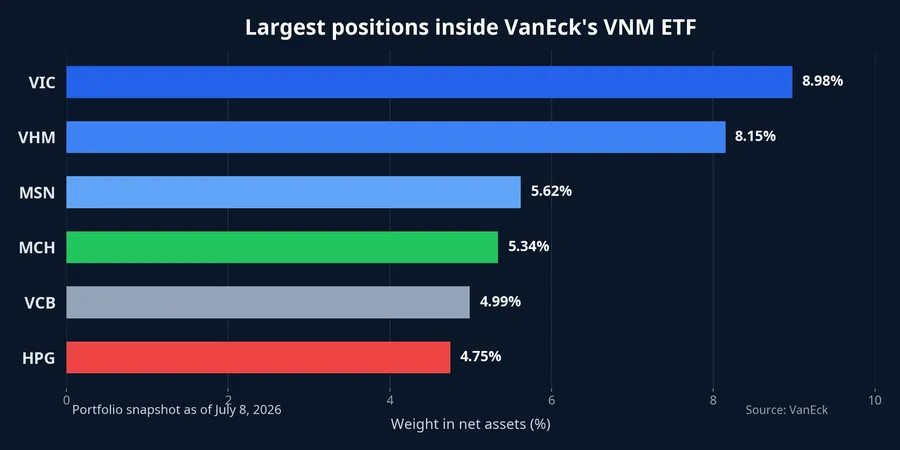
That helps explain why ETF headlines so often show up on Vietnamese trading screens as pressure in a familiar cluster of market leaders. ETF selling is not emotional. It is formula-driven. Stocks with larger weights and deeper liquidity are the first place where technical supply becomes visible.
Still, it is important not to overstate causality. If a stock drops in the same week that an ETF sees redemptions, the ETF is not automatically the only reason. Profit-taking, active foreign selling in the open market, or a broader market pullback may all be contributing at the same time. What the ETF story does tell you is that the probability of additional supply in high-weight names has increased.
That matters more in a year when foreign investors have already sold a net VND 82,000 billion on HoSE.CafeF When ETF redemptions line up with discretionary foreign selling, the market feels the pressure more directly than it would from a purely mechanical rebalance.
Not every Vietnam ETF transmits pressure the same way
Another point that beginners often miss is that “Vietnam ETF” is not a single structure. Xtrackers Vietnam Swap UCITS ETF currently has about EUR 333 million in assets, charges a 0.85% annual fee, and uses synthetic swap-based replication rather than simple full physical exposure.justETF
That distinction matters because the same outflow can produce a different footprint depending on how the fund is built. Some ETFs pass pressure into underlying stocks more directly. Others have an additional structural layer that changes the transmission. So the phrase “foreign ETFs are selling Vietnam” is directionally useful, but analytically incomplete.
The longer-term context also complicates the picture. FTSE Russell has confirmed that Vietnam will be reclassified to Secondary Emerging status, effective from the open on September 21, 2026.LSEG Ahead of a market-upgrade event like that, flows rarely move in one clean line. New money can come in, but existing funds can also rebalance, re-index, or reduce risk before the transition.
So a redemption cycle ahead of the upgrade does not negate the longer-term market story. It simply means that the path of foreign capital is more uneven than the headline narrative of “upgrade equals inflow” suggests.
Three signals worth tracking
For a retail investor, the practical framework is to split the story into three layers. First, watch the fund flow itself: is the ETF seeing inflows or redemptions, and is that a short burst or a persistent trend? Second, map the likely impact zone: which stocks sit at the top of the basket, and are those names already under selling pressure? Third, test domestic absorption: can local liquidity absorb the extra supply without forcing a deeper move?
The July 9 session shows why context matters. VN-Index closed at 1,840.70, down 0.70%, with 91 advancers and 203 decliners.CafeF In a market tone like that, any ETF redemption headline can hit sentiment harder, especially in the large-cap names that dominate screens and index behavior.
But if domestic demand still absorbs the supply, the effect may remain a short-term technical move. If redemptions arrive when the market is already weak, liquidity is thinning, and active foreign selling is still running, the same flow can become much more visible. That is the difference between a signal to monitor and a sweeping conclusion about the health of Vietnamese equities.
The core takeaway is straightforward. Strong ETF performance does not guarantee that capital will stay. In foreign ETFs, the decision-maker is the investor holding the fund units in the listing market, while the immediate impact is felt by the Vietnamese stocks inside the basket. That is why Fubon’s strong return and heavy redemptions are not a contradiction in fundamentals. They are a reminder that ETF flows should be read as a market mechanism first, and only then as a broader sentiment signal.
The next useful checkpoints are the pace of flows into each fund, the intensity of selling in high-weight holdings, and the market’s capacity to absorb that supply. If all three deteriorate together, technical pressure on Vietnamese blue chips becomes more serious. If they do not, the redemption headline may end up being short-term noise inside a much larger market transition.