


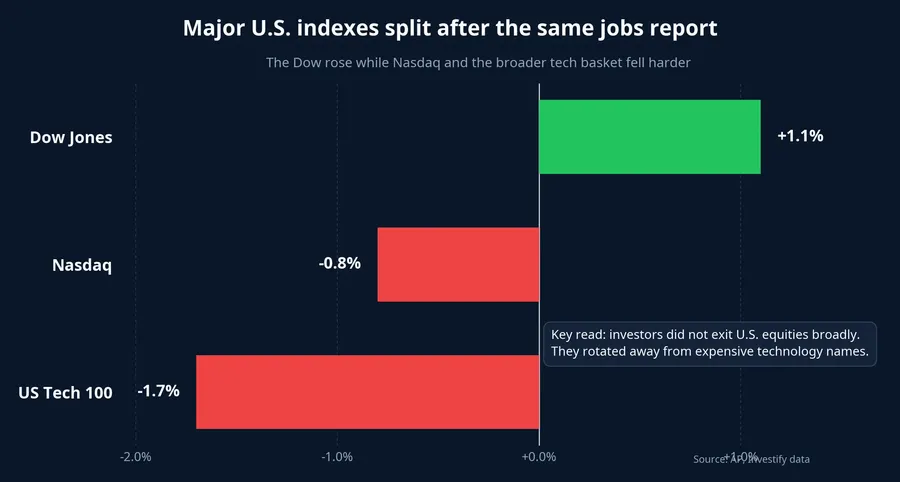
The June jobs report sent two very different signals across Wall Street: the Dow Jones Industrial Average rose 1.1% while the Nasdaq Composite fell 0.8%. Read superficially, that looks inconsistent. If the macro data softened and the Fed looked less threatening, why did one major index rally while another slipped? The cleaner answer is that investors were pricing two things at once: less immediate pressure from rates, and a stricter test for expensive technology stocks.AP
That distinction matters for newer investors. Economic data do not flow straight from a government release into index moves. They pass through Fed expectations, Treasury yields, the dollar, sector valuations, and positioning. Once you see that chain clearly, a split tape like this stops looking random and starts looking like rotation.
The Jobs Report Took Some Pressure Off the Fed
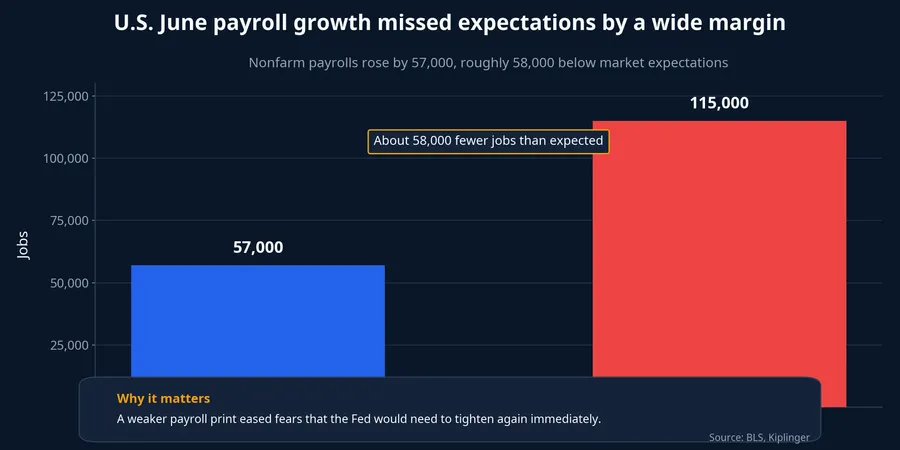
The first leg of the story is the labor data itself. The U.S. economy added 57,000 nonfarm jobs in June, far below the roughly 115,000 jobs economists had expected. The unemployment rate came in at 4.2%, and the prior two months were revised down by a combined 74,000 jobs.BLSKiplinger
The practical takeaway is straightforward. Markets were already braced for a less-than-hot report, but this print came in softer than expected. That reduced the urgency of any near-term Fed tightening. Investors did not suddenly decide the economy was collapsing. They decided the odds of another immediate rate hike had become less pressing.
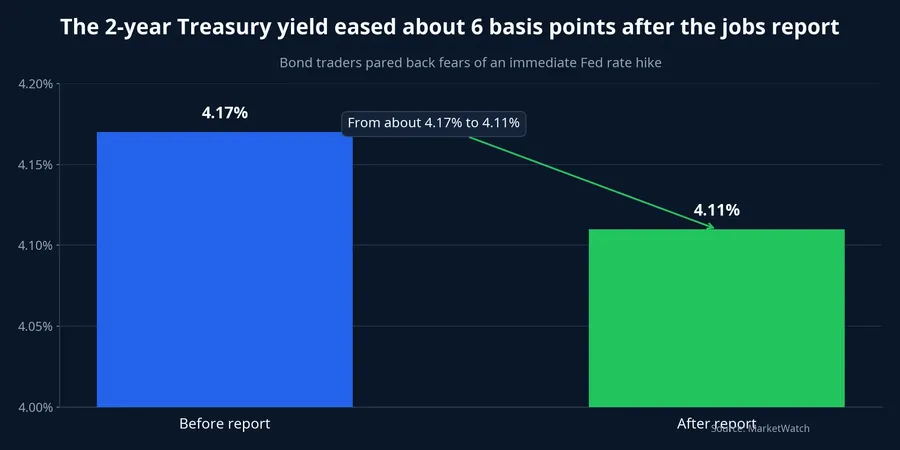
That change showed up quickly in bonds. After the report, the 2-year Treasury yield fell about 6 basis points to roughly 4.11%. For markets, that is one of the most important signals on the board because the front end of the Treasury curve is highly sensitive to policy expectations.MarketWatch
When short-term yields cool, sectors that are more exposed to financing costs often get breathing room. Industrials, financials, defensive consumer names, and other cash-flow-heavy businesses can look more attractive because the market is no longer as fixated on a fresh jump in the cost of money. That is the basic support behind the Dow’s strength.
Why the Dow Was Bought While Nasdaq Was Sold
The obvious follow-up is why Nasdaq did not benefit from the same rate relief. Growth stocks usually welcome lower yields because future earnings are discounted less aggressively. But that relationship is not absolute. It can be overwhelmed by valuation, positioning, and investor fatigue inside the most crowded parts of the market.
That appears to be what happened here. Internal market data show the US Tech 100 fell 1.7%, a steeper drop than the Nasdaq itself. That is a useful clue because it suggests the pressure was concentrated in the large-cap technology complex rather than spread evenly across U.S. equities.
It would be too simple to say the jobs report alone dragged Nasdaq lower. A better reading is that several forces lined up at once. Softer labor data helped money rotate into groups that had lagged. Technology had also already enjoyed a long run, which made profit-taking easier to justify. And investors are still asking whether heavy spending on artificial-intelligence infrastructure will translate into revenue and margins quickly enough to defend current valuations. Schwab’s market note before the session pointed to clear pressure across parts of the AI-linked complex, even as reactions among individual large-cap names diverged.Schwab
That is why “Dow green, Nasdaq red” is not a contradiction. One part of the market was reacting to lower rate pressure. Another was re-pricing the old leadership group more critically. The S&P 500 finishing almost flat fits that interpretation well: the broader market did not break, but the previous leaders no longer pulled everything higher with them.AP
What New Investors Often Miss in a Split Session
The most common mistake is forcing every market move into a single cause. Markets rarely work that cleanly. The same labor report can ease pressure in the bond market, support rate-sensitive cyclicals, and still trigger selling in technology if that is where valuations and positioning were already most stretched.
Put simply, stock prices reflect not only the news itself but also how much investors had already been willing to pay before the news arrived. If one part of the market has run very far on the promise of artificial intelligence, investors eventually ask for harder proof. At that point, even a friendlier rates backdrop may not be enough to keep money locked in.
That is why the right takeaway is not “technology is broken” or “the U.S. market is healthy across the board.” The more defensible conclusion is that leadership is narrowing and money is becoming more selective. Investors still want equity exposure, but they are no longer assigning the same price to every growth narrative.
What Vietnam-Based Investors Should Watch Next
For Vietnamese investors heading into the local session, the useful framework is not the headline color of the Dow or Nasdaq. It is a three-layer checklist.
First, watch short-term U.S. yields. If the 2-year Treasury yield keeps easing on the next round of data, pressure on growth-stock valuations and the broader risk backdrop should keep softening. This is the lead signal because it feeds directly into the Fed path.
Second, watch the dollar. The source article noted that the dollar also cooled alongside yields, and that matters more than any single-day index move. For Vietnam, the point is practical rather than abstract: USD/VND was around VND 26,314.50 on July 1. If the global dollar loses some heat, sentiment toward emerging markets often steadies with it.Investify
Third, watch market breadth. New investors routinely underweight this signal. An index gain alone does not tell you whether money is spreading or hiding in a few large caps. That rule matters in Vietnam as well. The VN-Index stood at 1,866.35 on July 2, but decliners still outnumbered advancers. A green index can therefore coexist with a much more cautious underlying tape.
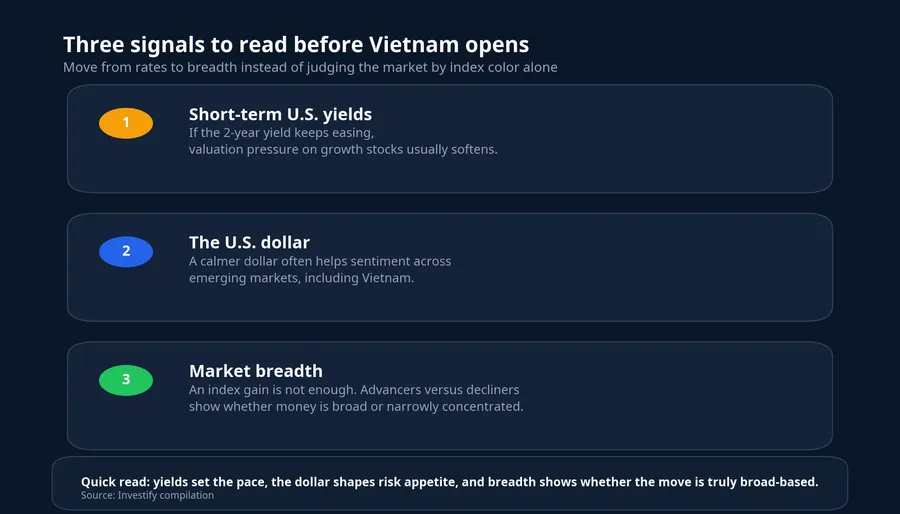
The central thesis, then, is not that investors are abandoning U.S. equities. It is that they are changing the price they are willing to pay for risk. Lower yields help large parts of the market, but that relief is no longer enough to automatically shield technology stocks whose valuations already assume a lot of future success.
For Vietnam-based readers, the next few sessions should be read through those same filters. Do U.S. yields keep easing? Does the dollar soften further? Does breadth improve in both the U.S. and Vietnam? If those signals begin to align, the rotation case gets stronger. If yields cool but breadth stays weak, the market is still telling you this is a selective move, not a broad reset higher.