


Middle East tension does not automatically turn every asset into a safe haven. Ahead of Vietnam's June 29 session, oil ticked higher, gold did not break out, and U.S. stock futures were only modestly firmer. That combination suggests markets are pricing energy supply risk more clearly than a wider fear shock.MarketWatch
That is exactly where newer investors can misread the tape. Many people still rely on a simple rule: if there is a war headline, gold must surge. Markets rarely work in such a straight line. Brent closed at USD 72.50 a barrel on June 26, well below the USD 80.59 level seen on June 19, while spot gold closed at USD 4,052.38 an ounce on June 26, up from USD 3,999.60 on June 24 but still short of a full-blown haven run.
Oil And Gold Are Answering Different Questions
The simplest way to think about it is this: oil and gold both react to geopolitics, but they react through different channels. Oil responds first to a physical question. Is supply at risk, are shipping costs rising, and does stress around the Gulf force buyers to pay a bigger insurance premium? As long as those questions remain open, oil has a reason to move higher.
Gold works through a different mechanism. It is a haven asset, but it is also heavily shaped by the U.S. dollar and interest rates. If oil rises because energy risk looks harder to contain, markets may also start thinking inflation could stay sticky for longer. That, in turn, can reinforce the idea that the Fed may need to keep rates higher for longer, which supports the dollar and removes part of gold's upside.
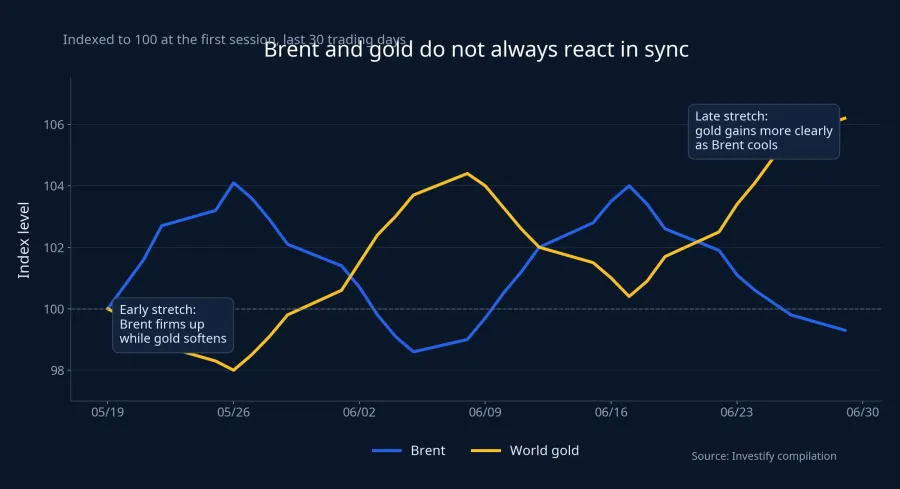
That is why investors should not force everything into a single "war equals gold" narrative. In many sessions, oil leads because it reflects real-economy costs directly. Gold only becomes the dominant signal when fear shifts from supply disruption to systemic stress: financial instability, a liquidity squeeze, or broad selling across risk assets.
Read that way, the current message is fairly clean. Oil is picking up an additional risk premium, while gold is merely recovering rather than entering a panic-driven rally. For first-time investors, that distinction matters because it tells you whether you are looking at an energy shock or a confidence shock.
The Dollar Is Still The Headwind Gold Buyers Forget
If you want to read gold properly, do not stop at geopolitics. Watch the dollar as well. The DXY closed at 101.53 on June 26, up from 100.84 on June 22. USD/VND ended June 26 at VND 26,316 per dollar, only slightly below the VND 26,337.5 level recorded on June 25. Put simply, the dollar has not weakened in a way that would give gold a clean tailwind.
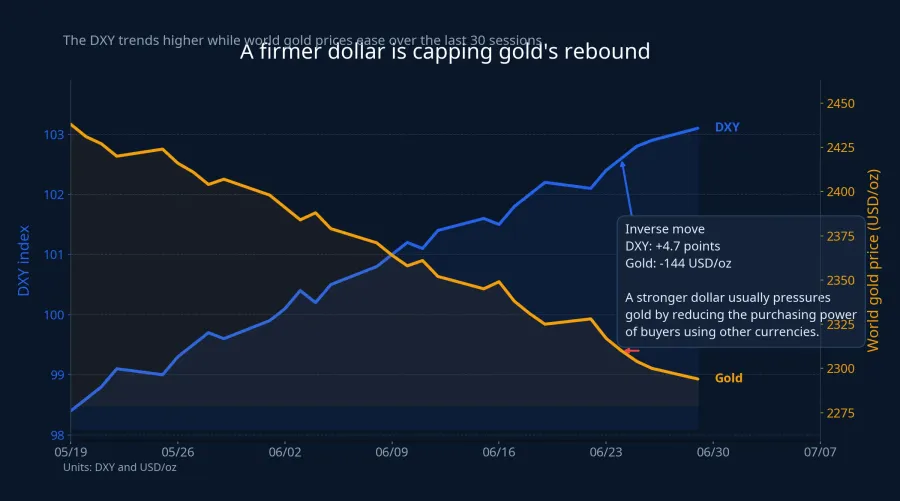
When the dollar rises, buyers using other currencies have to pay more for the same ounce of gold. That is a very practical constraint. Even if Middle East headlines increase defensive demand, gold can still underperform expectations when the dollar is moving the other way.
That also explains why one session is never enough. If oil edges up while the DXY also firms, gold can get trapped between two forces: haven demand on one side and dollar strength plus higher-for-longer rates on the other. Only when one force starts to dominate does gold's direction become easier to read.
For retail investors in Vietnam, the lesson is to follow the chain, not the headline. Geopolitical stress affects oil. Oil affects inflation expectations. Inflation expectations affect interest rates and the dollar. Gold responds to that entire chain, not just to the conflict headline at the top of a news feed.
SJC Gold Is Not The Same Story As World Gold
Another common mistake is to use SJC gold as the only thermometer for global fear. On the morning of June 27, SJC gold bars were quoted at VND 148.5 million per tael on the sell side and VND 145.5 million per tael on the buy side.Thanh Niên Investify's internal data show the same sell-side level for June 27.
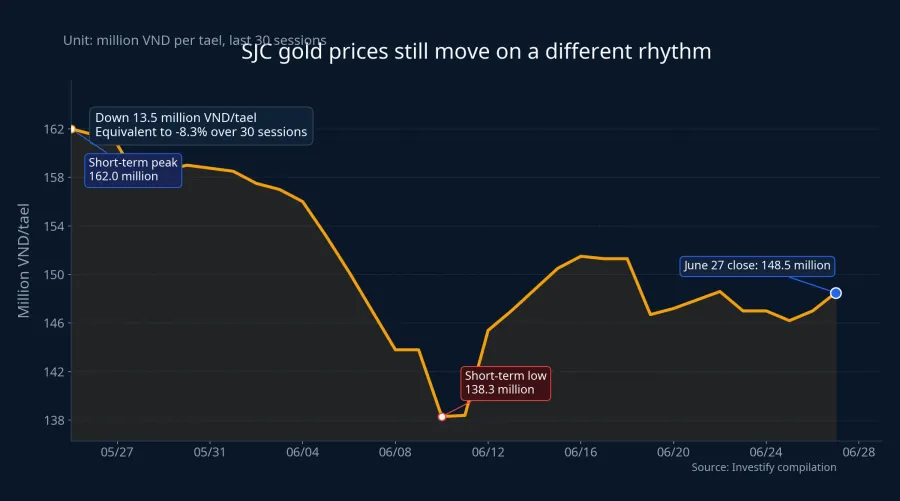
But SJC does not reflect global gold alone. Domestic prices are also shaped by physical demand, holding psychology, bid-ask spreads, and the premium over world prices. On the same June 27 morning, the world gold price converted into dong terms was roughly VND 19 million per tael below the domestic SJC price.CafeF A gap that wide is enough to send SJC on a very different path from international gold.
So if SJC rises more sharply than world gold, do not rush to conclude that the global market is panicking. What may actually be rising is demand for physical gold inside Vietnam. Conversely, if world gold moves sideways while SJC stays elevated, the explanation may lie in domestic scarcity or local defensive sentiment, not in a fresh global shock.
That is the key distinction for new investors. World gold and SJC are connected, but they are not interchangeable. One reflects a global financial asset. The other carries the extra features of a domestic market with its own supply-demand structure. Mixing those two layers is an easy way to end up chasing the wrong move.
Oil Stocks Do Not Move As One Block Either
The next reflex after an oil move is to assume oil and gas stocks should all benefit together. That is not how the sector works. Drilling services, transport, refining, and downstream distribution sit at different points in the value chain, so they do not absorb the same benefit from a higher crude price.
The price action makes that clear. PVD closed at VND 31,600 a share on June 26, below the VND 35,050 level seen on April 1. GAS ended at VND 77,000, also below its April 1 level of VND 80,700. Over the same stretch, Brent traced a wide arc: from USD 101.16 a barrel on April 1 to USD 112.10 on May 18 before dropping back to USD 72.50 on June 26.
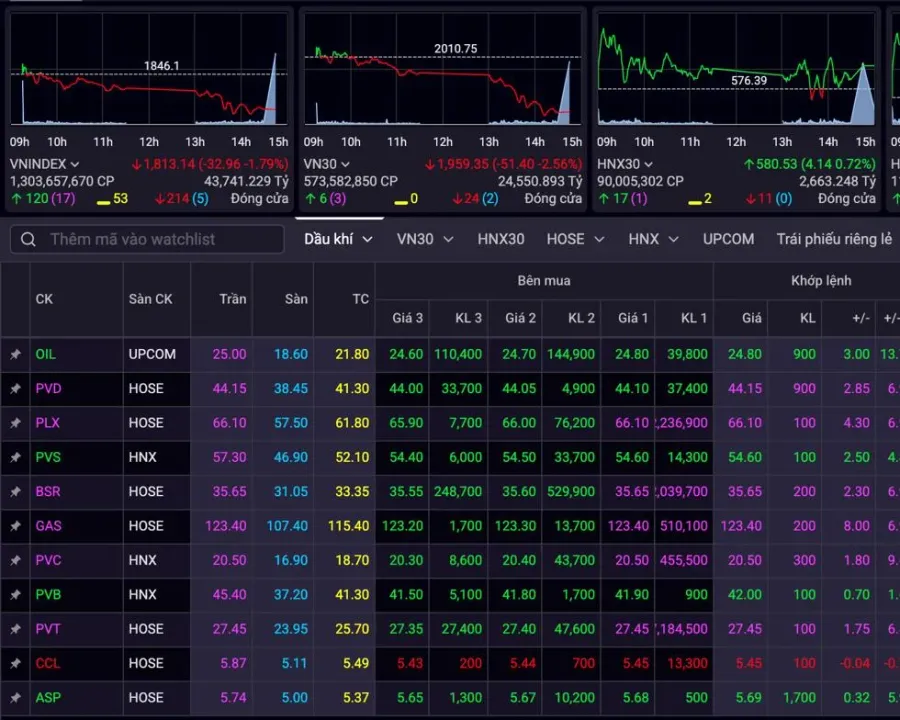
In other words, a mildly green open in oil and gas names is not enough to prove the market is pricing in a new earnings cycle. A few hours of higher oil after a geopolitical headline is very different from oil staying high long enough to change revenue, margins, and capital spending plans. Investors who blur that distinction are usually confusing a news reaction with a change in fundamentals.
Three Signals Worth Watching Before Calling A Trend
The first signal is whether Brent can hold the USD 72.50 area. If oil only pops briefly and then slides back below its June 26 close, the market is saying supply risk still looks manageable. In that case, the move is more a short defensive adjustment than the start of a new cycle.
The second signal is whether world gold can move decisively above USD 4,052.38 an ounce. If gold only drifts around that level while oil edges higher, the story still belongs more to energy risk than to broad haven demand. For newer investors, that distinction can prevent buying gold simply because war headlines are showing up more often on social feeds.
The third signal is the dollar. If the DXY strengthens further while USD/VND stays firm, gold will remain constrained by the currency and rate channel. If the dollar softens while oil holds its rebound, gold has a better chance of reacting more forcefully. The key is not one asset in isolation but whether oil, gold, and the dollar start moving in a consistent pattern.
The bottom line is that markets are currently paying more for oil supply risk than for a systemic fear shock. That thesis remains intact as long as Brent is only edging higher, gold is still below a clean breakout from USD 4,052.38 an ounce, and the dollar keeps relative strength. The real question for June 29 is not whether investors should reflexively buy gold, but whether energy risk starts spilling over into the dollar, gold, and broader risk appetite.