
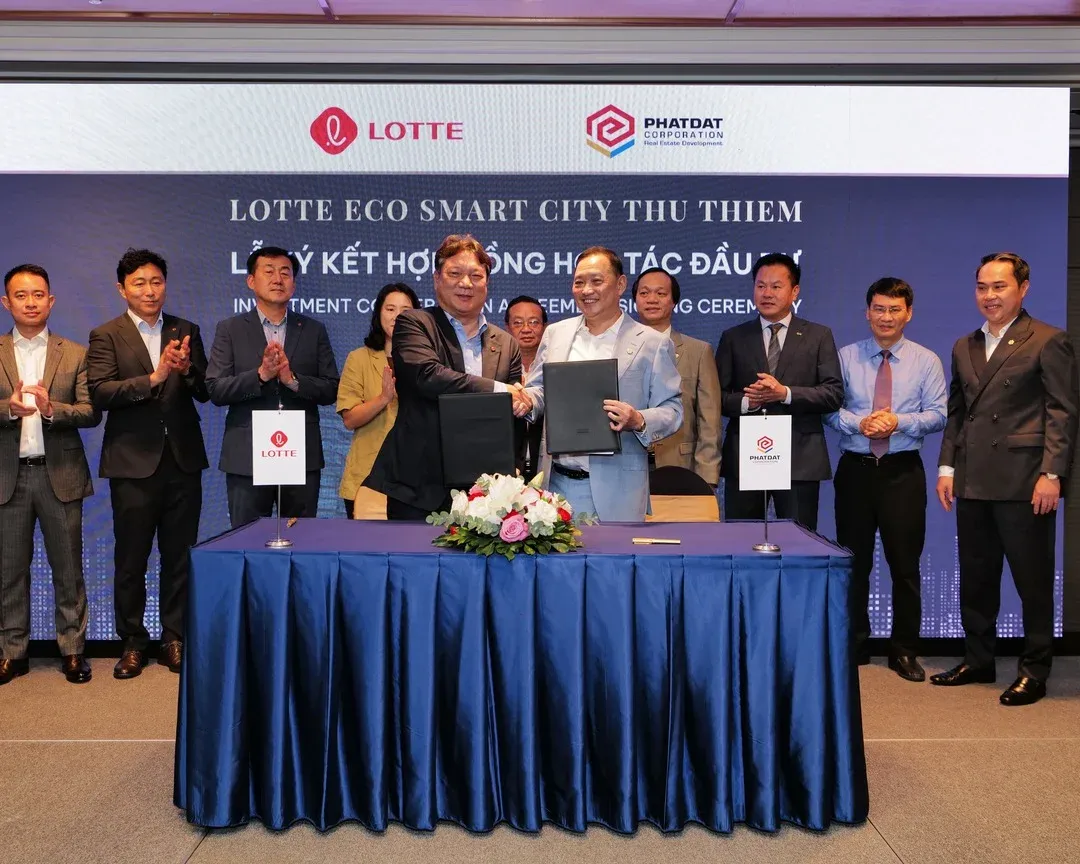

VND 60,000 billion is the kind of number that pulls all the attention into the headline. But in Phat Dat's case, the real story is not the size of that figure. It sits in the layers underneath it: how much of the project the company is actually taking on, what scope of work it has accepted, and what funding structure will carry a development cycle that could run for years.
Read that way, the Lotte deal is not a simple case of "buy into a giant project and wait for the stock to jump." It is a test of co-development capability, capital discipline, and the ability to turn a prime Thu Thiem location into actual cash flow. The core thesis is straightforward: the transaction improves the quality of Phat Dat's story, but that value will only be proven if execution milestones are met.
VND 60,000 billion is not Phat Dat's full economic share
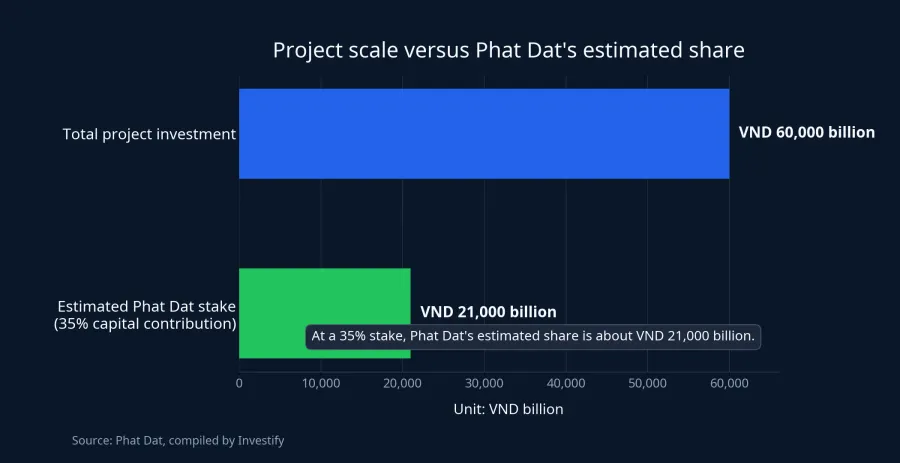
The first step is to separate scale from participation. Phat Dat has entered Lotte Eco Smart City Thu Thiem, a project with an estimated total investment of about VND 60,000 billion, but it is not taking over the entire project.Phát Đạt
According to the company's disclosure, Phat Dat's participation ratio is 35%. If that share is applied to the project's stated total investment, its economic portion could be roughly VND 21,000 billion. That is not the same as cash that must be paid at one time, but it is enough to show why investors should not read a VND 60,000 billion headline as if the entire amount will land on Phat Dat's balance sheet.Phát Đạt
That distinction matters because real estate headlines often create an illusion of scale. The larger the project, the easier it is to jump from "big investment number" to "big profit opportunity." In practice, the upside depends on participation ratio, work scope, legal progress, and how cash flow is shared over the life of the development.
The real value lies in development scope, not just nameplate exposure
Look more closely and this is not a passive capital contribution. Lotte Eco Smart City Thu Thiem sits in functional zone 2A, spans about 7.54 hectares, and covers six land plots in the core of Thu Thiem, which makes it one of the scarcer central-city sites available in Ho Chi Minh City.Phát Đạt
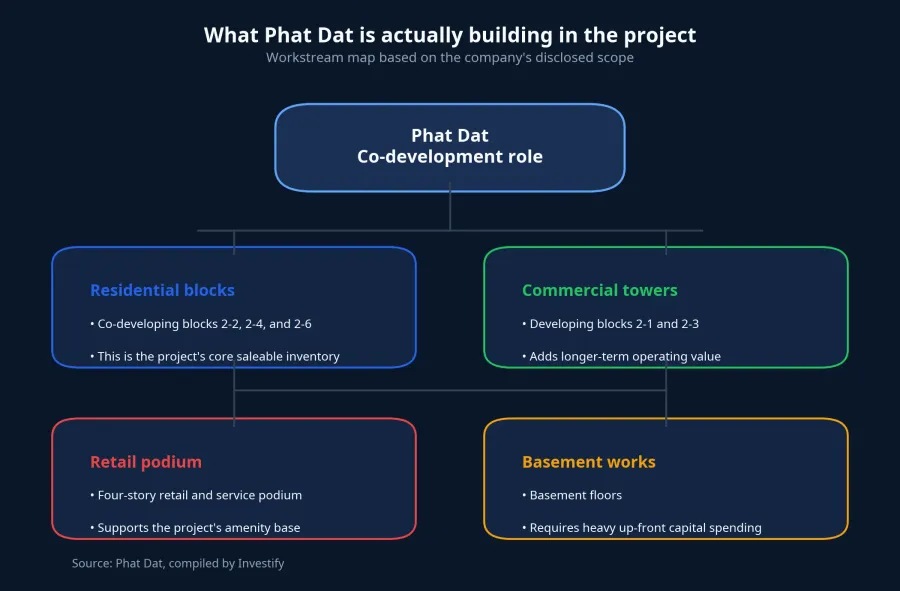
More importantly, Phat Dat is not there just on paper. The company will co-develop the residential component in blocks 2-2, 2-4, and 2-6. It will also develop the commercial towers in blocks 2-1 and 2-3, along with the four-story retail-service podium and the basement works.Phát Đạt
That matters because the company is taking on both saleable inventory and longer-duration value creation within the project. In other words, this is not just about joining a prestigious development. It is about stepping into a much more complex development structure than the market's short-form real estate headlines usually imply.
Funding support helps, but it does not erase risk
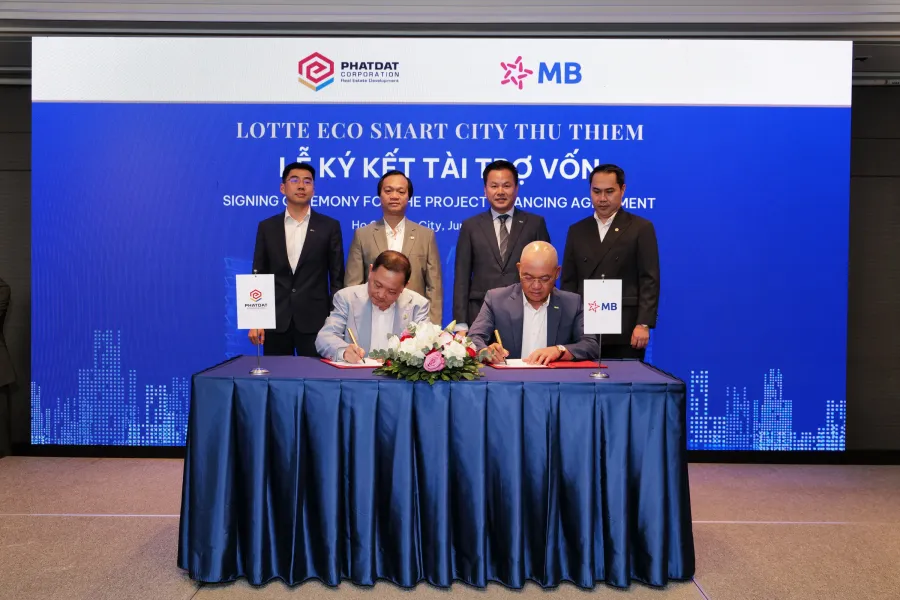
The most constructive piece of the deal is the funding line. On the same day that it signed the investment cooperation agreement with Lotte, Phat Dat also signed a financing agreement with MB Bank. According to the company's announcement, MB Bank will finance the entire capital portion that Phat Dat contributes to the project.Phát Đạt
That is meaningful in large-scale real estate. Prime-city developments usually require heavy front-loaded capital, especially during permitting, basement construction, and early infrastructure works. Once a bank is willing to fund the participation portion, the strain on the developer's own cash becomes less severe, and the market gets an additional signal that the project has moved beyond a ceremonial handshake.
Still, financing support does not make risk disappear. It only changes the shape of that risk. The questions shift from "can the company raise enough money?" to more detailed issues such as disbursement conditions, collateral, funding cost, contribution schedule, and whether the project can generate cash flow on time. For new investors, that is a crucial distinction: a funded path is not the same as near-term profit.
Why the stock has not reacted with immediate euphoria
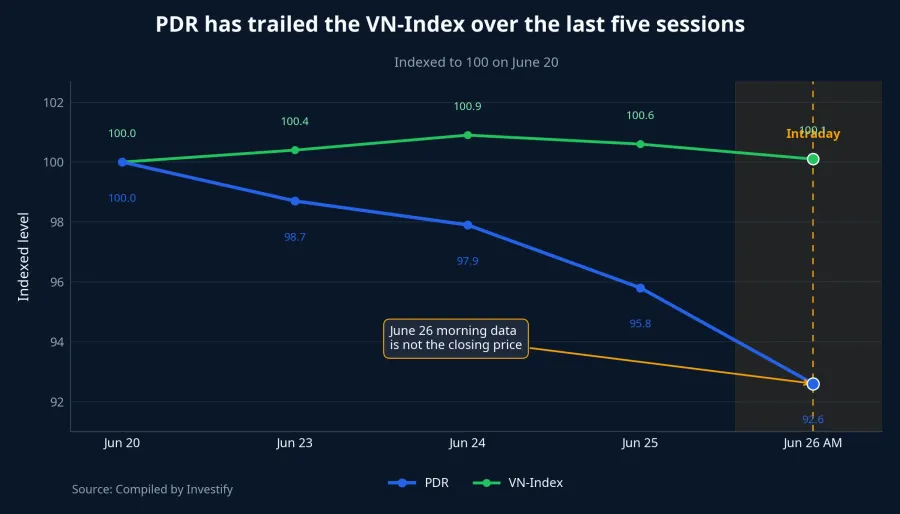
One small but useful clue came from the June 26 morning session. Internal data showed PDR at VND 14,700 per share, down 0.34%, on volume of 1,220,800 shares. At the same time, the VN-Index was at 1,856.61, down 0.35%. A single intraday snapshot is not enough to say the market is pricing the story correctly or incorrectly, but it does remind investors that a large announcement does not automatically convert into immediate buying pressure.
There are at least two reasonable explanations. The first is that the market is being disciplined, recognizing that this is a multi-year story and refusing to pay up immediately for benefits that still sit in the future. The second is that short-term money still prefers catalysts with faster earnings visibility over a transaction that requires many execution steps. With the evidence available so far, the first explanation looks more convincing: the news is genuinely positive, but it is still too early for a meaningful re-rating.
Another notable point is that PDR has underperformed the VN-Index over the last five sessions. That suggests investors are not looking at Phat Dat through the signing ceremony alone. They are still weighing the company's broader context: cash-flow resilience, execution discipline, and whether the new project can move from announcement to measurable progress.
What investors should watch next
Once the headline layer is stripped away, the investment question becomes much clearer. Phat Dat has added a strategically valuable asset in location terms, and it has done so with an international partner strong enough to improve the quality of the company's narrative. But the value for shareholders will not be decided at the signing table. It will be decided by how quickly cooperation turns into execution.
The next checkpoints fall into three groups: legal and design progress, the pace and structure of financing disbursement, and the point at which the project starts producing saleable products or income-generating assets. Each of those matters far more than the VND 60,000 billion headline itself because they show whether the project is moving from expectation into delivery.
For newer investors, this is also a useful template for reading real estate stocks. A large headline can make emotion run ahead of evidence. But once you return to the basics such as participation ratio, work scope, funding source, and the length of the execution cycle, the picture becomes less glamorous and much more reliable.
The right conclusion for now is this: the Lotte transaction makes Phat Dat's story broader and more credible, but it is not enough on its own to justify a durable re-rating. What will prove the value is not the VND 60,000 billion headline. It is whether the company can hit the legal, funding, and execution milestones over the coming quarters.