


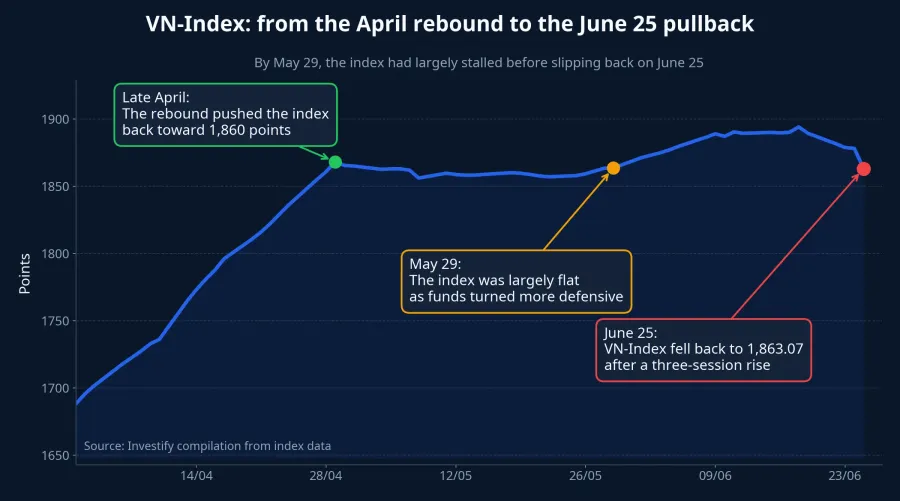
June 25 ended with a visible pullback: the VN-Index fell 14.95 points to 1,863.07, HoSE turnover came in at more than VND 16.1 trillion, and foreign investors were net sellers by roughly VND 1,099 billion across the market.TBTCO If you isolate that single session, it is easy to read it as a sudden reversal. Put it next to May fund data, though, and the cleaner interpretation is that risk appetite had already been fading. June 25 simply made that defensive turn easier to see.
That does not mean funds “knew” the market would fall. That would go beyond what the evidence supports. The June 25 decline also reflected profit-taking near the 1,900 area, weakness in large caps, and foreign selling pressure.TBTCO What fund data can tell us is not where tomorrow’s close will land, but whether professional money has become more cautious about the environment.
Markets do not change character in a single session
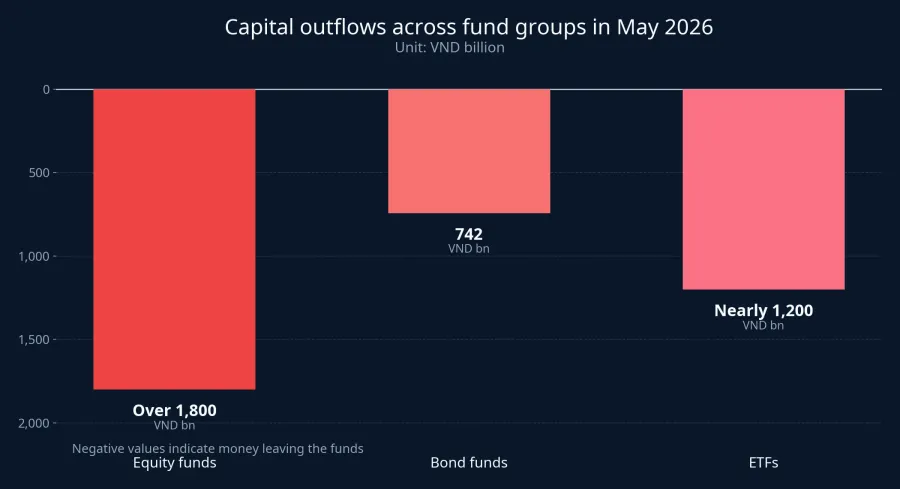
April 2026 still looked like a rebound phase. By May, the quality of fund flows had deteriorated. FiinGroup data showed net withdrawals from investment funds topping VND 2.5 trillion in May, up 59.4% from the previous month. Equity funds alone saw more than VND 1.8 trillion leave, 6.8 times April’s pace and 71.2% of total market-wide fund outflows.Tin nhanh CK
That matters because it says incoming money was no longer strong enough to support broad-based deployment. Once equity funds face sustained redemptions, managers have to think differently. They are not just hunting for good stocks. They also need enough liquidity to meet withdrawals without dumping positions on a weak day. For retail investors, that is the part that often gets missed. Funds do not just invest. They manage daily cash flow risk as well.
By the end of May, total net assets across investment funds had slipped to more than VND 260 trillion, down 2.3% from the previous month, or around VND 6.1 trillion. ETFs alone posted nearly VND 1.2 trillion in net outflows, up 159% month on month.TBTCO When both open-end funds and ETFs lose money at the same time, the market loses another layer of support: fewer patient buyers, while short-term demand is not deep enough to absorb every pullback.
Why equity funds are holding more cash
The mechanism is simple. When performance weakens and investors pull money out, a fund cannot behave the same way it does in a strong tape. FiinGroup said average equity fund performance fell 1.4% in May after gaining 2.2% in April. As many as 70 out of 86 equity funds posted negative returns for the month.Tin nhanh CK
Once losses spread across the category, pressure builds on both sides. Investors stop adding money and may start redeeming. Fund managers, meanwhile, need a bigger liquidity buffer so that withdrawals can be handled without being forced sellers in quality names. In that context, a higher cash balance is not a sign of panic. It is a way to preserve control.
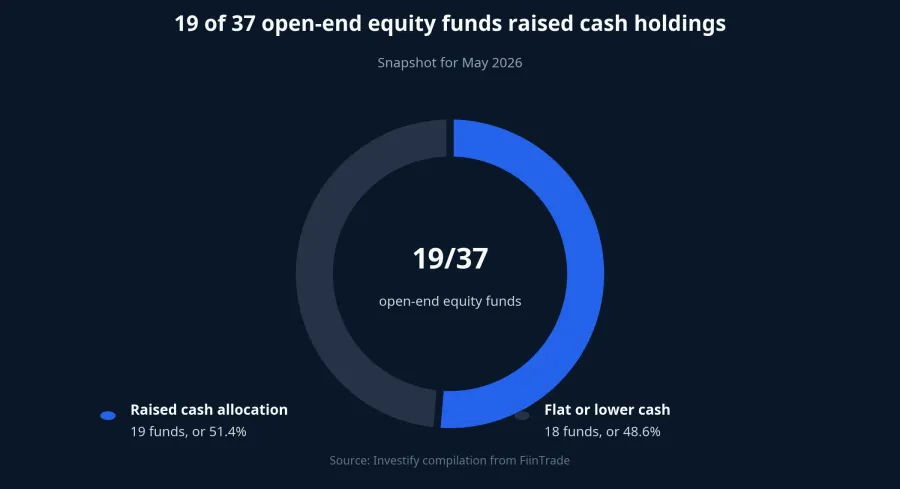
VnEconomy, citing FiinTrade, reported that 19 out of 37 open-end equity funds increased cash holdings in May, reversing April’s more aggressive deployment trend. The shift was concentrated among larger funds with net assets between VND 2 trillion and VND 9 trillion. VinaCapital VESAF, with net assets of more than VND 2.4 trillion, had already raised its cash ratio for three straight months.VnEconomy
The other useful detail is that funds did not stop rotating altogether. Tin nhanh Chứng khoán said VPB, GEX, FPT, VCB and HDB were among the biggest net buys by volume in May, while OCB, MBB, SHS, HVN, STB, VIB, SSI and MWG were among the names seeing reduced weightings.Tin nhanh CK In other words, professional money did not abandon risk entirely. It stopped buying the whole market and became more selective while carrying more cash.
Bond funds are not an automatic safe haven either
Newer investors often treat bond funds as the calm corner of a portfolio. That is only partly true. Bond funds are less volatile than equity funds, but they are not immune to outflows, especially when the yield gap versus bank deposits narrows quickly.
According to FiinGroup, average bond fund performance was 0.42% in May, down from 0.53% the month before. Over the first five months of the year, the group delivered roughly 2.5%, while 12-month deposit rates at state-owned banks had risen to about 5.9% per year.Tin nhanh CK Once the extra return from a bond fund no longer looks meaningfully better, many investors move back to deposits because certainty matters more than a thin pickup.
That helps explain why bond funds still saw more than VND 742 billion in net withdrawals in May, even though the pace was 44.7% lower than the previous month. It was also the ninth straight month of net outflows, bringing the cumulative figure to around VND 13.2 trillion.Tin nhanh CK The lesson is straightforward: “less risky than stocks” does not mean “always attractive to fresh money.” Capital will shift when the alternative looks cleaner.
How retail investors should read the signal
The practical impact is that your return expectations should change before your portfolio does. When more funds are raising cash, ETFs are seeing outflows, equity funds are broadly negative, and market liquidity has not clearly improved, the setup is usually no longer friendly to the kind of phase where almost every entry works. In that environment, the bigger mistake for a retail investor is not missing a short rally. It is using a bull-market playbook after the backdrop has already turned more defensive.

A more disciplined framework is to break the signal into three layers. First, fund flows: are funds still losing money, or are redemptions stabilizing? Second, the defensive structure: is cash inside open-end funds still rising, or has that trend stopped? Third, the underlying market: is HoSE liquidity improving beyond the VND 16.1 trillion seen on June 25, and is foreign selling easing?TBTCO
If those three layers do not improve together, the more coherent stance is still to prioritize risk management over chasing the emotion of each session. That does not mean every stock is broken, and it certainly does not mean a rise in fund cash is a blanket sell signal. The core thesis is narrower than that: the market is in a phase that demands more selectivity, and fund data is one of the cleanest ways for retail investors to recognize when they need to slow down.
For now, the defensive reading still carries more weight than the bullish one. That picture only really softens if ETF outflows ease, open-end fund cash stops climbing, and market liquidity improves in a sustained way rather than bouncing from session to session. Until then, the smarter goal is not to predict tomorrow’s candle. It is to keep portfolio discipline strong enough that you are still in position when stronger money comes back.