

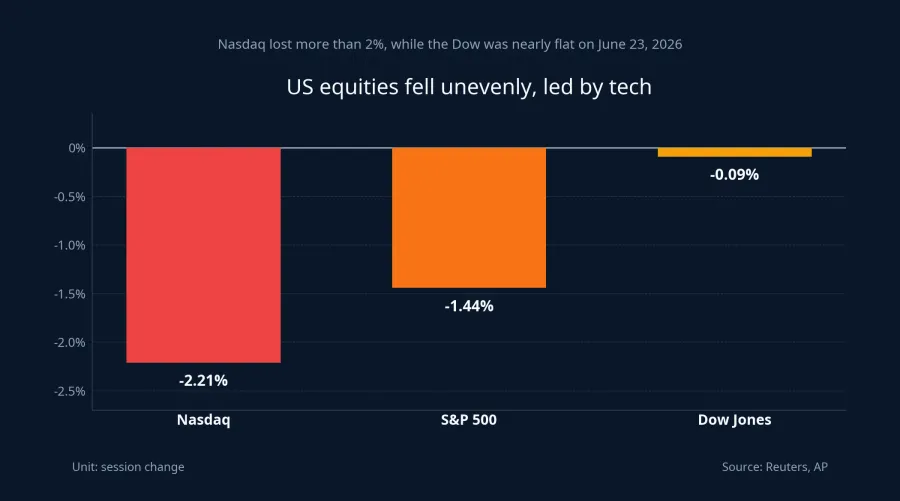
By the close on June 23 in the US, the Nasdaq had fallen 2.21% to 25,587.04, the S&P 500 was down 1.44%, and the Dow Jones slipped just 0.09%. The more important detail was not the headline decline itself, but where the selling landed: squarely in the part of the market that had benefited most from the artificial intelligence narrative.Reuters
The simplest way to read this is that investors are asking a different question now. Earlier in the rally, the market was willing to pay in advance for the promise of future growth. At this stage, the question is no longer whether technology can keep expanding, but whether future revenue will be large enough to justify today's investment bill.
Why this looked like more than routine profit-taking
At first glance, this could still be described as a profit-taking session after an extended run higher. That interpretation has some support, because MarketWatch noted that the S&P 500 information technology sector was still up 16.6% year to date after the June 23 close, while the SOXX semiconductor ETF was still up 100.4%. After gains of that size, some cooling off is entirely normal.MarketWatch
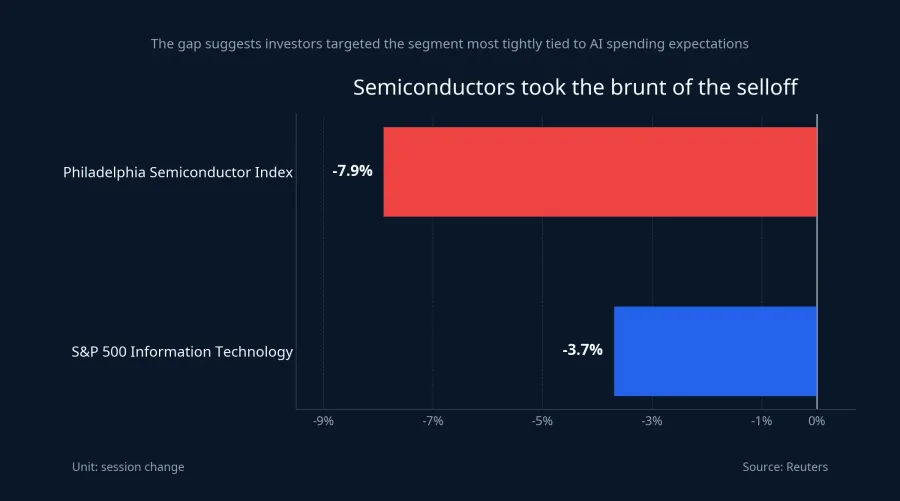
But profit-taking is only part of the story. Reuters reported that the Philadelphia Semiconductor Index dropped 7.9%, far more than the broader market and materially more than the rest of technology. That suggests investors were not simply selling risk at random. They were cutting exposure to the part of the chain most tightly tied to expectations for data center spending, memory demand, and artificial intelligence infrastructure.Reuters
That distinction matters for newer investors. Profit-taking usually means prices moved too far, too fast, and traders are locking in gains. A deeper repricing begins when the market starts to question whether future earnings can actually catch up with the valuation already embedded in those stocks.
Why semiconductors were hit first
In the artificial intelligence boom, semiconductors are where the story becomes tangible. Large models require data centers, and data centers require processors, high-speed memory, networking gear, power, and cooling. When investors believe that build-out will keep accelerating, chipmakers tend to command the richest valuations in the market.
The reversal can happen just as quickly. Once investors begin to suspect that capacity expansion is running ahead of the real economic payoff, semiconductor stocks are usually the first to be marked down. Reuters framed the concern around AI infrastructure spending rising very quickly, with some of that spending tied to debt and to assumptions that future revenue will eventually absorb today's costs.Reuters
The stock-level moves made that point even clearer. Nvidia fell 4.1%, while Intel, Marvell Technology, and AMD were down in a range of 5.8% to 9.4%. Micron and SanDisk each lost about 13%, and AP put Micron's decline at 13.2%, placing it among the session's biggest losers.ReutersAP
Why Micron became the nearest-term test
Micron does not stand in for the entire semiconductor industry, but it occupies a sensitive place in the chain. DRAM, NAND, and especially HBM are essential to artificial intelligence data centers. That is why Micron is being treated as one of the closest real-time checkpoints for whether visible revenue is catching up with the market's expectations.
Micron said it would report fiscal third-quarter results after the US market close on June 24, with its investor call scheduled for 2:30 p.m. Mountain Time, or 4:30 p.m. Eastern Time. The timing matters because it places Micron's report almost immediately after the selloff, turning it into a near-term test of demand in the artificial intelligence hardware stack.Micron IRMicron IR

It is worth avoiding an easy overreach here. Micron's drop does not prove that the artificial intelligence trade is over, and it does not prove that every semiconductor stock has been mispriced. What the market is doing right now is checking whether orders remain strong, margins are holding up, and management teams are confident enough to keep their outlook intact.
If Micron's report shows that memory demand tied to artificial intelligence servers is still healthy, current worries may end up looking like a sharp but temporary reset after a powerful rally. If inventories build, customers turn more cautious, or guidance weakens, June 23 will look more like the opening move in a broader repricing. That is the line between a rough session and a genuine change in how future growth is valued.
Three signals retail investors should watch
The first signal is earnings guidance from semiconductor companies themselves. Stock prices can swing violently in a single session, but sustained confidence still depends on revenue and margin durability. If several companies start lowering expectations at the same time, the market will read that as more than a passing sentiment wobble.
The second signal is the paying power of the large customers building data centers. This is ultimately a cash-flow question. If the biggest cloud platforms keep investing and still generate enough operating cash to support that build-out, the growth story retains its foundation. If capital spending expands faster than measurable economic benefits, investors will demand a steeper discount across the chain.
The third signal is the breadth of the selloff. If only a handful of overheated names are hit, that usually points to short-term cooling. If pressure spreads from memory to processors, networking equipment, data center infrastructure, and related software, the message is bigger: confidence in the entire artificial intelligence complex is being marked down.
What this means for fund and ETF investors
For Vietnamese investors reaching the US market through funds or ETFs, the real lesson is not about calling a bottom in Nasdaq after one or two sessions. The more useful lesson is concentration risk. A fund basket with heavy exposure to semiconductors and infrastructure can surge when the theme is being rewarded, but it can also become much more volatile when the market starts to question how durable that theme really is.
The most coherent conclusion for now is that Wall Street has not walked away from artificial intelligence. It has simply moved into the phase where the bill has to be justified. June 23 looks more like a test of real revenue, customer spending power, and the pace of capacity expansion than proof that the entire theme has broken. The key signals to monitor over the next few sessions are Micron's report, guidance from other companies in the chain, and the market's reaction to any evidence that spending is moving faster than measurable economic returns.