


The sharp pullback in early June exposed something many first-time investors tend to miss: all of these products are called gold, but they do not lose money in the same way. Holders of SJC gold bars, gold rings and investors who only track global bullion prices are standing in three different risk positions. Treating them as one trade leads to the wrong conclusion.
That distinction matters because gold is often framed as a safe place to park money. But "safe" does not mean every gold-linked product reacts the same way to the same shock. For SJC, this week's move involved two simultaneous pressures: weaker global gold prices and a narrowing domestic premium. Gold rings also fell, but their pricing structure is different.
The first hit came from the U.S.
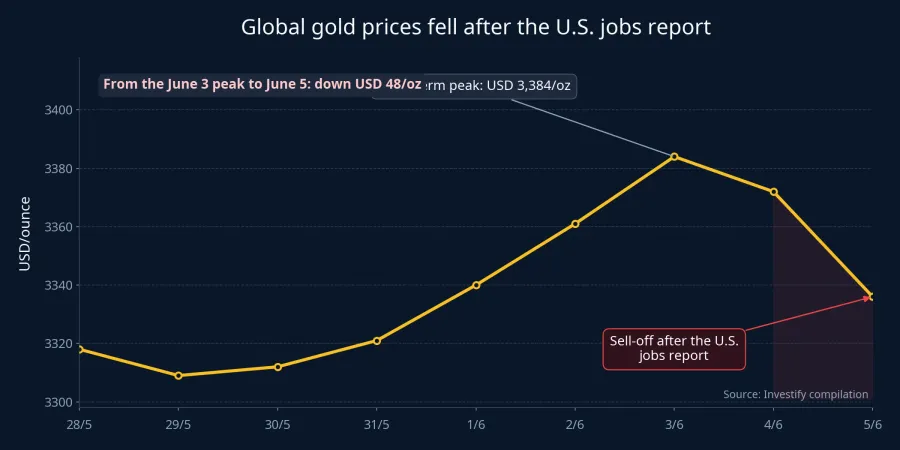
In plain terms, the move started with U.S. labor data. According to Thanh Niên, U.S. nonfarm payrolls rose by 172,000 in May, above the Reuters survey estimate of 85,000, while the unemployment rate held at 4.3%.Thanh Niên
For newer investors, the link between U.S. jobs data and gold can sound abstract. In practice, the mechanism is straightforward. When the labor market stays firm, the Fed has less reason to cut rates quickly. That keeps Treasury yields elevated, supports the U.S. dollar, and makes gold less attractive because bullion does not generate income.
Reuters, as carried by Kitco, said spot gold fell 2.4% on June 5 to USD 4,365.93/oz in morning New York trading.Kitco Investify's internal data also show world gold ending June 5 at USD 4,417.10/oz, down 1.29% from the prior day. On the morning of June 6, Người Lao Động reported that global gold closed the week near USD 4,330/oz, down USD 146/oz, while the U.S. 10-year Treasury yield briefly touched 4.55% and the dollar index traded around 100.Người Lao Động
The point is not any single number in isolation. What matters is the chain reaction: stronger-than-expected jobs data reduced hopes for early Fed easing, which pushed yields higher and put direct pressure on gold.
For SJC, global gold is only half the story
If the analysis stops at the U.S. rate story, it misses the key issue for SJC holders. Domestic SJC gold usually trades above the implied local price of world gold. That premium is its own pricing layer, shaped by branding, supply conditions and the structure of Vietnam's gold market. When the premium shrinks, SJC holders are hit not only by falling bullion prices but also by the compression of that extra domestic markup.
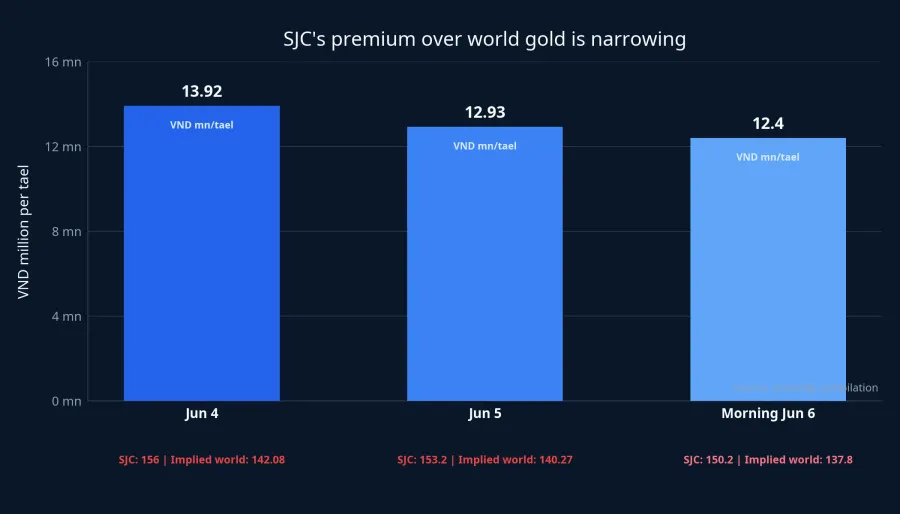
The numbers make that clear. On June 4, Investify's internal data put world gold at USD 4,474.89/oz. Using a USD/VND exchange rate of 26,335.5, the implied local price was about VND 142.08 million per tael, while SJC's selling price was VND 156 million per tael. That left a premium of about VND 13.92 million per tael.
On June 5, world gold fell to USD 4,417.10/oz, the USD/VND rate moved to 26,340, and the implied local price slipped to roughly VND 140.27 million per tael. SJC's selling price fell to VND 153.2 million per tael, narrowing the premium to around VND 12.93 million per tael. By the morning of June 6, the SJC selling price had dropped again to VND 150.2 million per tael, while Người Lao Động said the implied world-gold price was around VND 137.8 million per tael, leaving a premium of about VND 12.4 million per tael.Người Lao Động
That is why the current SJC move is a two-layer risk event. Layer one is the global gold decline triggered by the U.S. jobs shock. Layer two is the compression of the domestic premium. For investors who bought SJC at elevated levels, that difference matters because a world-gold chart alone understates the actual damage.
Gold rings also fell, but their risk structure is different
This is where new investors often make the wrong shortcut. When both SJC and gold rings fall, it is tempting to assume they are essentially the same product with different branding. They are not. Gold rings still react to world gold, but their domestic pricing layer is typically different from SJC bars, so the decline does not have to travel through the same premium channel.
On June 5, Investify's internal data showed SJC gold rings selling at VND 151.5 million per tael, VND 1.7 million below SJC bars. On the morning of June 6, Người Lao Động reported that 99.99% gold rings and jewelry were trading around VND 146 million per tael bid and VND 150 million per tael offered.Người Lao Động That means gold rings still fell hard, but they were not necessarily absorbing the same pace of premium compression as SJC bars.
That does not make gold rings "safer" in any absolute sense. It simply means holders face a different pricing structure. They still carry world-gold risk, still face bid-offer spreads, and still depend on brand-specific pricing. What they do not automatically carry is the same domestic premium profile as SJC bars.

The buy-sell spread is the cost many beginners forget
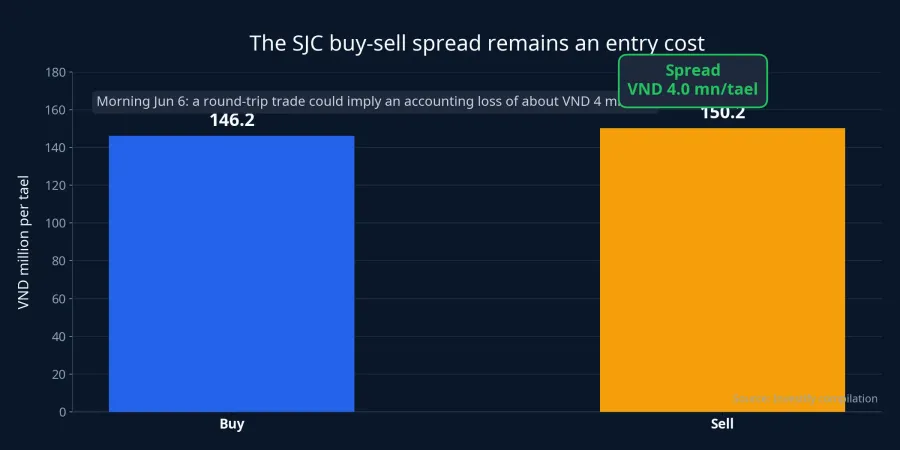
Another risk that gets overlooked is the spread between bid and offer prices. Thanh Niên reported that on the morning of June 6, SJC was quoted at VND 146.2 million per tael bid and VND 150.2 million per tael offered, implying a VND 4 million per tael spread.Thanh Niên
Put simply, a buyer who enters and exits immediately can lock in a sizable accounting loss even if the market price does not fall further. This is not a forecast risk. It is an upfront cost embedded in the trade. For first-time investors who treat gold as a cash-storage tool, the spread needs to be treated as part of the entry conditions, not as a minor detail.
That is why reading a gold sell-off properly requires separating at least three layers: how world gold is responding to yields and the dollar, whether SJC's domestic premium is compressing quickly or slowly, and how wide the trading spread is at the moment of entry. Ignore one of those layers, and the buying decision becomes easy to misjudge.
What to watch next week
For global gold, the first variables remain U.S. Treasury yields and the dollar. If incoming economic data keep the market leaning toward higher-for-longer rates, gold could stay under pressure. If yields cool, bullion may regain some short-term support.
For SJC, the more important question is whether the gap versus implied world gold keeps narrowing or begins to stabilize. If world gold goes sideways while SJC continues to slide, that usually signals further compression in the domestic premium. If global gold rebounds but SJC recovers more slowly, the market is also telling you that the old premium may not snap back quickly.
For gold rings, the key indicators are their selling price relative to SJC and the bid-offer spread at each brand. They are not a pure copy of world gold, but they also do not carry the same layered risk profile as SJC. Using one framework for all three products will cause new investors to misread both the real drawdown and the real entry point.
The conclusion is fairly direct: these are all gold products, but they should not be read through the same signal. For SJC, the current setup is a two-layer risk event, and the domestic premium is the part most investors are likely to underestimate. The main signals to monitor over the next one to two weeks are whether U.S. yields cool and whether the gap between SJC and implied world gold stops narrowing.