

Vietnam's seafood story is getting better on paper, but the stock market is not treating the sector as one block. In the first five months of 2026, seafood exports reached USD 4.67 billion, up 11% from a year earlier. The catch is that the strongest lift came from China and Hong Kong, while the US and the EU are still acting as clear pressure points for exporters.VASEP
The easiest way to read that is to stop treating the industry's top-line number as the whole story. A sector average can improve even when only part of the field is actually benefiting. For investors, the real question is not whether exports are up, but which markets are driving the increase, which product lines are benefiting, and which listed companies can turn that demand into margins rather than just revenue.
Orders are rotating toward Asia
For years, investors looked first at the US, the EU and Japan when judging Vietnam's seafood exporters. Those were the premium, more established end markets, and holding share there usually signaled both pricing power and compliance strength. In 2026, the map looks different.
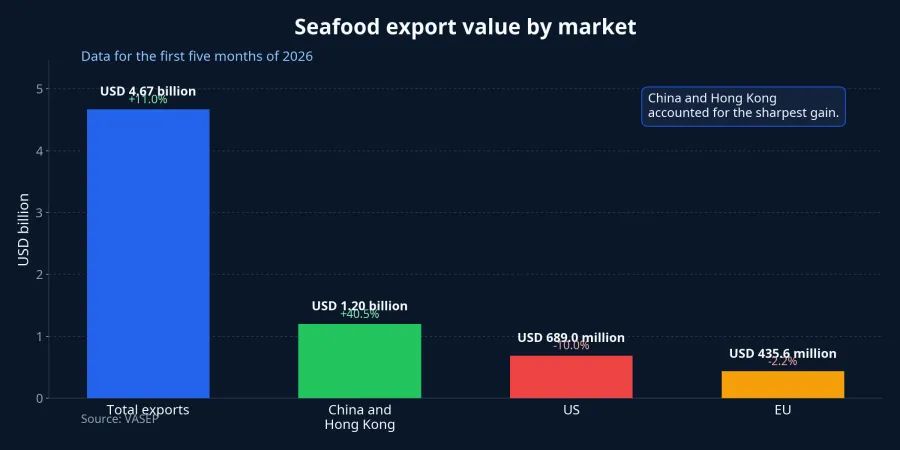
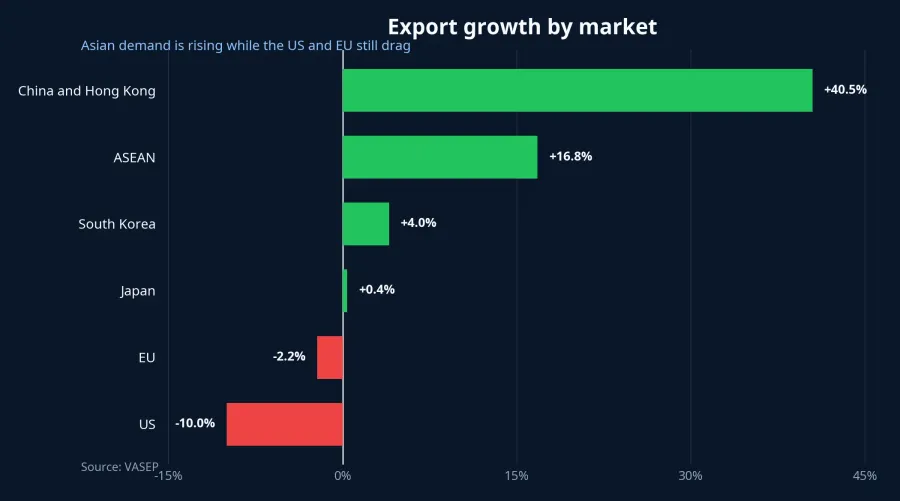
China and Hong Kong generated USD 1.20 billion in the first five months, up 40.5% year on year. By contrast, exports to the US fell 10% to USD 689.0 million, while the EU slipped 2.2% to USD 435.6 million. Japan was nearly flat with 0.4% growth, South Korea rose 4%, and ASEAN gained 16.8%.VASEP
That shift matters because a rebound concentrated in Asia will not flow evenly across all exporters. Companies with customer relationships, distribution channels and product mixes that match Asian demand are more likely to see the revenue benefit earlier. Companies still leaning heavily on the US or Europe may face a slower recovery because weaker orders usually mean more pressure on pricing, inventory and working capital turnover.
The rebound is coming from different product stories
Shrimp remains the sector's largest pillar. In the first five months of 2026, shrimp exports reached USD 1.90 billion, up 11.5% and accounting for roughly 40.4% of total seafood exports. The improvement was supported by better demand in parts of Asia, stronger processed product orders and lobster shrimp demand from China.VASEP
But a better shrimp export number does not automatically mean cleaner profit growth. Shrimp is still a competitive category on price, and processors remain exposed to raw material costs, logistics and trade-defense risks. That means companies with deeper processing capability or better control over raw supply may convert the same export tailwind into very different earnings outcomes.
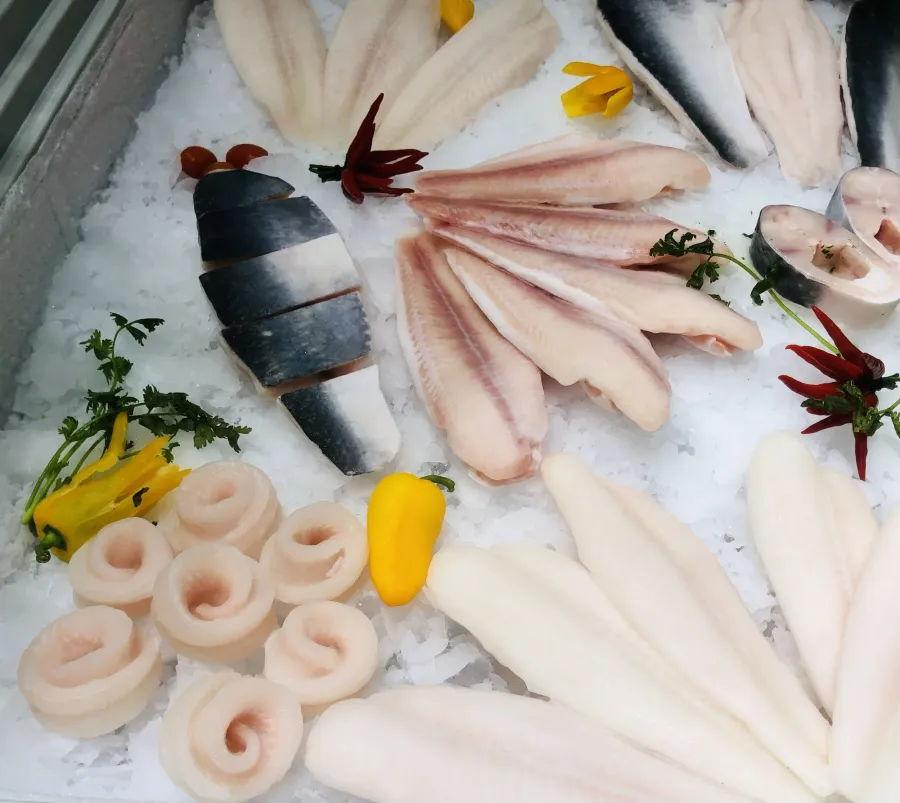
Pangasius is improving for a different reason. Exports reached USD 905 million, up 12.6% from a year earlier. In a market where buyers are paying more attention to affordability, pangasius still has an edge as a lower-cost whitefish option, which makes it well suited to customers that are trying to manage food budgets more tightly.VASEP
That is why shrimp and pangasius should not be rolled into the same investment expectation. Shrimp can benefit when processed demand improves and buyers accept better pricing. Pangasius can hold up when customers need a cheaper protein source without cutting seafood purchases altogether. Both are constructive stories, but they do not favor the same business models at the same time.
Not every category is participating equally. Tuna exports fell 6% to USD 372 million. Squid and octopus reached USD 304 million, up 18%, while crab and other crustaceans rose 19% to USD 160 million, and shellfish climbed 22.8% to USD 122 million.VASEP
The broader point is that the seafood rebound is not one clean wave lifting all boats. It looks more like demand moving through several channels at once, with different product groups responding to different customer needs. Investors who read the sector that way are less likely to mistake a stronger headline number for a uniform earnings recovery.
Faster demand does not mean easier compliance
One easy mistake is to assume that stronger Chinese demand means an easier export market. It does not. VASEP says China is moving more firmly toward formal import channels, with tighter requirements on quality, biosafety, exporter registration, farming area codes and traceability. Order 280 took effect on June 1, 2026, replacing Order 248.VASEP
For listed companies, that means a fast-growing market is not necessarily an easy-profit market. If an exporter cannot keep up with documentation and traceability standards, revenue may arrive more slowly or margins may thin out under compliance costs. In the same demand environment, companies with cleaner supply chains, clearer farming records and stronger quality control should be better protected.
The US remains difficult because of tariffs, trade-defense measures, traceability and strict import rules. The EU is still centered on illegal fishing controls, traceability and sustainability standards. Those frictions do not immediately erase the sector's recovery, but they do shape which companies can defend orders and which ones may need to sacrifice margin just to keep customers.VASEP
Why seafood stocks are not moving together
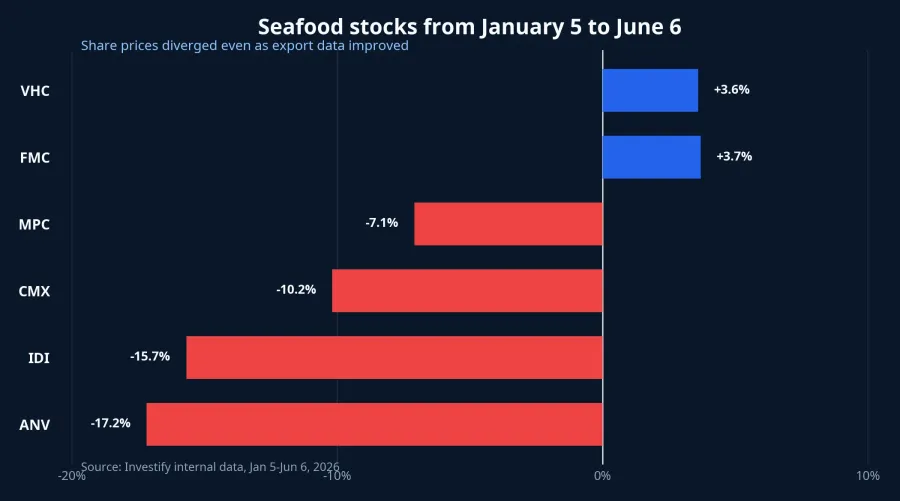
If exports are recovering, it is tempting to expect a broad rally in seafood shares. The market is rarely that forgiving. From January 5 to June 6, 2026, VHC rose about 3.6% and FMC gained about 3.7%, while ANV fell around 17.2%, IDI dropped roughly 15.7%, MPC lost about 7.1% and CMX declined around 10.2%.
Those price moves do not prove one single driver, and they should not be over-read as a simple split between good companies and bad companies. Valuation at the start of the year, earnings expectations, liquidity, stock-specific issues and broader market sentiment all matter. What the tape does show is that investors are not buying the whole seafood complex just because sector exports are back in growth mode.
This is exactly where newer investors often get trapped. They hear that seafood exports are recovering and assume seafood stocks should move together. In practice, the market wants evidence that each company can convert orders into profit. A business that wins more Asian volume but gives up pricing to keep customers may still be less attractive than one growing more slowly while preserving margin and cash generation.
So the more useful question is not whether the sector is “good.” It is where a company is selling, what it is selling and how much it keeps after compliance, raw materials and logistics. That is a much better framework for a fragmented phase, where one industry narrative can produce six very different price outcomes.
What matters in the second half
VASEP expects Vietnam's seafood exports in 2026 to rise about 8-10% and surpass USD 12 billion if China holds up, pangasius keeps its pricing advantage, shrimp improves competitiveness and wild-catch seafood exporters ease bottlenecks around input certification, traceability and illegal-fishing controls. That is a conditional forecast, not a guaranteed line of travel.VASEP
The other side of the story is still important. If compliance costs, logistics pressure and raw material shortages remain elevated, second-half growth could slow, especially for shrimp, tuna, squid, octopus, crab and other wild-catch products. In other words, the easy part of the rebound may already be visible, while the harder part is proving that stronger orders can translate into sustainable margins.VASEP
The most defensible conclusion here is that the export recovery is real, but the benefits should remain uneven across listed companies. The core thesis is not simply that seafood is improving. It is that demand has rotated toward Asia while compliance requirements are getting tighter, and companies that cannot defend margin in that setup may still struggle to win stock market conviction.
The three signals worth tracking over the next few weeks are whether demand from China and Hong Kong stays firm, how listed exporters report second-quarter margins, and how exposed each company remains to the US and Europe versus Asia. Those are the triggers that will separate businesses genuinely benefiting from the order recovery from those merely borrowing the sector's headline story.