


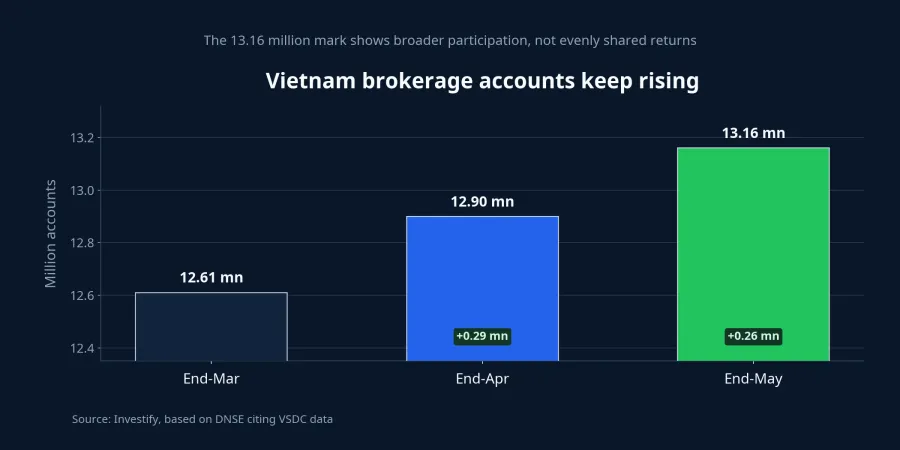
The jump to nearly 13.16 million brokerage accounts sounds like the kind of milestone that should make the market feel easier. On the surface, it says more people are opening the first door into equities. But opening an account is not the same as walking into a market where gains are broadly shared, especially for first-time investors.
That distinction matters because beginners often use a simple mental shortcut: if more people are joining, opportunity must be widening, and if the index is up, their portfolio should be up too. The market action in May, and again on June 5, suggests otherwise. In a market where money is moving selectively, account growth says something about participation, while returns still depend on where capital is actually concentrating.

What 13.16 million accounts do and do not tell you
According to DNSE, citing VSDC data, Vietnam's stock market had nearly 13.16 million trading accounts by the end of May, up by more than 256,200 from the end of April. Domestic individual investors alone added more than 255,700 accounts, lifting their total to more than 13.09 million.DNSE
In plain terms, that tells us equities are reaching further into everyday personal finance. Opening an account is easier, the cost of getting started is lower, and more households are at least willing to try the market. That is a healthy sign for market penetration, but it does not mean profit opportunities are evenly distributed across the tape.
Accounts measure how many people are standing at the market's entrance. Returns are determined by what is happening inside the market once those people arrive. The two are connected, but they do not move at the same speed. A month that adds hundreds of thousands of new accounts can still be a month when investors who bought the wrong pocket of the market feel stalled or underwater.
Why a rising index can still leave portfolios behind
The easiest trap for new investors is the way VN-Index works. It is a market-cap-weighted index, which means the largest stocks carry the most influence. If a small cluster of heavyweight names rises enough, it can keep the benchmark green even when much of the market underneath is doing very little.
Put differently, VN-Index tells you the water level at the lake, while each investor stands in a different current. The surface may still look calm and slightly higher than yesterday, but the current where you are standing may already be weakening. If a portfolio leans toward mid-caps, small-caps, or stocks outside the favored leadership groups, the mismatch becomes obvious very quickly.
That is not a beginner's failure of judgment. The real issue is using the headline index as a direct mirror for a personal account. In a concentrated tape, the mirror still reflects the market's broad outline, but it does not fully reflect the lived experience of holding a specific basket of stocks.
May showed that market health was not spreading evenly
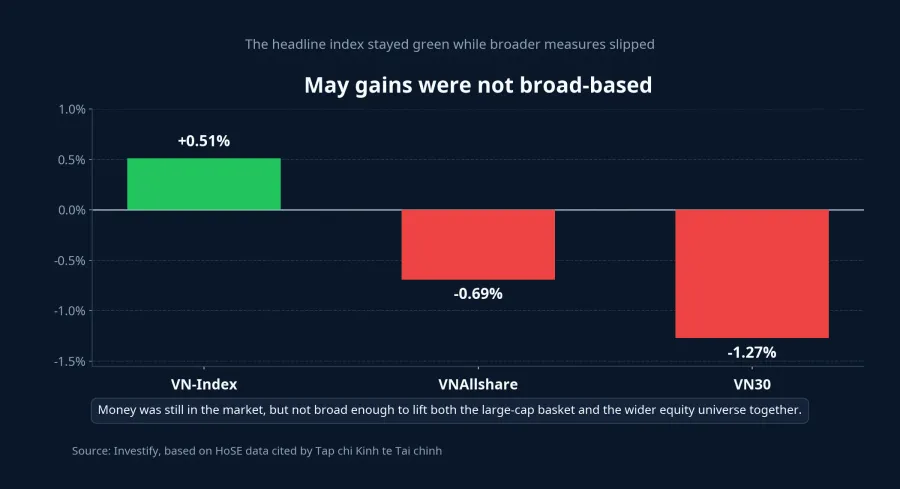
Based on HoSE statistics cited by Tap chi Kinh te Tai chinh, VN-Index ended May at 1,863.49 points, up 0.51% from the previous month. Over the same period, VNAllshare fell 0.69% and VN30 dropped 1.27%.TCKTTC
The key takeaway is not whether 0.51% is a big move. The key takeaway is that the headline benchmark stayed positive while broader gauges softened. For new investors, that is a crucial distinction: there were buyers in the market, but not enough broad participation to lift the average stock in a meaningful way.
Sector performance told the same story. In May, energy rose 9.76%, utilities gained 6.86%, and financials advanced 1.38%. On the other side, consumer discretionary fell 5.42%, information technology declined 5.18%, and construction materials lost 4.44%.TCKTTC If a portfolio sat in the losing side of that split, the phrase "the market is up" would have felt detached from the investor's actual P&L.
Another point that matters is that liquidity did not disappear in May. Average daily equity trading value was above VND 24,343 billion, up 1% from April, while average trading volume slipped 2.49%. Foreign investors were also net sellers of more than VND 18,991 billion during the month.TCKTTC
That combination suggests money was still active, but it was not showing up everywhere at once. Capital tends to move first into the most liquid names, the clearest narratives, or the sectors with the strongest short-term leadership. For beginners, this is where "money is entering the market" can be mistaken for "the stocks I own will be lifted too."
June 5 repeated the same lesson on breadth
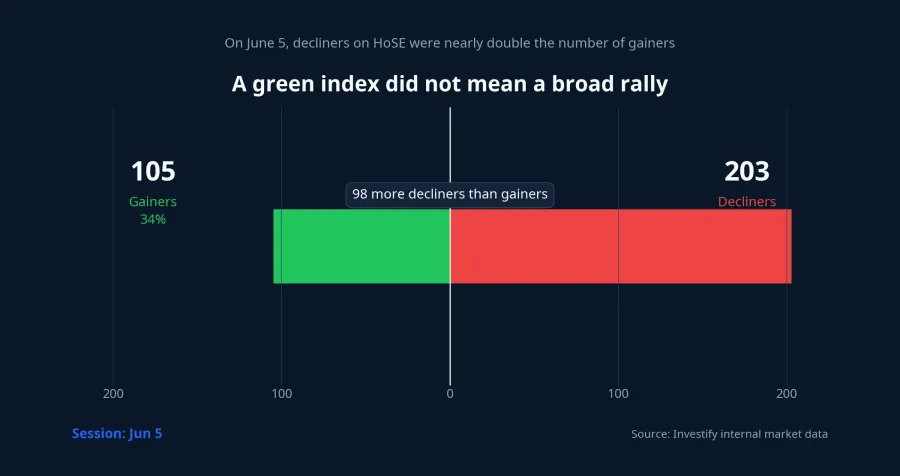
The divergence between the index and portfolio experience was still visible on June 5. Investify's internal market data showed VN-Index closing at 1,838.90, up 0.40% on the day. But even in that positive session, HoSE recorded only 105 gainers against 203 decliners.
That statistic matters more than the surface-level index move because it speaks directly to market breadth. If decliners are close to double the number of gainers, the green close is not a broad advance. It is more likely a session where one slice of the market was strong enough to support the benchmark while the majority of stocks remained under pressure or short of follow-through demand.
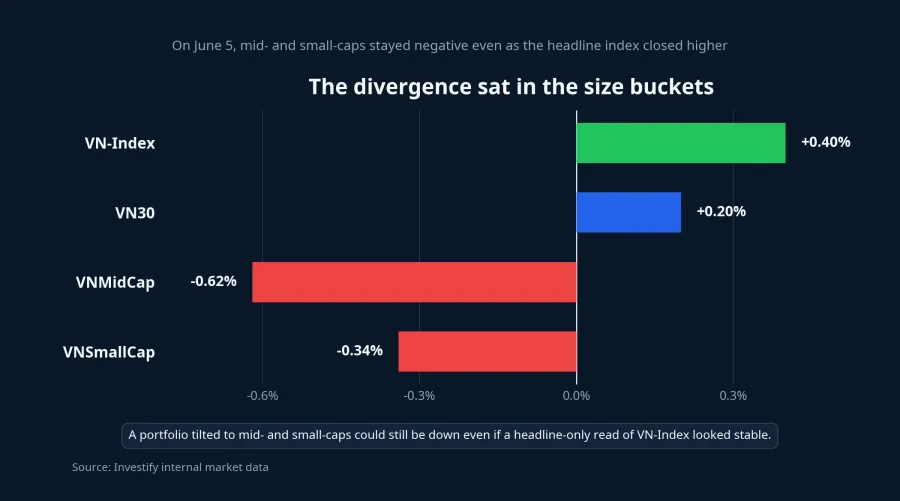
The split becomes even clearer when viewed by size bucket. On the same day, VN30 rose only 0.20%, while VNMidCap fell 0.62% and VNSmallCap lost 0.34%. That means a portfolio tilted toward mid- and small-cap names could still end the day in the red even if the headlines described the market as stable.
That is why many first-time investors feel out of sync just after opening an account or raising exposure. They step in while the market still looks green at the surface, but real money is flowing through only a handful of liquidity pools. If they buy into a story that is circulating in the weaker parts of the tape, their experience can diverge sharply from the tone of the daily recap.
What beginners should watch beyond VN-Index
If you focus on only one number, it is very easy to buy the feeling of safety instead of the market's actual condition. A more useful framework is to put VN-Index next to three questions. Is breadth tilted toward gainers or decliners. Are mid-caps and small-caps moving with the benchmark or against it. Is money spreading across sectors or clustering in a narrow set of leaders.
In practical terms, do not stop at asking whether the market is up. Ask which part of the market is up, where your portfolio sits inside that structure, and whether the advance is spreading beyond the heavyweights. Those questions sound basic, but they help new investors avoid one of the most common mistakes in a concentrated market: assuming a rising benchmark should automatically produce the same result in a personal portfolio.
The core thesis here is straightforward. The market is attracting more people, but that does not mean opportunity is being shared more evenly. As long as breadth stays weak and mid- to small-cap stocks keep lagging the leadership groups, VN-Index should be treated as the starting point for reading the tape, not the final answer on portfolio health. The signals worth monitoring over the next few sessions are whether breadth improves in a durable way and whether money begins to spread from the index leaders into the rest of the market.