

When an index fund gets close to $1 trillion in assets under management, the headline is not the most important part of the story. The bigger point is why so much money keeps flowing into a product that promises little beyond tracking the market itself. In VOO’s case, the appeal is straightforward: buy America’s largest listed companies in one trade, keep fees extremely low, and let time do more of the work.Crypto BriefingDaily Upside
Why money keeps finding VOO
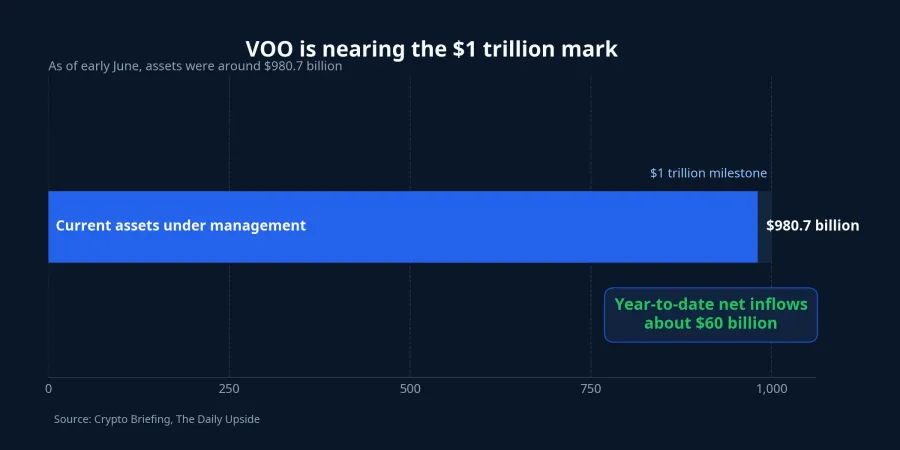
As of early June, VOO was sitting around $980.7 billion in assets, just below the $1 trillion threshold that no ETF had crossed before. It had also pulled in about $60 billion in fresh money since the start of 2026. Put together, those figures show that the story is not only about rising stock prices. Investors are still adding new capital to the fund at a very large scale.Crypto BriefingDaily Upside
The mechanism is easy to understand. A growing share of investors no longer wants to beat the market by picking the right handful of names. They want exposure to the best-known part of the U.S. equity market with as little decision fatigue as possible. For beginners, that behavioral advantage matters because the fewer predictions a product demands, the easier it is to stay disciplined through volatility.
Simplicity works better when costs stay low
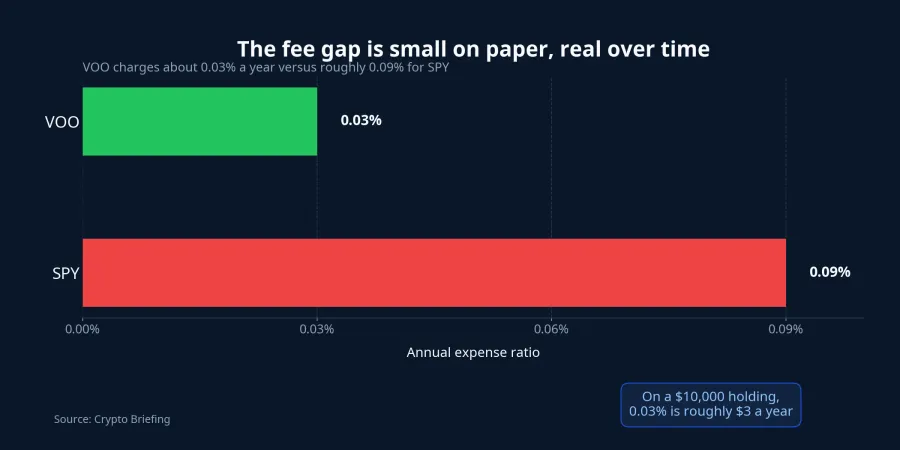
Part of VOO’s appeal is that the running cost is tiny. Crypto Briefing notes that the fund charges about 0.03% a year, versus roughly 0.09% for SPY. The gap looks small in a single year, but over a long holding period, lower fees mean less return leaking out of the portfolio.Crypto Briefing
This is exactly the kind of detail new investors tend to ignore because it does not feel urgent in the way a sharp rally or a dramatic earnings report does. But index funds are not selling a promise to identify the next superstar stock. They are selling lower friction, lower cost, and a disciplined way to capture the market’s broad result over time.
Seen that way, VOO is not really a bet on clever fund management. It is a bet that reducing costs and reducing unnecessary decisions can improve investor behavior.
Diversification does not mean equal risk
This is where many first-time investors misunderstand index funds. A portfolio can hold hundreds of stocks and still lean heavily on a handful of giants, because VOO tracks the S&P 500 on a market-cap-weighted basis. The larger the company, the larger its weight in the fund. So you are not buying 500 companies with equal influence. You are buying a portfolio where the biggest names matter far more than the smallest ones.
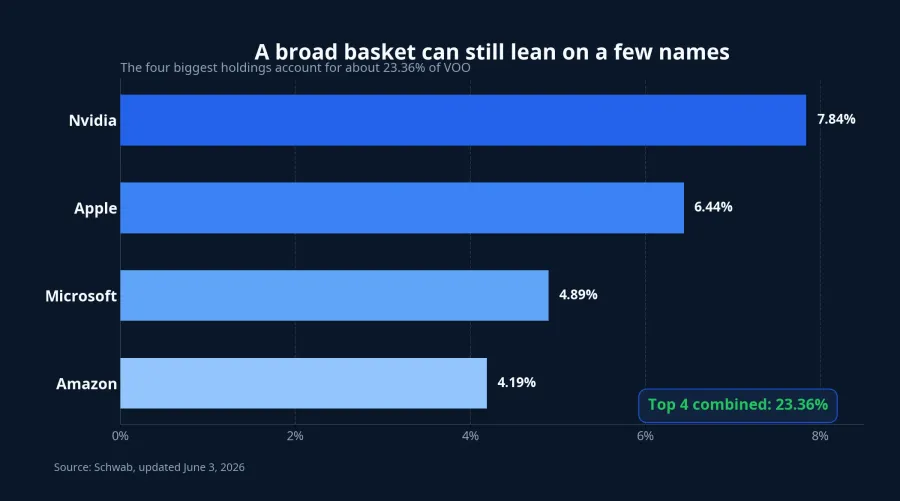
According to Schwab’s June 3 update, VOO’s four largest holdings, Nvidia, Apple, Microsoft, and Amazon, together account for about 23.36% of the portfolio. Nvidia alone is around 7.84%, while Apple is about 6.44%. That is enough to make the fund meaningfully sensitive to whatever happens in mega-cap technology leadership.Schwab
That does not make VOO a flawed product. It simply means investors should not confuse broad ownership with evenly distributed risk. If mega-cap tech keeps leading, the fund benefits. If that group comes under pressure, the fund will feel more of that pressure than the phrase “I own the whole market” may suggest.
This is an important distinction for beginners. Index funds reduce single-stock selection risk, but they do not remove concentration risk when the market itself is top-heavy.
A down day is enough to remind investors what an equity ETF is
Even with strong long-term inflows, an equity ETF is still an equity product. On June 3, the S&P 500 fell 0.7% and the Nasdaq Composite dropped 0.9% after a run of gains. One session does not break the long-term case for index investing, but it does remind buyers that an equity ETF is not a capital-protection tool. It rises and falls with the market it is built to track.AP
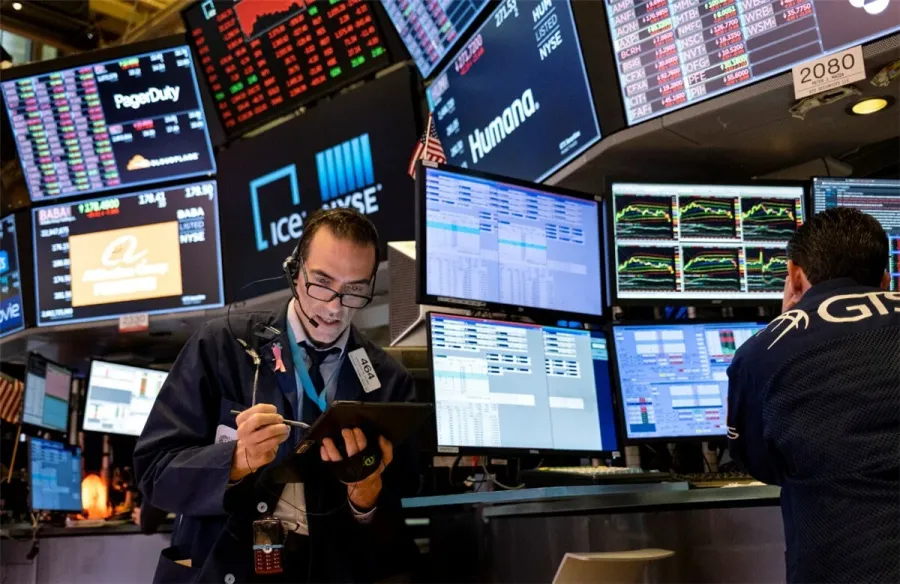
That distinction matters in practice. Buying the fund can reduce stock-picking mistakes, but if U.S. equities sell off broadly because of rates, geopolitics, or a reset in technology valuations, the fund will fall with them. What you own is a market-tracking machine, not a shield against every drawdown.
What Vietnamese investors should take from this
The real lesson is not that every investor should now find a way to buy VOO. The lesson is how to read a fund before putting money into it. Which index does it follow? How is that index weighted? What does it cost? Where are the largest holdings? Those questions are more useful than simply looking at recent performance and assuming the best-performing fund will keep outperforming.
The same logic applies in Vietnam. A local equity fund may hold many tickers and still lean heavily toward banks, technology, or property. A bond fund may sound steadier than an equity fund, but its actual risk still depends on duration, issuer quality, and redemption mechanics. Once investors learn to read a fund as a capital-allocation mechanism, the phrase “fund investing is safer by default” becomes much easier to challenge.
That leads to a clear conclusion. Simplicity is a genuine advantage, but only if investors understand what is being simplified. VOO is attractive because it removes a lot of stock-picking effort and keeps costs very low. It does not turn the stock market into a low-risk product, and it does not make the influence of mega-cap companies disappear.
Three signals are worth watching from here: whether fresh inflows stay as steady as they have been so far this year, whether the weight of the largest technology names keeps expanding, and whether any U.S. market pullback broadens beyond a few short-term sessions. For beginners, understanding those signals matters more than trying to guess whether VOO will close green or red tomorrow.