


The VN-Index has now fallen for six straight sessions, closing at 1,826.47 points after losing 18.07 points on June 2. If you only look at the headline index, the instinctive conclusion is that money is leaving the market altogether. But that is not the most useful read right now. The more important signal is that market breadth has clearly deteriorated.
June 1 and June 2 looked similar on the surface, yet they told two different stories underneath. On June 1, the VN-Index also lost nearly 19 points, but gainers still outnumbered losers in ACBS data and in Investify's internal HOSE breadth data.ACBS By June 2, that changed sharply: only 90 stocks advanced while 244 declined. In plain English, this is no longer just weakness in a few large-cap names. Selling pressure has spread to a much broader portion of the board.
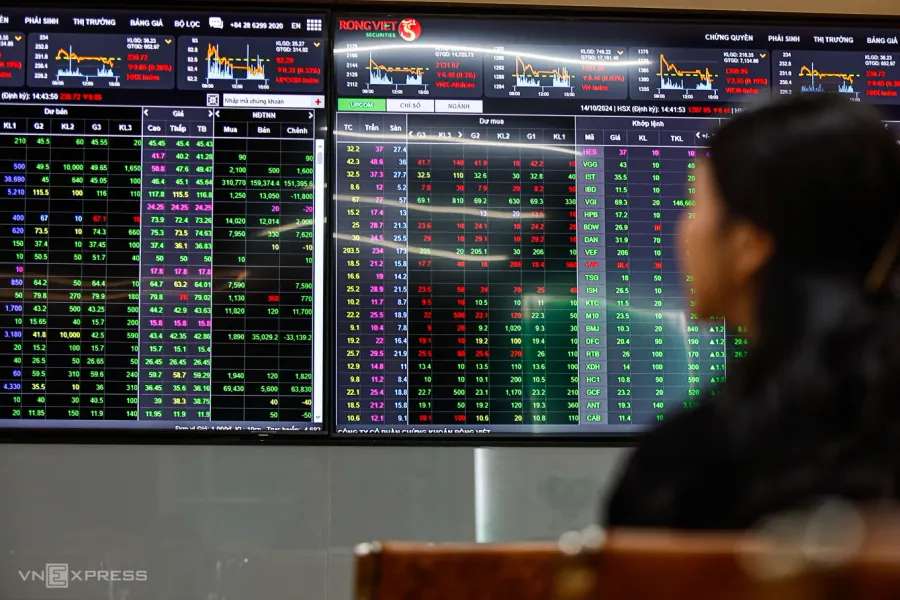
Why an index drop does not always mean money has left
The simplest way to think about it is this: the VN-Index is not an equal-weight count of every stock in the market. A handful of very large companies carry far more influence than the rest, so when those names come under pressure, the benchmark can fall hard even if many other stocks are still holding up. That is why reading the index without reading breadth can lead to the wrong conclusion.
June 1 is the clearest example. ACBS said the VN-Index fell 18.95 points, yet gainers still outnumbered losers in its market review.ACBS Vietstock Daily made the same point from another angle, describing the selling pressure as concentrated in large-cap stocks while mid-cap and small-cap names kept a healthier tone.Vietstock Daily That tells us money had not disappeared from the market. It was simply avoiding the part of the market under the heaviest stress.
What pulled the benchmark lower on June 1
When you want to understand why the index fell, start with the names that carry the most weight. On June 1, VIC, VHM and GAS fell 3.03%, 2.56% and 3.66%, respectively. Those three moves alone were heavy enough to put meaningful pressure on the VN-Index, even if the broader market was not uniformly weak.
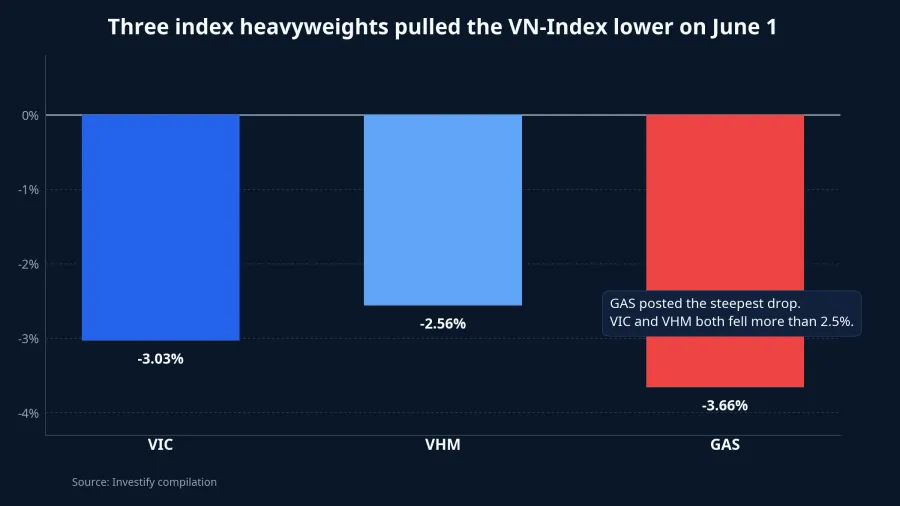
This is where many inexperienced investors get misled. They see an 18-point loss in the benchmark and assume most portfolios must have suffered the same damage. In reality, anyone holding stocks outside the heavyweight cluster may have had a much milder session.
ACBS and Vietstock Daily both support that reading: the main drag came from large-cap stocks.ACBSVietstock Daily So the correct takeaway was not that "the market has broken." The more accurate takeaway was that "the index was being pulled lower by heavyweights, while broader selling had not fully arrived yet." Those are two very different setups for the next session.
From avoiding the heavyweights to broader selling pressure
June 2 is the more important session to study. The VN-Index slid again to 1,826.47 points, but this time breadth no longer leaned in favor of buyers. With 90 advancers against 244 decliners, the ratio was weak enough to say that selling pressure had spread beyond the heavyweight group.
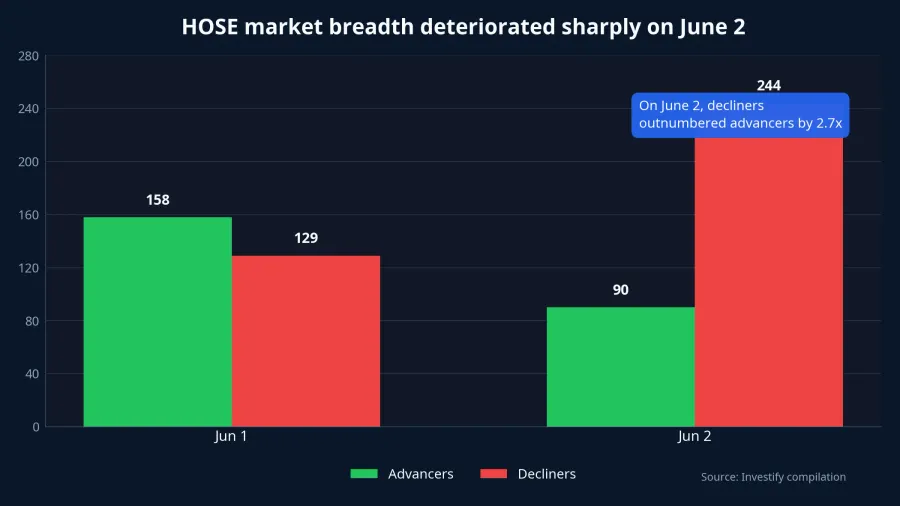
That shift matters because it changes the character of the pullback. If June 1 was a session where the headline index looked bad but the broader market had not yet cracked, June 2 moved into a tougher state: the index was weak and the wider market was weak as well. Two sessions with similarly large point losses can still carry very different messages.
Where money is still holding up
That said, it is still too early to say that money has abandoned the entire market. Some names and sectors continue to show better resilience than the average stock. FPT is the clearest example over the past two sessions, rising 1.82% on June 1 and another 2.61% on June 2. That tells us money is still selective, even if the list of safe havens is shrinking.
On June 1, ACBS said buying interest was concentrated in retail, technology, electronics and electrical equipment. MWG rose 3.67%, FPT gained 1.82%, and GEE advanced 2.84% in that session.ACBS Brokerage names also offered a few bright spots, with VND up 4.15% and VIX up 1.13%. Those numbers explain why the June 1 sell-off did not feel like indiscriminate liquidation.
By June 2, however, that support group had narrowed. FPT still gained 2.61%, but MWG fell 1.52%, VND lost 2.28%, and VIX dropped 2.79%. In other words, even the stocks that had been helping stabilize the tape were no longer moving in sync.
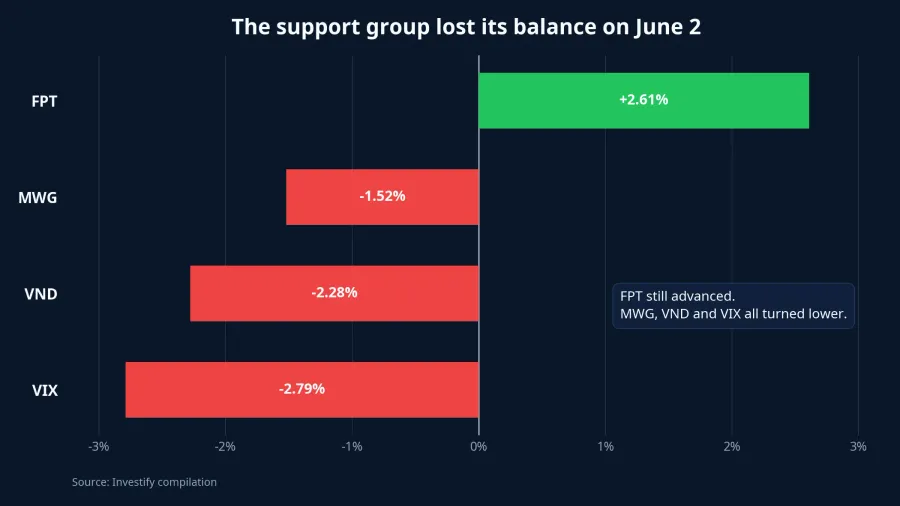
That is another important lesson for newer investors. One strong stock does not mean an entire sector is strong. When the green zone shrinks to just a few standout tickers, the market is usually still in a stress test rather than in a convincing rebound phase.
What turnover says about the quality of the decline
Breadth should also be read together with turnover. ACBS said trading value on June 1 came in at VND 15,129 billion, down 23.09% from the previous session.ACBS Vietstock Daily also said matched volume on HOSE was only about 432 million shares, down 22.3% session over session.Vietstock Daily
Lower turnover during a down session where breadth has not fully broken often suggests that sellers have not yet forced a market-wide unwind. But once we move into June 2, higher volume alongside heavily negative breadth needs to be read more carefully. If turnover rises while losers dominate the board, that is not yet a healthy signal for the broader market.
What to watch in the next session
The bigger picture is that the market has shifted from a benchmark decline led by heavyweights to a decline with broader participation. That is the central thesis here: the point loss alone is no longer a sufficient signal, because what now matters most is whether breadth can recover alongside the index. If breadth does not improve, a technical green day in the VN-Index would not tell us much.
That leaves two signals worth watching next. First, do the heavyweight stocks stop dragging the benchmark lower. Second, do advancers begin to regain a clear edge over decliners. If only the first happens, the index may look less ugly while the average portfolio still struggles. If both happen together, that would be the first early sign that money is trying to build a new rotation.
The concise conclusion is this: after six straight down sessions, the real warning is not just how many points the VN-Index has lost, but that weakness has started to spread across the board. That does not mean all money is gone, because names like FPT are still holding up. But until breadth improves in a visible way, the safer reading is to watch the ratio of gainers to losers before taking comfort from the color of the benchmark itself.