


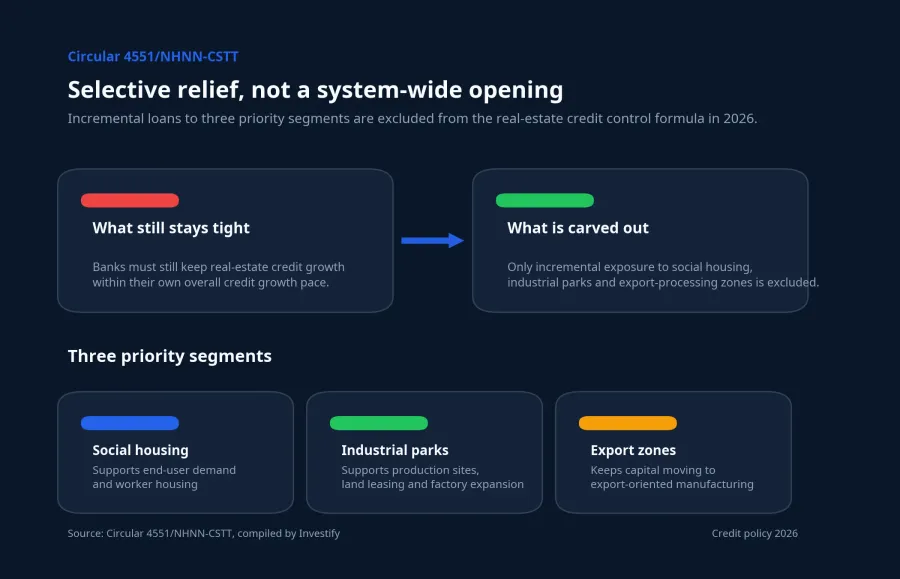
One circular can produce two very different market reactions. Circular 4551/NHNN-CSTT does not throw open the gates for the entire property sector. It only removes the incremental loan balance for social housing, industrial parks and export-processing zones from the real-estate credit control formula for 2026.DĐDN
For newer investors, that detail matters more than the headline. "Credit easing" sounds like a broad-based positive for property stocks. In practice, banks do not lend based on a narrative. Capital moves fastest into projects that already have paperwork, execution progress and a visible commercial endpoint.
That leads to a clear thesis for this post: industrial parks can react faster than social housing, not because policy favors them more, but because more projects in that segment are ready to absorb capital. Social housing still fits the policy direction, but the path from policy support to actual cash deployment usually includes more operational bottlenecks.
What the circular opens, and what stays tight
The most important phrase in the policy is "incremental." Circular 4551 excludes only the increase in loan balances versus the end of 2025 for the three priority segments from the property-credit control formula. The measure applies from January 1, 2026 through December 31, 2026.DĐDN
That also means the broader control framework is still in place. Based on reporting by Diễn đàn Doanh nghiệp from Circular 11686/NHNN-CSTT, banks must still keep real-estate credit growth from exceeding their own overall credit growth. If they fail to comply, their annual credit-growth quota can still be reduced.DĐDN
In plain English, this is a re-routing mechanism, not a sector-wide removal of guardrails. Social housing is tied to end-user demand. Industrial parks and export-processing zones are tied to production, employment and exports. The rest of the property market remains inside the same control zone as before.
The scope also matters. The article says 25 credit institutions are covered, but it only lists part of the group, including VietinBank, Agribank, BIDV, Techcombank, MSB, Sacombank, ACB, OCB, VietABank, PGBank and Eximbank.DĐDN Investors should not assume that every bank has the same room or the same implementation speed.
The size of the credit base explains why policymakers are taking the selective route. According to figures cited by Diễn đàn Doanh nghiệp, total outstanding credit in the economy exceeded VND 19.4 quadrillion as of April 28, 2026, up 4.42% from the end of 2025. Outstanding credit tied to real-estate business activity reached approximately VND 2.235 quadrillion as of February 28, 2026, up 11.7% from the fourth quarter of 2025 and 43% year over year.DĐDN
Once the credit pool is that large, the gap between "broad easing" and "conditional easing" is not semantic. It determines whether money flows into end-user housing and production infrastructure, or circles back into segments with weaker long-term capital absorption.
Why industrial parks can move first
If the question is which segment can turn policy into disbursement fastest, industrial parks start with a practical edge. A project with cleared land, infrastructure close to completion, signed tenants or at least clearly visible tenant demand gives a bank much more to underwrite.
Banks do not read a policy the same way stock traders read a ticker. They look at lease contracts, site-preparation progress, utilities and expected project cash flow after operations begin. If those elements are already in place, the excluded incremental credit can become a genuine implementation advantage almost immediately.
That is also why not every industrial-park stock should be treated the same way. A developer with a large land bank but unresolved legal work cannot turn a policy circular into revenue. By contrast, a company already close to the execution stage can benefit earlier because new lending may accelerate infrastructure work, land handover or lease signing.
Share prices should be treated as a secondary signal. At the end of the week, KBC closed at VND 30,500 per share and IDC at VND 43,400. Those levels do not suggest a market-wide burst yet, which gives investors time to watch whether liquidity, leasing updates and project progress actually validate the story.
Why social housing is unlikely to match that pace
Social housing is also inside the priority bucket, but its operating equation is more complex than loan limits alone. Project supply, buyer eligibility, local approvals, developer margins and documentation readiness all shape whether money can move. That is why a slower reaction in social housing would not contradict the policy's supportive intent.

Per Nhịp Sống Nhà Đất, citing SBV data, total outstanding loans under the social-housing program had only reached about VND 41,000 billion by mid-March 2026. Of that, more than VND 25,000 billion sat at the Vietnam Bank for Social Policies, while commercial banks accounted for just over VND 16,000 billion.Nhịp Sống
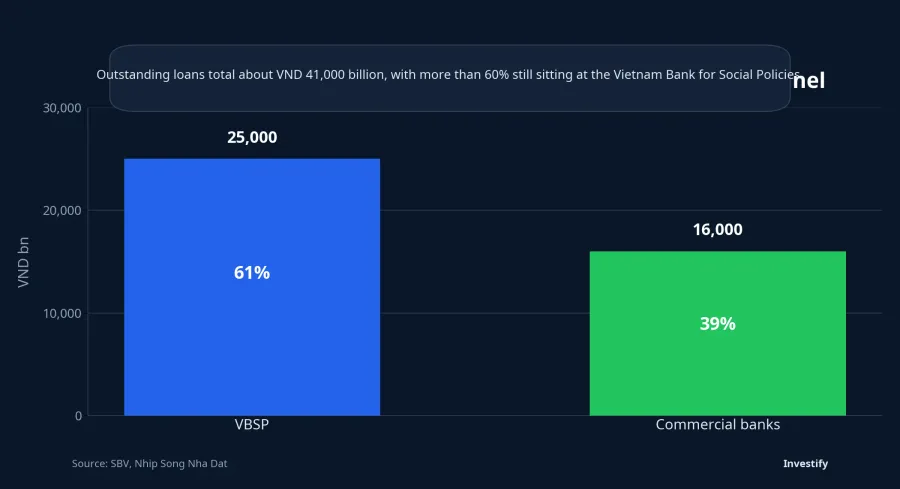
Those numbers explain why social-housing credit still lacks strong momentum. More than 60% of the balance remains in the policy-banking channel rather than the commercial system. Demand is clearly there, but the process of scaling the segment through mainstream banking is still slower than the market often assumes.
This is also where investors are most likely to confuse policy support with immediate earnings impact. Stocks linked to social housing can rally quickly on the message that the segment is being favored. But if a project is not yet eligible for sale, cannot identify qualified borrowers, or is still stuck in land and local approvals, additional bank room does not translate into immediate disbursement. That is the difference between a policy story that sounds attractive and a business story that is ready to show up in reported numbers.
What to watch next week
In the near term, the key question is not which group spikes first on the screen. It is which group starts to show evidence that actual disbursement is beginning. For industrial parks, stronger signals would include new lease contracts, infrastructure progress updates or clearly identified funding tied to a specific project.
For social housing, the more credible markers sit in the documentation trail. Investors should watch which projects are placed on eligible lending lists, which banks announce specific lending packages, and which provinces clear procedures so projects can start, launch sales or hand over units to the right buyers. Without those signals, a share-price jump is still more likely to be sentiment than cash deployment.
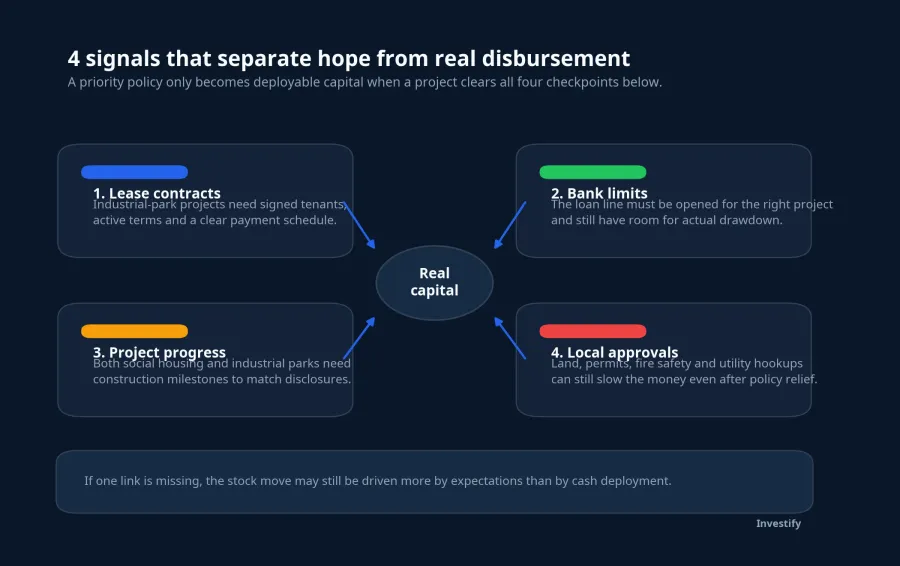
The broader market backdrop makes that distinction more important. VN-Index ended the week at 1,863.49, essentially flat. In a market that still lacks a strong index-wide trend, policy news can send capital hunting for a fresh narrative very quickly. But narrative leadership and earnings delivery are rarely synchronized.
The short conclusion is straightforward. Circular 4551 creates a wider lane for priority credit, but it does not remove property-market controls. Industrial parks have a better case for moving first because many projects only need additional funding to speed up execution. Social housing remains a valid long-term policy direction, but turning that support into revenue and cash flow requires several more checkpoints.
Over the next one to two weeks, the key question is whether either segment starts to show fresh evidence of real disbursement. Until that happens, the two priority buckets are still not standing on the same starting line.