

Three resignation letters on the same day. That is not how a routine personnel change unfolds at a bank operating in a stable phase. On May 26, 2026, Eximbank announced it had received resignations from Đào Hồng Châu, Deputy CEO of Vietnam Export-Import Commercial Bank (Eximbank, EIB); Nguyễn Hồ Hoàng Vũ, Deputy CEO and Chief Financial Officer; and Nguyễn Hướng Minh, Deputy CEO, all submitted on the same date.VnExpress The bank described the departures as part of a streamlining effort under its 2026–2030 strategy. That explanation may hold a grain of truth. But for a bank with a long history of boardroom power struggles, three simultaneous resignations deserve more than a surface reading before being written off as routine restructuring.
The Management Team Contracts: Seven Down to Four
Following these departures, Eximbank's management team will consist of just four people: Acting CEO Trần Tấn Lộc, two remaining deputy CEOs Phạm Quang Dũng and Nguyễn Văn Hòa, and Chief Accountant Lã Quang Trung. Châu and Vũ are expected to leave effective June 1, 2026; Minh will step down on July 15, 2026 to allow time for handover.MekongASEAN
It is worth noting that both Châu and Vũ had nearly 30 years of tenure at Eximbank, having survived multiple previous leadership upheavals. Minh has held the deputy CEO position since 2018. These are members of an old guard who outlasted many prior power shifts. That all three would exit on the same day, in the middle of a deep restructuring, rarely results from an orderly, pre-scheduled transition plan. Generational change at the management level is not inherently problematic. The question worth asking is why it happened simultaneously.
Acting CEO for Nearly a Year, No Formal Appointment in Sight
Eximbank is not just short on deputy CEOs. The bank has been operating under an "acting CEO" arrangement for close to twelve months. Trần Tấn Lộc was appointed Acting CEO on July 1, 2025, following the resignation of his predecessor.Tuổi Trẻ To date, the CEO position has not been formally filled.
In Vietnamese banking, "acting" and "formally appointed" carry meaningfully different weight. An acting appointment typically signals that the board has not yet reached the consensus needed to submit a candidate for State Bank of Vietnam (SBV) approval, or that potential candidates do not yet meet regulatory criteria. All key management positions at commercial banks require SBV clearance before taking effect. Nearly a year without closing this process is a signal about internal stability, not just a procedural footnote.
What the official announcements do not spell out: with three deputy CEOs departing on the same day, Acting CEO Trần Tấn Lộc must now run the bank with the thinnest management team in years, while his own "acting" designation remains unresolved.
Gelex and the Shifting Power Structure
Behind the executive suite lies a changing shareholder picture. As of January 15, 2026, Gelex Group held approximately 10% of Eximbank's charter capital, equivalent to nearly 187 million EIB shares. This is the highest stake among private institutional shareholders, and it equals precisely the ceiling that the 2024 Law on Credit Institutions sets for any single legal entity's ownership in a bank.VietnamBiz
Gelex's CEO, Nguyễn Văn Tuấn of Công ty CP Tập đoàn Gelex (GEX), stated that he would not personally join Eximbank's board of directors, while leaving open the possibility of raising Gelex's stake to 15% if regulations allow.CafeBiz That said, Nguyễn Trọng Hiền, former Chairman of Gelex, has been elected as an independent board member at Eximbank. The Gelex camp is not sitting in the executive suite, but it has a presence in the boardroom through a trusted representative.
Add one more detail: on March 25, 2026, Eximbank officially relocated its headquarters from Ho Chi Minh City to 27–29 Lý Thái Tổ Street, Hoàn Kiếm District, Hanoi, precisely where the new shareholder group is based.Nhịp Sống Kinh Doanh Each of these three signals has a standalone business explanation. Taken together, they point to a reordering of the bank's center of gravity, unfolding at the same time as the old management layer exits.
Earnings Declining Alongside the Leadership Shuffle
The personnel disruption is arriving as financial performance trends downward. Return on equity (ROE) fell from 13.99% in 2024 to 6.23% for the first nine months of 2025.Eximbank In Q1 2026, pre-tax profit came in at approximately VND 338 billion, down sharply by 59% year-on-year, driven primarily by a significant increase in credit loss provisions to approximately VND 319 billion.BaoMoi
At the 2026 Annual General Meeting, Eximbank set a full-year profit target of over VND 1,515 billion and resolved to retain all 2025 profits — paying no dividend — to strengthen its capital buffer.CafeF Withholding dividends is a defensible choice during a restructuring cycle. But with Q1 profit at approximately VND 338 billion, there is a substantial gap between the current run-rate and the full-year target, set against a backdrop of a management team that has just become significantly thinner.
Market Reaction Muted, But the Risk Is Real
EIB closed the May 26 session at VND 21,550, virtually unchanged from the prior session (+0.23%), on volume of just over five million shares. Against the peak around VND 23,600 reached in late March, the share price has retreated roughly 8.7%.
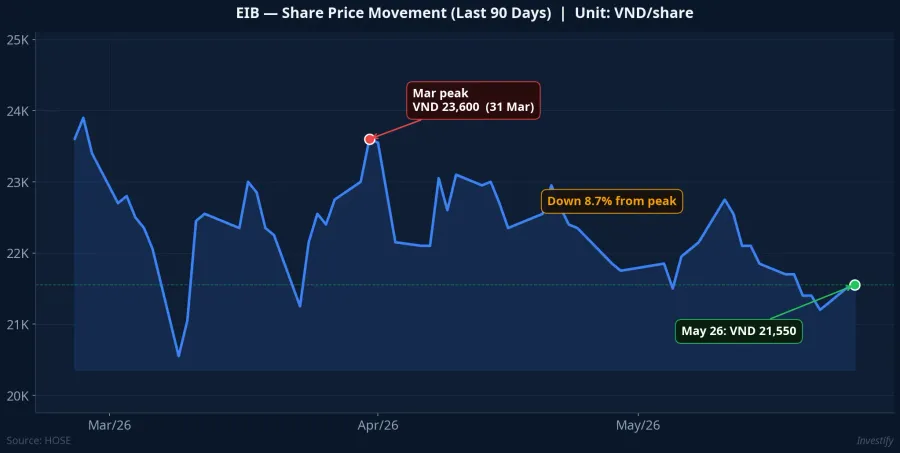
This muted reaction can be read two ways. One interpretation is that the market has simply grown accustomed to Eximbank's frequent leadership turnover and no longer treats individual personnel announcements as significant events. The other is that investors are backing the longer-term restructuring story tied to the new shareholder base, setting aside near-term earnings numbers. Both readings are plausible, and neither is mutually exclusive. Neither one, however, proves that the governance risk is fully priced into today's share price.
Three Milestones Worth Watching
The real risk does not lie in today's resignation announcement. It lies in the underlying structure: a four-person management team running a bank through a deep restructuring, under an unresolved "acting" designation, while the board has recently seen a significant turnover in members and the bank's largest shareholder sits at the legal ownership ceiling.
Governance instability carries real costs. Business strategy is more vulnerable to disruption when the management team changes mid-cycle. Major credit and funding decisions require longer internal approval chains without a formally appointed CEO. Share price valuation ends up depending more heavily on expectations than on demonstrated results.

Three milestones are worth monitoring in the months ahead:
Formal CEO appointment. When Eximbank submits a candidate and receives SBV approval, the governance picture becomes readable. This is the most important milestone because it confirms the board has reached consensus on long-term leadership.
Board cohesion following the membership turnover. After replacing multiple board members, will the board sustain consistent strategic direction, or will it slide into the kind of disagreements that marked earlier terms? Signals from board decisions and strategic announcements in the second half of the year will provide evidence.
Q2 2026 earnings. Q1 pre-tax profit was approximately VND 338 billion against a full-year target of over VND 1,515 billion. Q2 results will indicate whether the bank is closing or widening the gap, and whether the elevated provisioning in Q1 was a one-time measure or a trend.
When these three questions have clearer answers, EIB will have a more solid foundation for valuation analysis rather than relying primarily on expectations.