
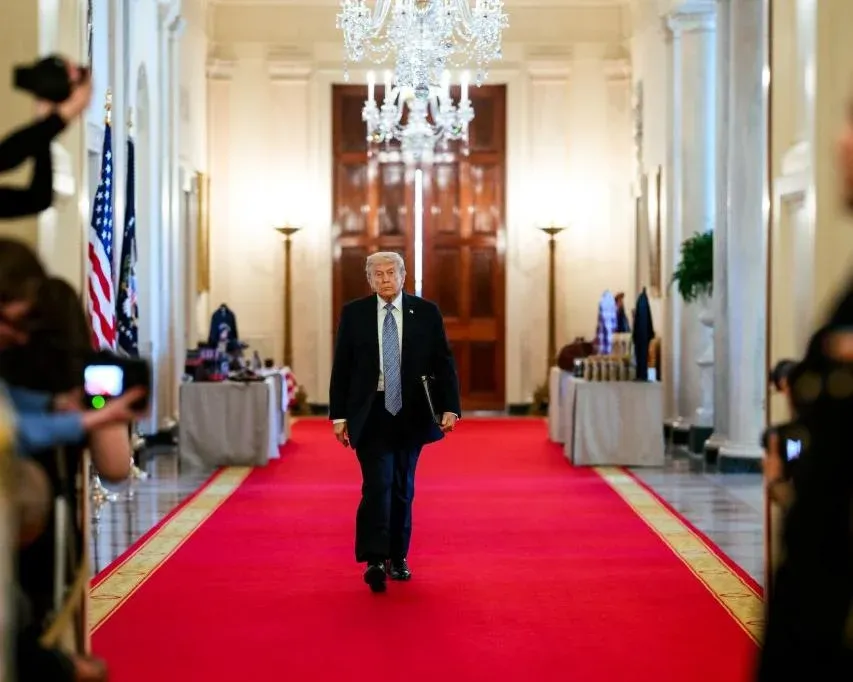

On the evening of May 23 (US time), President Donald Trump stated that the deal with Iran was "largely negotiated" and that the Strait of Hormuz would reopen.CNN Per CBS News, the framework starts with a memorandum of understanding, followed by 30-60 days of nuclear negotiations, alongside partial sanctions relief and unfreezing of blocked assets.CBS News
Hours later, Iran's state media pushed back. The strait remains under Tehran's control, and no outside party has the right to decide otherwise. Iran's Foreign Ministry issued a firm statement: the country will not compromise its national interests. Trump himself acknowledged that "some final details" were still being worked out.CNN
Two official statements, the same evening, describing two completely different realities about Hormuz. The big picture shows a deal unsigned, a strait unresolved, and markets forced to make decisions through conflicting information. This is the single largest unresolved variable heading into the May 25 session and the rest of the trading week.
How Far Have Oil Markets Already Moved
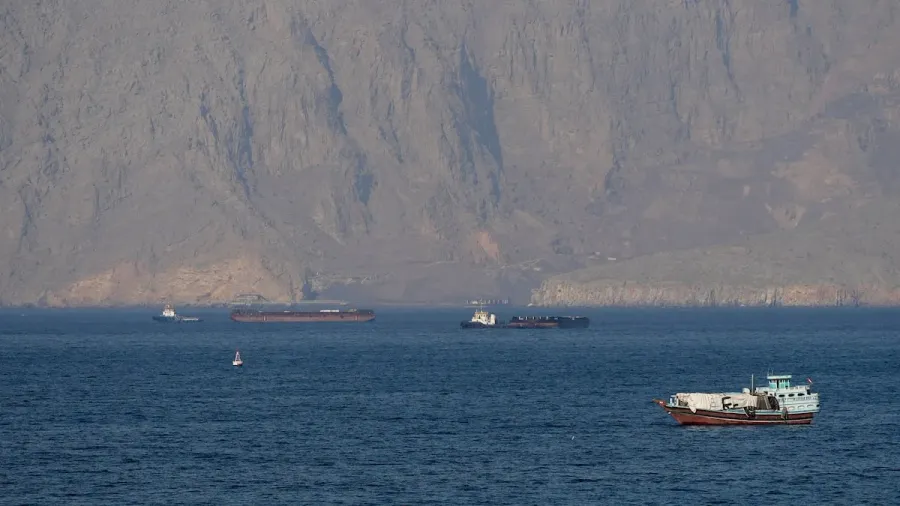
Before Trump's statement on the evening of May 23, global crude markets had already priced in a meaningful probability of a diplomatic breakthrough. WTI closed the week of May 22 at $96.12 per barrel, down 8.8% for the week. Brent settled at $102.98, down 5.7%.CNBC Both had pulled back from above $110 as diplomatic progress filtered through during the prior week. In other words, a significant probability of a deal had already been priced in before any official announcement.
The key question is how much of the total adjustment has already been made. Before the Hormuz crisis erupted in late February 2026, Brent was trading around approximately $65 per barrel. At the current level of $102.98, Brent remains roughly $38 above the pre-crisis baseline. If the strait fully restores navigation, the runway back toward long-term equilibrium is still substantial.
Vietnam's Oil Stocks: Trading on Diplomatic Headlines
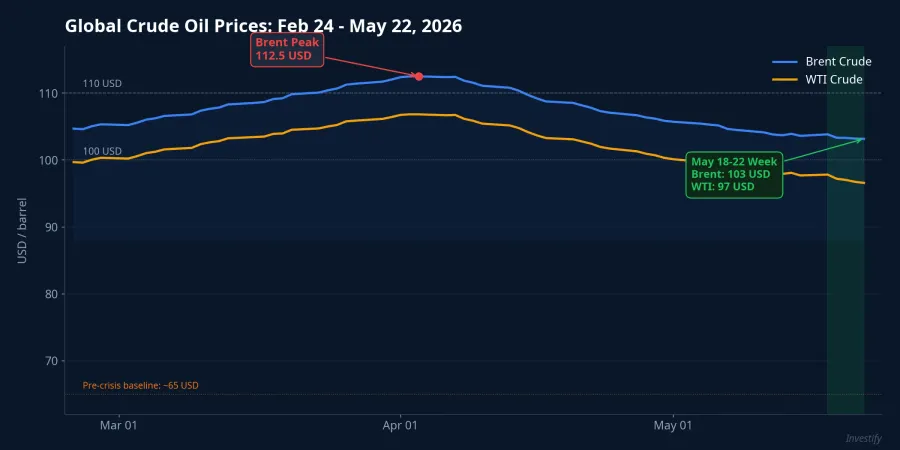
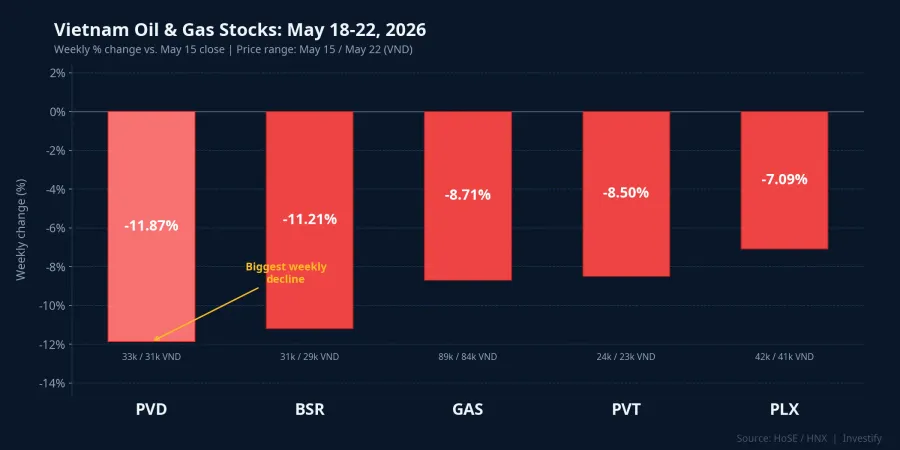
Vietnam's oil and gas stocks reflected those swings with considerably amplified magnitude. During the week of May 18-22, the sector surged sharply on positive diplomatic news one session, then fell limit-down the next when the mood reversed. By the close of May 22: BSR was at VND 29,700 (down 11.2% for the week), GAS at VND 84,900 (down 8.7%), PLX at VND 41,950 (down 7.1%), PVD at VND 31,550 (down 11.9%), and PVT at VND 23,150 (down 8.5%).
A 7-12% weekly swing does not reflect any change in the underlying business fundamentals of these companies. It reflects a structural reality: when oil prices depend directly on an unresolved geopolitical chokepoint, oil and gas stocks trade on diplomatic statements rather than financial reports. That will not change until Hormuz has a clear answer.
Three Scenarios for May 25-29
The Hormuz disagreement creates three divergent branches, each with a different market impact mechanism.
Scenario 1: Deal signed, Hormuz reopens within 1-2 weeks. The key signal is Iran's Foreign Ministry — not state media — confirming the Hormuz clause, or an officially signed memorandum of understanding being released publicly. Market consequence: Brent could drop toward the $80-90 range over the first few weeks as supply is repriced. Upstream and downstream oil and gas names face additional selling pressure. On the flip side, heavy fuel consumers — shipping, road transport, aviation, cement manufacturing, urea fertilizer — gain room to benefit from lower input costs over the medium term.
Scenario 2: Talks break down. The key signal is the US withdrawing its proposal, Iran formally rejecting the framework, or a military incident occurring in the strait. Market consequence: Brent bounces back toward $105-110, potentially higher if accompanied by military escalation. Upstream names such as PVD and PVS, along with refiner BSR, would recover most sharply in this scenario. Fuel-intensive industries face continued cost pressure, compounding an already difficult backdrop where E5 gasoline has risen 32% and diesel nearly 60% since the May 21 price adjustment.
Scenario 3: Ceasefire with no clear Hormuz clause. This is the middle-ground outcome and, based on the publicly visible disagreement on May 23, carries a non-trivial probability. The key signal is a ceasefire document released without explicitly naming straits transit rights, or both sides announcing "agreement in principle" before entering a longer negotiation period. Market consequence: Brent oscillates in a wide $90-105 band, markets move on every new headline daily. The ±7% per-session swings seen last week become the new normal for Vietnam's oil sector. This scenario offers the worst risk-reward from both long and short positions.
Why Hormuz Is the Hardest Clause to Resolve
The nuclear deal can be handled through a memorandum of understanding and a subsequent 30-60 day negotiation process. Both sides have implicitly accepted that structure. Hormuz is an entirely different matter.
The strait is sovereign Iranian territorial waters, and Iran is asserting exactly that. When Trump stated Hormuz "will reopen," the implication is that the US has a role in that outcome. When Tehran says the strait "remains under Iran's control," the implication is that no outside party can intervene. These two statements cannot be reconciled through careful wording because they reflect two legally incompatible positions. The most likely outcome is that the Hormuz clause gets stripped from the ceasefire text to allow both parties to sign, pushing the sovereignty question into a subsequent phase of talks. If so, Scenario 3 becomes the near-term reality on the ground.
Two Sides of the Oil Leverage Equation
The Strait of Hormuz is not just a question for the oil sector. With Brent above $100, the entire fuel consumption chain faces cost pressure: maritime shipping, road transport, aviation, cement production, and urea fertilizer, the agricultural input sector closely tied to gas and oil prices.
Scenario 1 would represent a durable tailwind for all of these sectors if Brent genuinely settles in the $80-90 range. The next domestic fuel price adjustment is scheduled for June 1: the actual size of any retail reduction will depend on where Brent trades through the end of May and decisions on the price stabilization fund. This is the most concrete near-term test for fuel-consuming industries, and it will provide clearer directional data on the cost trajectory.
Signals to Watch on Monday Morning, May 25
Before Vietnam's market opens at 9 AM, there are three observation points in chronological order.
The Asian oil session from 7-9 AM (Vietnam time): Brent front-month opening below $100 signals markets are leaning toward Scenario 1. Opening above $103 tilts toward Scenario 2 or 3.
Iran's Foreign Ministry — not state media — issuing an official statement is the single most important differentiator. If the Foreign Ministry strikes a more cooperative tone than Fars, Scenario 1 gains meaningful credibility. If the hardline posture holds, Scenario 3 becomes the default.
Vietnam's oil sector stocks in the first 15 minutes of ATO: BSR, GAS, PLX, PVD, and PVT opening down 3-5% confirms markets are reading Scenario 1. Opening up 3-5% signals capital is repricing toward a less smooth negotiation path.
A Three-Way Fork With One Unresolved Variable
The big picture presents three clear scenarios and one unresolved variable: the Hormuz clause. The optimistic scenario depends on Iran's Foreign Ministry confirming that the agreement framework covers the strait. The pessimistic scenario depends on a breakdown in talks or military escalation. The neutral scenario — and arguably the highest probability outcome given the publicly visible positions on May 23 — is a ceasefire signed with the Hormuz question left in a legal grey zone.
The decisive signals will come from the Asian oil session on Monday morning and from Iran's Foreign Ministry response. Both appear before Vietnam's trading board lights up, and together they will set the direction for the entire week.