
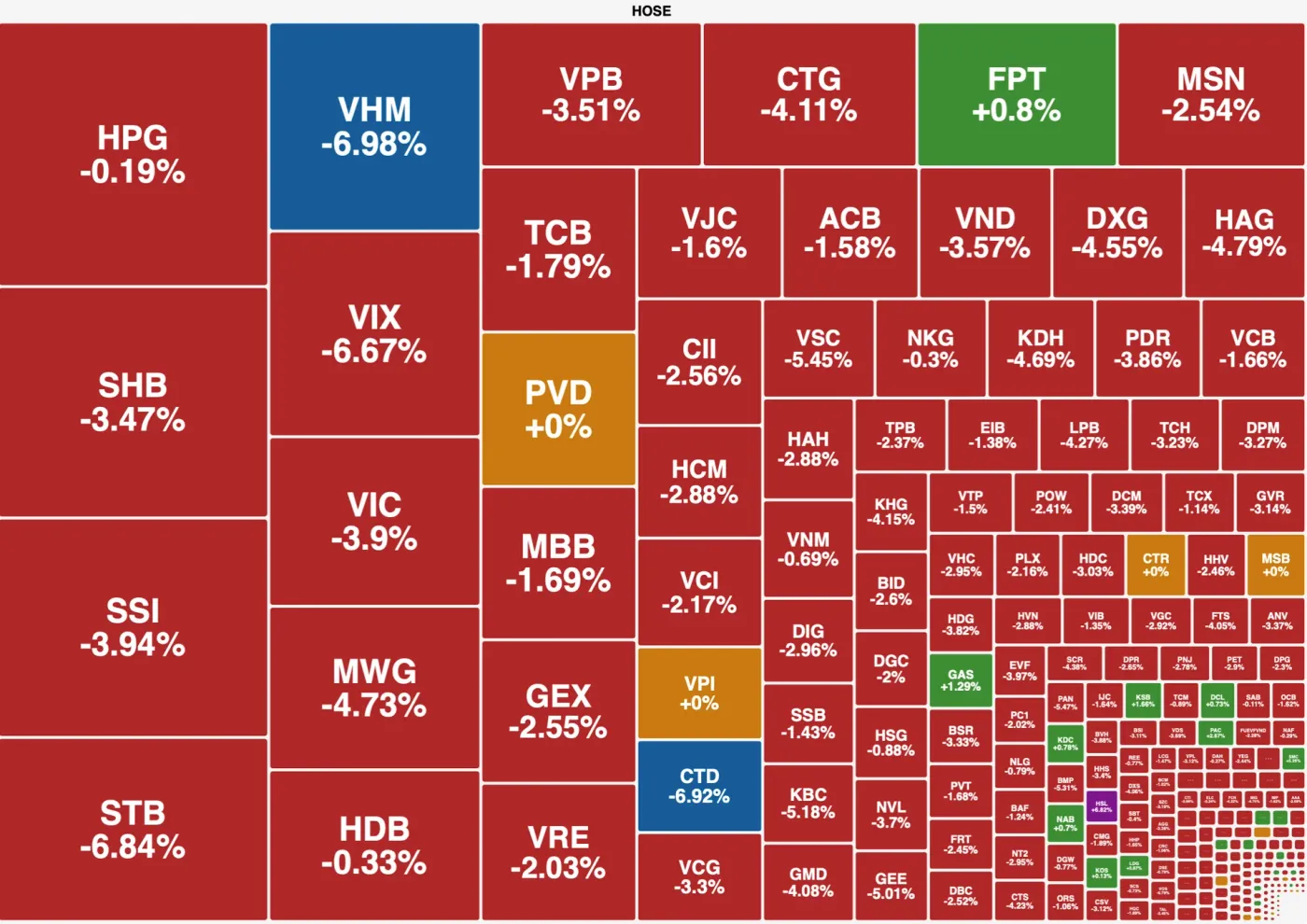

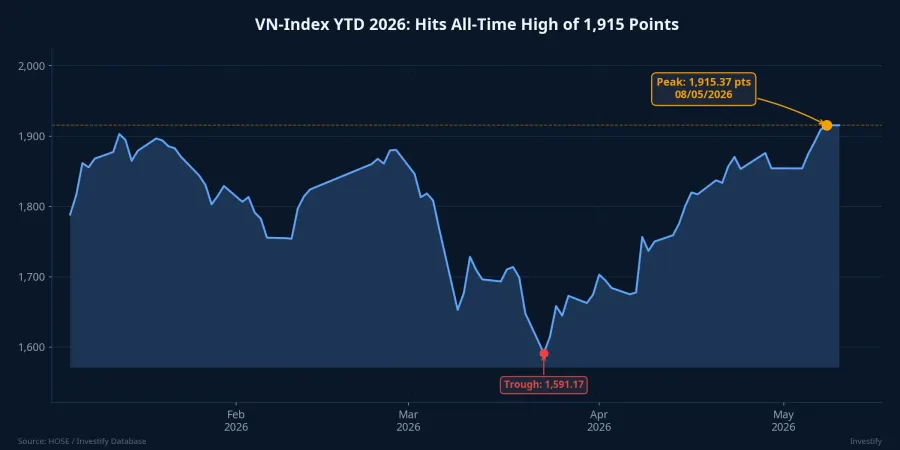
VN-Index closed the week of May 8, 2026 at 1,915.37 points, the highest level in Vietnamese stock market history.VietStock At the same time, total brokerage accounts nationwide crossed 12.9 million, equivalent to roughly 13% of the population.MekongASEAN On the surface, these two numbers should reinforce each other: index at a peak, participation at a record high, liquidity ought to follow.
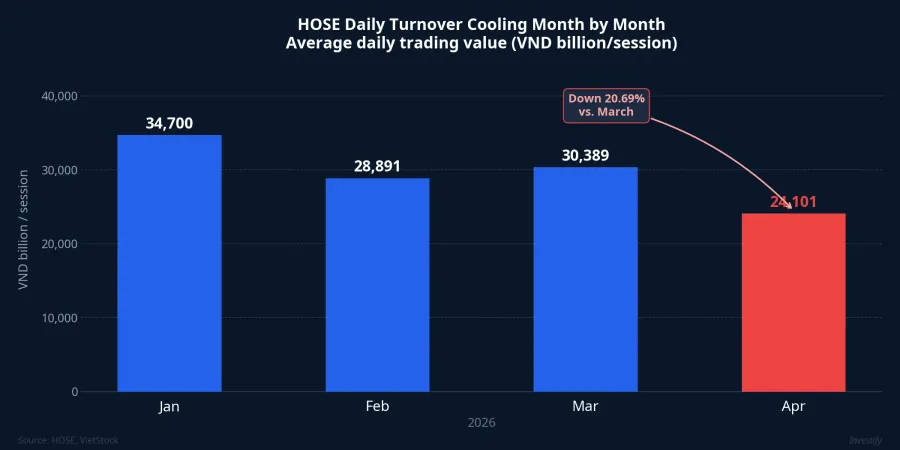
Reality moved in the opposite direction. Average daily trading value on HOSE in April 2026 came in at only VND 24,101 billion per session, down 20.69% from March and well below the approximately VND 34,700 billion recorded back in January.VietStock New account openings followed the same trend: April saw only 244,700 new accounts, nearly 30% below March's 346,000.MekongASEAN
This is a paradox, but an explainable one. Three structural mechanisms are working simultaneously beneath the surface of the market.
Mechanism 1: Most Accounts Are Not Trading
Simply put: 12.9 million is a 25-year cumulative figure, not the number of people placing orders today.
Vietnam took roughly 25 years to reach 12 million brokerage accounts, crossing that milestone in January 2026.VietStock Just four months later, nearly one million more had been added. Much of this growth came from promotional campaigns by brokerages: free account opening, zero-commission trading for the first few months, and free introductory stocks for first-time investors. A single person can open three or four accounts at different brokerages to collect all the perks, while actively trading at just one of them.
The result is that a significant share of those 12.9 million accounts sits dormant: opened but generating no transactions for months or even years. An indirect signal is visible in brokerage behavior, as many are proactively closing inactive accounts to reduce operating costs. If you divide April's VND 24,101 billion in trading value evenly across 12.9 million accounts, each account contributes less than VND 2 billion per session. That math only makes sense when you understand that the actual trading population is a small fraction of the headline total.
The new-account trend reinforces this point. When VN-Index headlines repeatedly feature the phrase "all-time high," first-time investors become more hesitant to enter than they were earlier in the year, when prices were lower and the upside story felt more compelling. A 30% drop in new account openings during April is a clear signal that net new money entering the market is slowing, even as the cumulative total keeps growing.

Mechanism 2: VND 405,000 Billion in Margin Debt Is Locked In
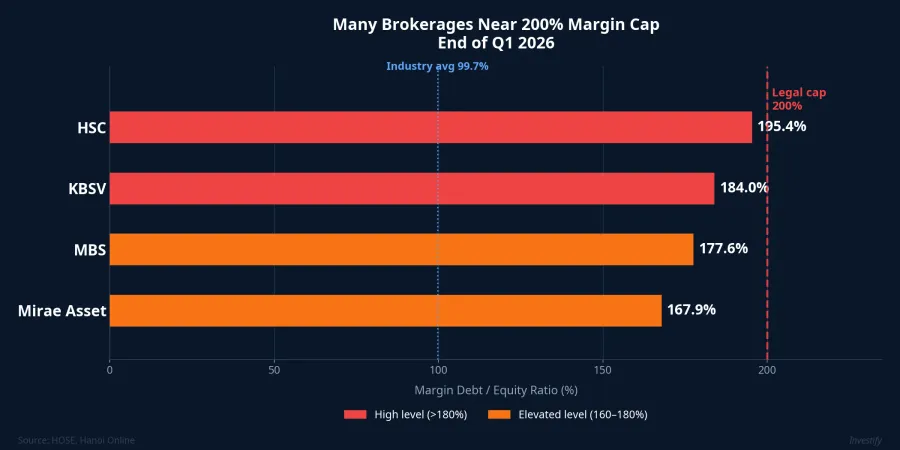
By the end of Q1 2026, outstanding margin debt across the market reached VND 405,000 billion, a record high, up approximately VND 13,000 billion from end-2025.Hanoi Online The industry-wide margin-to-equity ratio reached 99.7%, with several individual brokerages approaching the legal ceiling of 200%: HSC at 195.4%, KBSV at 184%, MBS at 177.6%, and Mirae Asset at 167.9%.CafeF
The key distinction is this: margin money and cash generate two different kinds of liquidity. When you borrow on margin to buy stock, that money flows into a position and stays there until you sell. It does not cycle within the same session. By contrast, pure cash in an account can be bought and sold multiple times throughout the day, generating multiple units of liquidity from a single pool of capital.
With VND 405,000 billion already sitting as outstanding debt, a large portion of the market's portfolio value has shifted from "ready to trade" to "locked in a position." Margin borrowers who want to sell must also account for debt repayment, which extends the average holding period compared to all-cash investors. That reduces the frequency of profit-taking and portfolio rotation, and therefore reduces daily liquidity, even though total debt outstanding sits at a record.
The near-exhaustion of available margin capacity adds another constraint. This is why brokerages are moving to raise additional capital, estimated at approximately VND 100,000 billion in aggregate for 2026, to restore lending headroom.CafeF Until that new capital arrives, leverage-driven momentum remains capped at its current level.
Mechanism 3: "Hold and Wait" Behavior at Uncharted Highs
There is a consistent behavioral pattern at all-time market peaks: instead of trading volume expanding, it contracts.
During recoveries from market lows, individual investors tend to rotate portfolios aggressively: booking gains on stocks that have run, rotating into laggards, hunting sector stories. Each rotation generates transactions on both sides, directly contributing to turnover.
When the index enters an all-time high zone, this behavior reverses across three distinct groups. Investors sitting on large gains refuse to sell, fearing they will miss further upside if the trend continues. Investors sitting on losses refuse to cut, hoping the market will eventually bail them out. Investors on the sidelines refuse to buy at the highest prices ever seen. All three groups reduce their order frequency simultaneously, and turnover falls even as the index keeps climbing.
The rally from mid-March through early May 2026 illustrates this precisely. VN-Index advanced steadily over seven consecutive weeks, but the bulk of that gain was concentrated in a handful of large-cap stocks, while overall market turnover declined month by month. This is the characteristic structure of a market digesting a peak zone, not one breaking through with broad participation.
Three Indicators That Measure Liquidity Better
The total account count is a useful long-term measure of financial inclusion. To gauge the actual health of the market this week or this month, three indicators are more reliable:
Monthly average daily trading value: compare it to the prior month and to the same period last year. April 2026's VND 24,101 billion per session is a clear cooling signal relative to February's VND 28,891 billion and March's approximately VND 30,400 billion.
Margin debt and the brokerage-sector margin-to-equity ratio: when this ratio is near its legal ceiling, the market has limited capacity to absorb a new wave of leverage-driven buying. This indicator is forward-looking for turnover in the coming weeks, not a reflection of today's action.
Monthly new account opening speed: not the cumulative total. Two consecutive months of decline typically accompany a market in the process of digesting a peak zone. When this metric reverses and accelerates again, it signals that a fresh wave of capital is beginning to form.
A Paradox That Makes Sense
The three mechanisms above are not random anomalies. They are the structural outcome of a market sitting at an all-time high, with leverage at record levels and risk caution spreading across participants. The 12.9 million account figure tells an important long-term story about the breadth of Vietnam's capital markets. But the health of today's trading session depends on the three practical indicators above, not on the cumulative historical total.
As VN-Index tests the 1,915-point zone in the coming weeks, the signals worth monitoring are: whether May's average daily trading value holds above VND 24,000 billion, whether new account opening speed recovers, and whether margin debt continues to grow after new brokerage capital is deployed or begins to stabilize. Those three questions will reveal which way the underlying flow of money is actually tilting.