
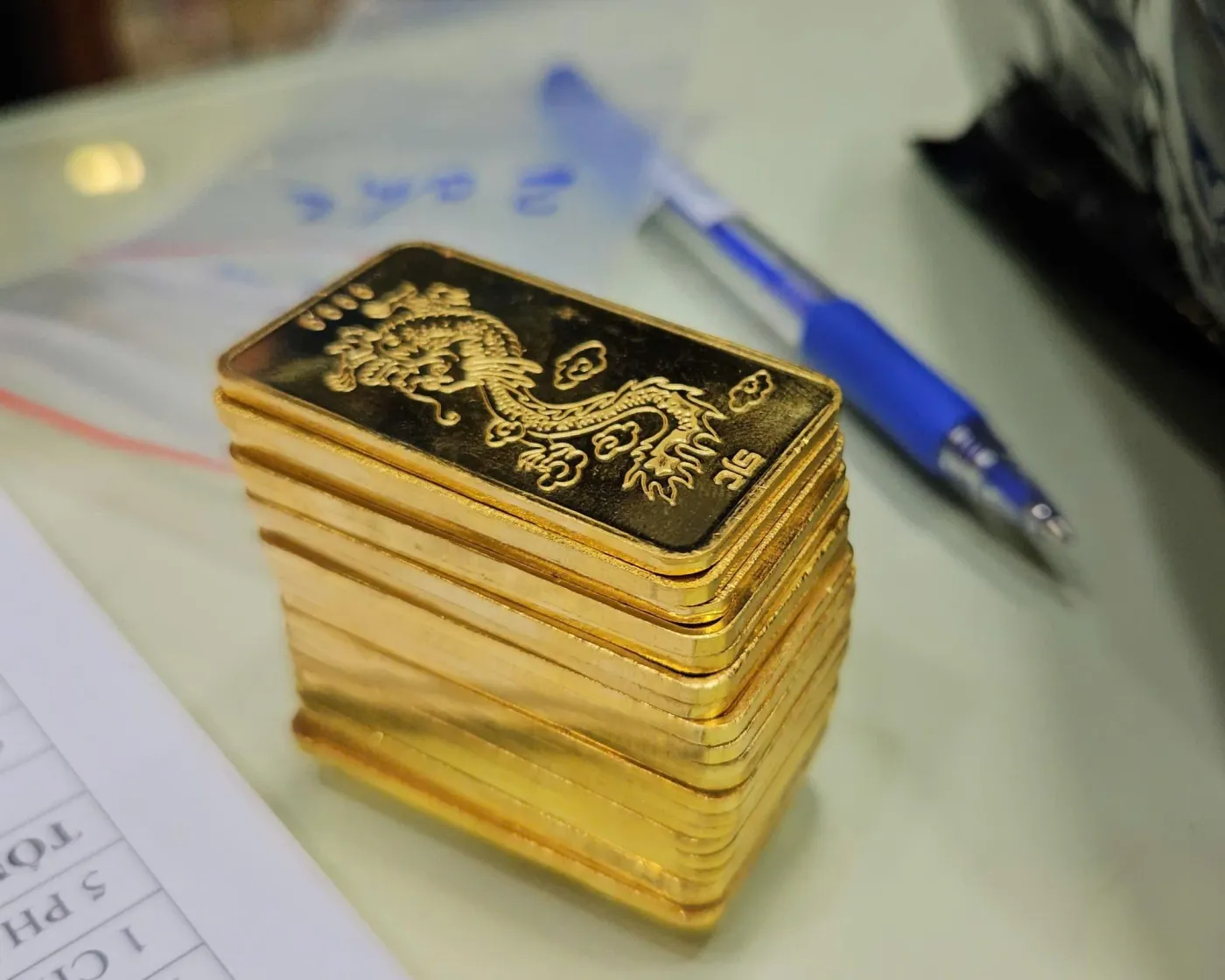

In 2012, Decree 24 built a wall: the State held monopoly rights over gold bar production, and commercial banks were banned from mobilizing or lending gold. That wall held for 14 years. By 2026, the same major banks are lining up to do what that wall once reserved exclusively for the State: produce gold bars.
Vietnam's gold management policy is undergoing its biggest reversal since 2012 — not through a single sweeping decision, but through four consecutive policy milestones. Understanding these four milestones explains why domestic gold prices are currently around VND 17–18 million per tael above the international price, and why that gap is likely to narrow in the years ahead.
Milestone 1 (2012): The Wall Was Built for Good Reason
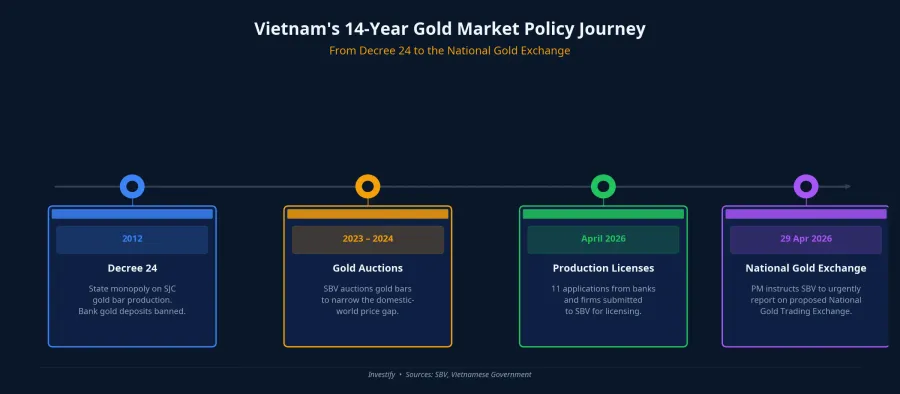
Decree 24/2012/ND-CP took effect on May 25, 2012, in response to a genuine threat of gold-ization in the banking system. The price gap between SJC gold and the international market had at times reached millions of dong per tael; USD/VND exchange rates faced persistent pressure as households shifted savings from deposits into gold hoarding.Vietnam Government Portal
The decree established four pillars. The State Bank of Vietnam (SBV) became the sole authorized importer of raw gold for gold bar production. The SJC brand became the only national gold bar brand. Commercial banks were barred from mobilizing or lending gold. Gold jewelry manufacturing required an SBV-issued license.
In the early years, the policy worked as intended: gold-ization in bank balance sheets fell sharply, and exchange rate pressure eased. But single-channel supply meant an unavoidable consequence: when retail demand for gold grew faster than the volume of SJC gold authorized for market release, the price gap widened with no market mechanism to close it.

Milestone 2 (2023–2024): Auctions Treated the Symptom, Not the Cause
When the SJC-to-world price gap widened again, the SBV deployed gold bar auctions. Licensed institutions bid in session-by-session auctions; volumes were set according to the SBV's stabilization needs. This mechanism helped narrow the gap after each supply-demand flare-up, but did not change the fundamental structure: gold bar supply still flowed through a single channel, still dependent on administrative decisions session by session.
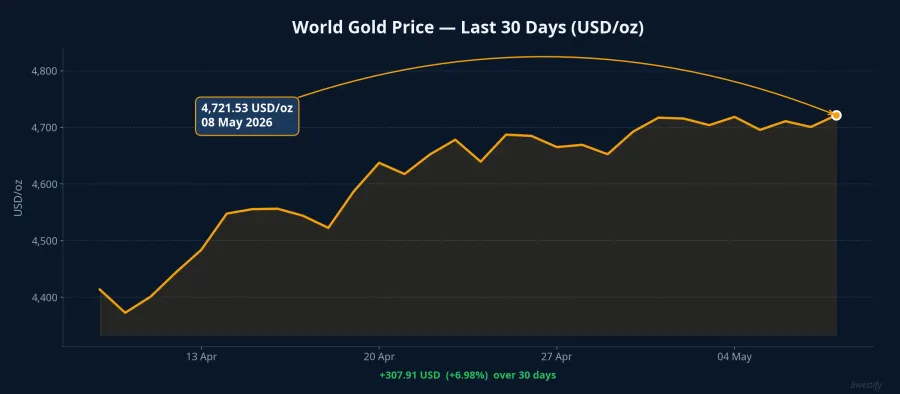
As of early May 2026, SJC gold bars are quoted at approximately VND 167.5 million per tael (ask price), while the world gold price stood at 4,721.53 USD/oz on May 8, 2026.VietnamNetVietnam Finance Times The spread of approximately VND 17–18 million per tael remains, though it has narrowed from peak levels. This is the clearest evidence that auctions are a situational tool, not a structural solution.
Milestone 3 (April 2026): The Supply Structure Is Officially Opening
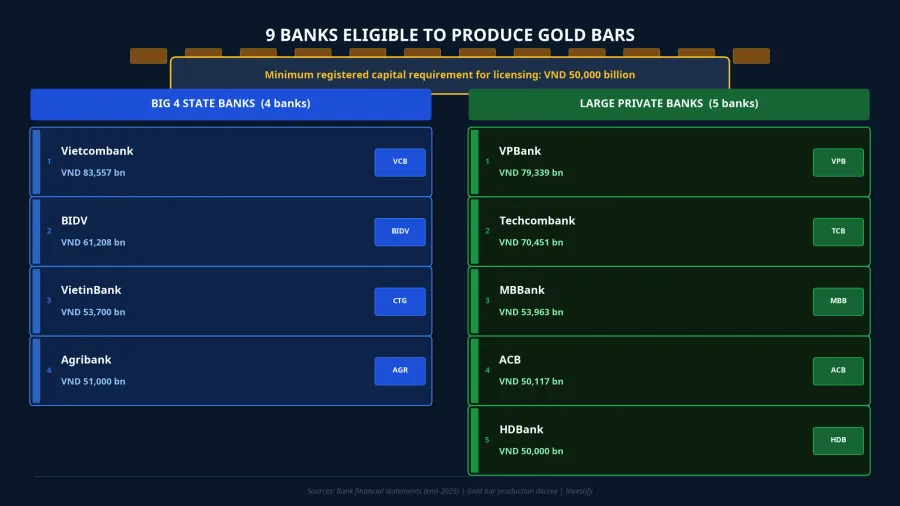
This is the pivotal milestone, more consequential than the auctions. New regulations set a minimum registered capital threshold for gold bar production licensing: VND 1,000 billion for enterprises and VND 50,000 billion for commercial banks. As of April 14, 2026, the SBV had received 11 license applications from both banks and enterprises.Dan Tri
On the banking side, nine institutions exceed the VND 50,000 billion threshold: the Big 4 state banks (Vietcombank, BIDV, VietinBank, and Agribank) plus five large private banks (VPBank, Techcombank, MB, ACB, and HDBank).VietnamNet On the enterprise side, PNJ, DOJI, and SJC have also applied. The SBV is coordinating with relevant ministries to review the submissions.
What makes this milestone structurally different from auctions: when multiple brands are authorized to produce and import raw gold, domestic gold bar prices can converge toward international levels through competition rather than waiting for each administrative auction session. That is a difference in mechanism, not just in the number of suppliers.
Milestone 4 (April 29, 2026): The National Gold Exchange Proposal Is on the Table
At a working session with the SBV on April 29, 2026, Prime Minister Lê Minh Hưng instructed the SBV to urgently report to the Standing Committee of the Government on the research, assessment, and proposal to establish a National Gold Trading Exchange — "without further delay."Vietnamese Government
This directive should be read precisely: it is an instruction to research and report on a proposal, not a decision to establish the exchange. That said, combined with the wave of production licensing, the direction is clear. If the National Gold Exchange is established, domestic and international gold prices will be matched continuously on a centralized platform rather than through session-by-session administrative intervention.
At the same time, the World Gold Council (WGC) has recommended that Vietnam allow banks to participate more deeply in the gold market and consider a framework for recognizing gold as financial collateral, pointing to Indonesia and Singapore as regional benchmarks.Vietnam Finance Times This is not a signal that determines Vietnam's direction. It is a convergence point between domestic policy trajectory and the regional model taking shape.
Four Milestones, One Logical Thread
Looking back from 2012 to 2026, the policy sequence has consistent internal logic. Decree 24 solved the gold-ization problem in bank balance sheets but did not resolve the gold sitting idle in household hands. By various estimates, the gold accumulated in Vietnam's economy ranges from approximately 500 tonnes to more than 2,000 tonnes, representing tens to hundreds of billions of USD sitting outside the economic flow at current prices.The Saigon Times
The 2023–2024 auctions tried to address the symptom (price gap) without touching the cause (single-channel supply structure). The multi-entity production licensing of 2026 finally opens that supply structure. The National Gold Exchange, if established, would be the final layer: the mechanism through which domestic and international gold prices converge continuously through market forces rather than administrative sessions.
Signals Worth Watching in the Months Ahead
Policy is changing, but many important variables still lack clear answers. Three specific signals are worth following closely.
Timing of the first licensing round. When the SBV formally grants production licenses to qualifying entities, the market will have multiple gold bar brands competing with SJC. The price spread between SJC and new brands will reflect the remaining monopoly premium embedded in SJC. By competitive theory, that portion of the spread should narrow over time as supply diversifies.
Legal roadmap for the National Gold Exchange. The proposal is currently in the research and reporting stage. When and if the exchange becomes operational, the model envisions a centralized trading platform connecting domestic gold prices to international prices in real time. Based on current discussions, the initial phase is expected to focus primarily on imported raw gold transactions between institutional members.
Gold-linked financial products. The WGC has raised the possibility of using gold as collateral for loans. If authorized, this would give gold holders a way to earn a yield rather than purely storing value, and would draw household gold holdings into financial circulation rather than leaving them idle.
Fourteen years on, the core question has not changed: how do you keep gold in household hands from sitting idle outside the economy? The answer is changing. The actual pace of transition will depend on the licensing timeline, the legal roadmap for the gold exchange, and the SBV's capacity to maintain exchange rate stability through the transition. These three variables will shape the contours of Vietnam's gold market for the next two to three years.