
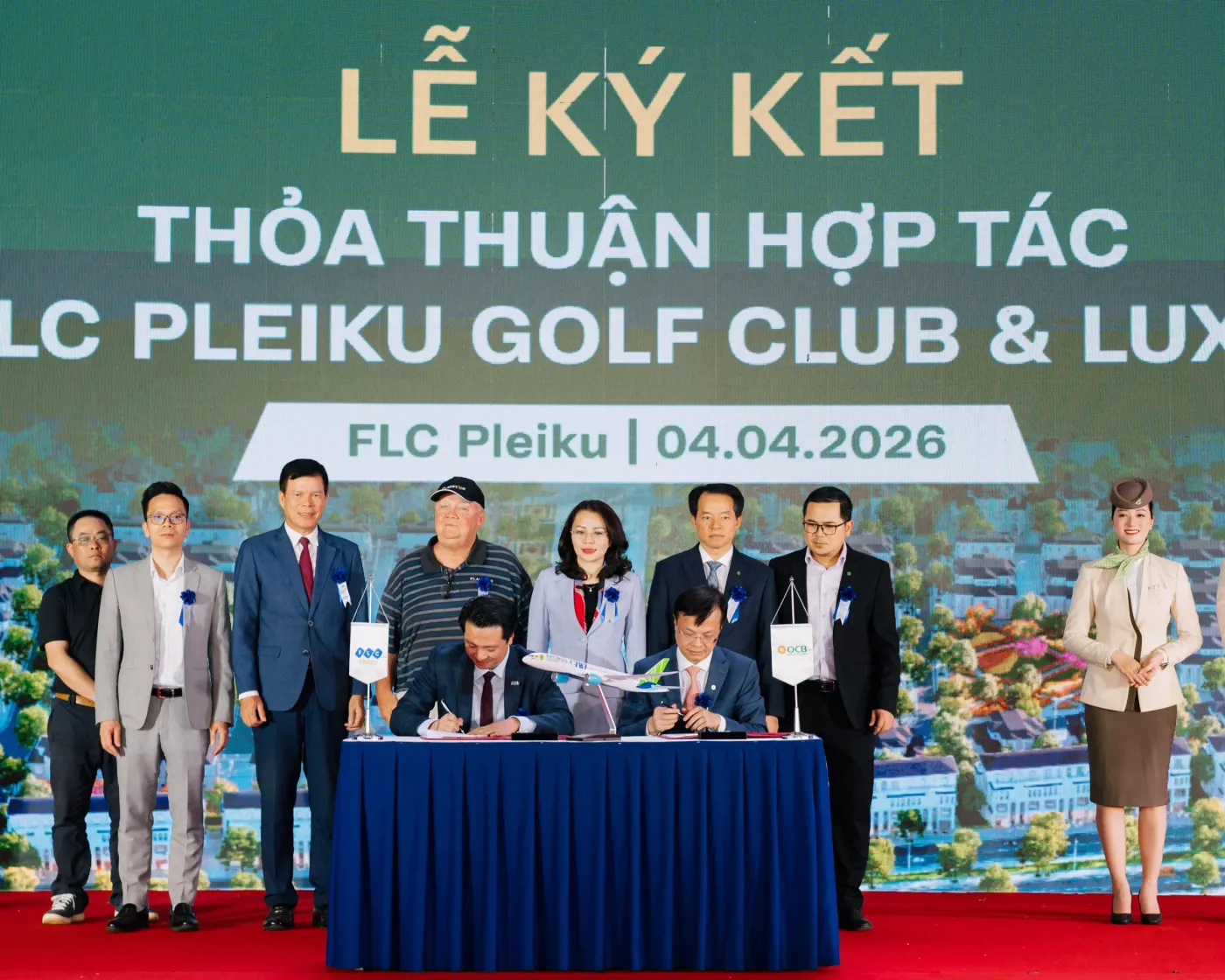

On April 4, 2026, exactly four years after his arrest, Trinh Van Quyet, Chairman of FLC Group JSC, stepped onto the podium and broke ground on FLC Pleiku Golf Club & Luxury City Resort, a 517-hectare development in Dak Doa District, Gia Lai Province, with a stated total investment of nearly VND 20,000 billion.Nhan Dan That single image compressed four years of FLC's story into one frame. But what deserves closer reading is not the 517 hectares. It is everything that remains unresolved just beyond that frame.
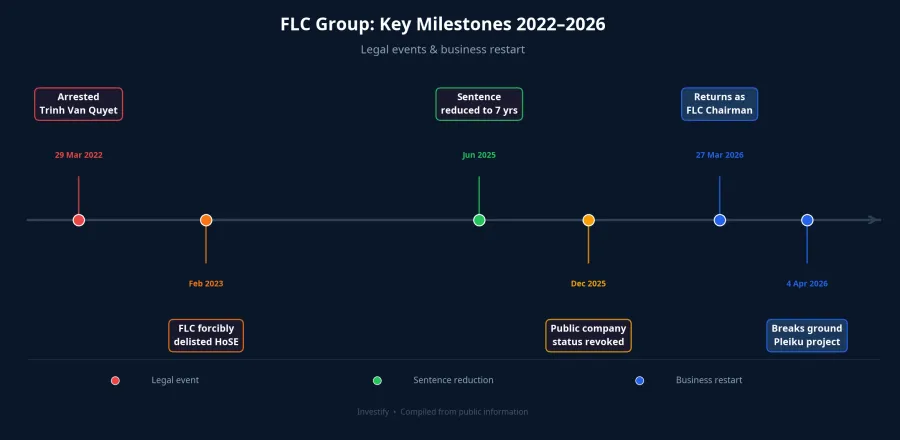
Four Years in Review: From Suspended Trading to Arrest
The sequence began on January 10, 2022, when Quyet sold 74.8 million FLC shares without making the legally required pre-trade disclosure.VnExpress The State Securities Commission imposed a VND 1.5 billion administrative fine and suspended his trading for five months. The matter did not stop there.
On March 29, 2022, the Ministry of Public Security's criminal investigation agency detained Quyet on two charges: market manipulation and concealment of information in securities activities under Articles 209 and 211 of the Penal Code.Ministry of Public Security His sister, Trinh Thi Minh Hue, was also prosecuted as an accomplice.
From that point through April 2026, FLC went through four years of compounding setbacks: forced delisting from HoSE in early 2023, a reduced sentence on appeal in mid-2025, revocation of its public company status in late 2025, and then Quyet's public return and the Pleiku groundbreaking within a single week at the end of March and beginning of April 2026.
710 Million Shares and the Investors Still Stuck
The part of the "FLC comeback" story that tends to get glossed over is the part belonging to retail investors who bought in during 2020 and 2021 and still hold those shares today.
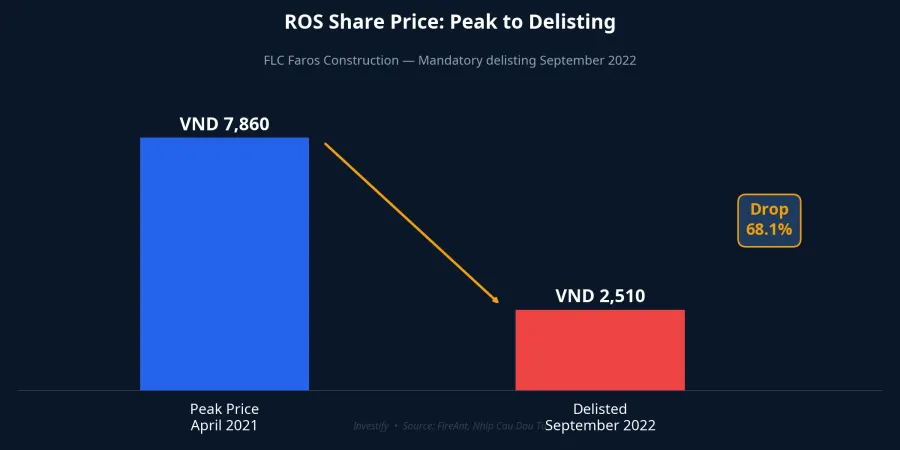
Before Quyet's arrest, FLC and ROS shares had already fallen 53.3% and 48.1%, respectively, from their early-2021 peaks.Nhip Cau Dau Tu By September 2022, ROS was forcibly delisted at VND 2,510 per share, down approximately 68.1% from its April 2021 peak of VND 7,860.FireAnt That is before accounting for the VND 214,000 historical peak in 2017 that many early investors paid into.
On February 20, 2023, the Ho Chi Minh Stock Exchange (HoSE) mandatorily delisted nearly 710 million FLC shares for serious disclosure violations: late submission of audited financial reports and failure to hold the Annual General Meeting.Tuoi Tre The stock was transferred to UPCoM but remained suspended. Then on December 18, 2025, the State Securities Commission revoked FLC's public company status altogether, removing the ticker from every regulated trading venue.Thanh Nien
Loss of liquidity is the sharpest part. The shares still appear in brokerage accounts, still show a last-known reference price, but cannot be sold. One figure that needs to be read clearly: the VND 1,886 billion that Quyet's family paid as remediation during the June 2025 appeal was designated for victims of the ROS manipulation scheme, not for investors who bought FLC shares at the 2021 peak.Tien Phong These are two different injured groups, and no specific compensation mechanism exists for the second one.
Phase Two: Four Structural Differences Worth Noting
At the June 2025 appeal hearing, the court reduced Quyet's sentence from 21 years to 7 years, citing the VND 1,886 billion remediation payment and other mitigating factors.Tuoi Tre The shorter sentence allowed him to resume business activities while still serving the remaining term. On March 27, 2026, he officially reappeared as Chairman of FLC Group JSC after nearly four years away from public view, and the company simultaneously appointed Trinh Van Nam, born 1991, as Chief Executive Officer.VnExpress
Compared to the 2019-2022 period, four structural differences characterize the way FLC operates now.
First, the business model no longer rests on an interconnected stock ecosystem. ROS has been delisted, FLC has lost its public company status, and Bamboo Airways is still in renegotiation. The Pleiku project must now fund itself through project revenues and partner bank credit. There is no longer a mechanism to raise capital quickly by issuing new shares to the public.
Second, the founder's legal status has changed in a material way. Quyet is running the company while still serving a prison sentence.Dan Tri His management rights have not been suspended, but the specific constraints related to securities market participation need to be verified from official legal documents.
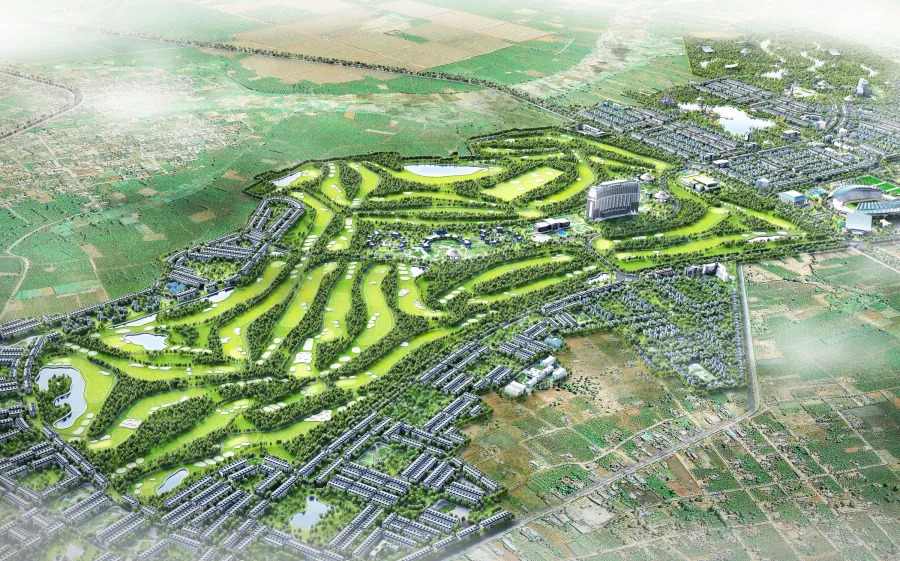
Third, the Pleiku project is the largest FLC has ever broken ground on in the Central Highlands: 517 hectares total, with a 36-hole golf course covering more than 171 hectares, alongside residential zones, villas, an eco-park, a shopping center, and a school.GolfNews Orient Commercial Bank (OCB) is participating as the financial partner, providing mortgage credit for buyers of units within the development.
Fourth, FLC is running multiple sites simultaneously: the Hausman apartment project in Hanoi targeted for completion in June 2026, a commitment of approximately VND 150,000 billion in Gia Lai for expansion projects, and plans for nearly VND 27,750 billion in logistics and R&D infrastructure in Thanh Hoa Province.
What the Press Releases Don't Say: Where the Real Risk Sits
Groundbreaking events are media milestones, not legal clearance documents. The real risks sit in the questions that remain unanswered.
The legal documentation for the 517 hectares has not been publicly confirmed. Before assigning any weight to the Pleiku groundbreaking, investors should independently verify whether land-use rights have been fully transferred, whether the detailed 1:500 construction plan has been approved, and whether construction permits have been issued for individual components of the 517-hectare site. These answers need to come from the relevant government authority, not from the developer's marketing materials.
The gap between the two investment figures is a signal worth tracking. The groundbreaking ceremony cited a total investment of nearly VND 20,000 billion. The Gia Lai investment promotion conference on March 27, 2026 recorded approximately VND 8,267 billion for the initial policy approval. That gap will need FLC's latest audited financial statements to explain.
The founder's legal status is still an open variable. Quyet is running FLC while serving a sentence. Any change in the enforcement of that sentence, any new litigation related to outstanding compensation obligations, would directly affect the company's operations and the projects currently underway.
Retail investors from Phase One still have no exit mechanism. This is where the real risk sits for many readers: not whether the stock price will recover, but the fact that 710 million shares have lost all liquidity, with no specific compensation scheme covering investors who bought FLC shares at the 2021 highs.

What to Watch Over the Next 12 Months
FLC Phase Two starts from a structurally different position. The interconnected stock ecosystem is gone, the rapid share-issuance funding mechanism no longer exists. Those are genuine structural changes, not marketing claims. The Phase One lesson was unambiguous: when liquidity breaks and disclosure standards fail, assets in a brokerage account can become illiquid regardless of the price shown on screen.
The core question for Phase Two is not whether FLC shares will return to a listed venue. It is whether the Pleiku project generates real operating cash flow from room nights and property sales, or whether it continues to depend on partner credit lines and pre-sales ahead of construction completion.
The signals worth monitoring over the next 12 months: FLC's most recent audited financial statements, the complete legal documentation for the 517-hectare Dak Doa site, actual sales velocity at the Hanoi Hausman project, and any changes in the enforcement status of Quyet's sentence. When those four signals have clear answers, Phase Two will have enough evidence for a serious analysis.