


On the night of May 4, 2026 (U.S. time), Palantir Technologies delivered two pieces of news in the same earnings call: Q1 revenue grew 85% year-over-year, and the company's CEO called most AI products on the market "AI slop," roughly translating as garbage. On the surface, the two seem to contradict each other. If the AI market is flooded with garbage, how is Palantir posting its fastest growth since its 2020 IPO? The answer lies in a detail the financials make plain: whom Palantir is selling to.
The Q1 2026 Numbers
Total Q1 2026 revenue came in at $1.633 billion, up 85% year-over-year, well ahead of Wall Street estimates.Yahoo Finance That is the fastest growth rate since Palantir's first year after its IPO.
Breaking it down by segment makes the picture clearer. U.S. revenue reached $1.282 billion, up 104% year-over-year.Las Vegas Sun Within that, U.S. Government contributed $687 million (up 84%) and remained the largest single segment, while U.S. Commercial crossed $595 million for the first time at 133% growth, becoming the new growth engine. The remaining roughly $351 million (~21% of total revenue) came from international markets at a substantially slower pace.
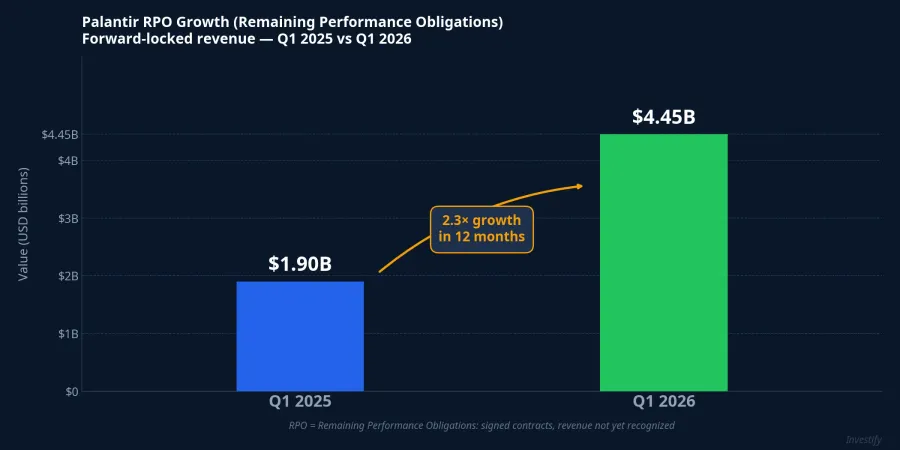
What stands out is not just recognized revenue but the forward commitments. Remaining Performance Obligations — contracts signed but not yet recognized as revenue — reached $4.45 billion in Q1 2026, 2.3 times the $1.90 billion recorded in Q1 2025.Las Vegas Sun That figure means Palantir's growth is not a one-quarter spike: a large portion of future revenue is already locked in through signed contracts.
Management raised full-year 2026 revenue guidance to $7.65–$7.66 billion, representing approximately 71% growth. For U.S. Commercial alone, the updated guidance implies a minimum of 120% growth, with the segment expected to exceed $3.224 billion for the year.Las Vegas Sun
What Karp Actually Means by "AI Garbage"
In his shareholder letter and on the May 4, 2026 earnings call, CEO Alex Karp of Palantir Technologies used the term "AI slop" in a precise way. He was not dismissing AI in general; he was dismissing a specific category of products that produce output which appears functional but has no grounded relationship to objective truth and cannot be audited.
Karp wrote in the shareholder letter: "We stand on the ramparts, the sentinels of the interior, against the wave of AI slop." And on the call: "Results that are actually usable require granularity, specificity, and a real connection to truth. Software that looks like it's running is not software that is running."
To understand why Palantir can credibly occupy that position, it helps to know what "ontology" means in enterprise data software. It is the structural layer that describes relationships between entities in an organization: which aircraft belong to which squadron, which shipment is tied to which contract, who has access to which data and at what classification level. AI systems that lack this layer will answer confidently and incorrectly, with no mechanism to detect the error from the outside. For defense and government customers, a wrong decision produces real consequences, not paper losses. They do not pay for software that looks like it is working.
85% Growth: Fastest in the Cohort, Read in Context
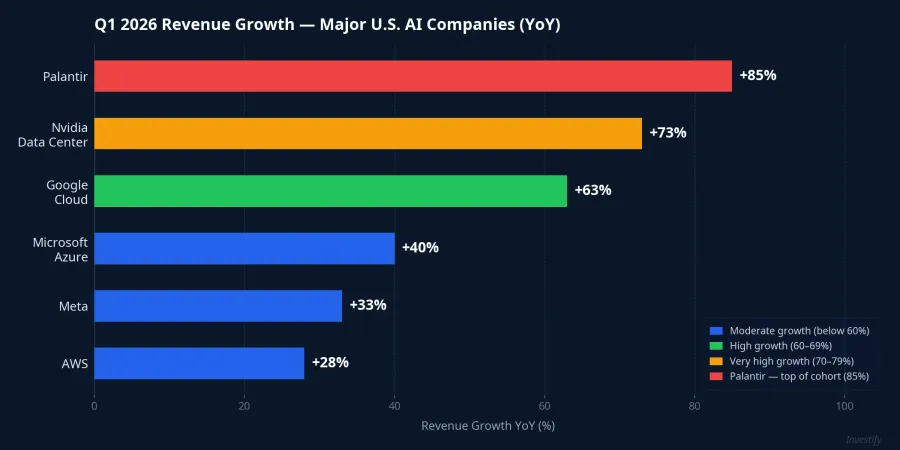
Compared to other major AI names that reported Q1 2026 results, Palantir's 85% leads the group. Nvidia's data center segment — the core of the leading chip company — posted $39.1 billion in revenue at 73% growth, a scale 24 times larger than Palantir's but a slower rate.Nvidia The three major cloud infrastructure platforms grew considerably more slowly: Google Cloud at 63%, Microsoft Azure at 40%, and AWS at 28%.UncoverAlpha
Three points matter when putting that 85% in context.
First, part of the speed reflects a low comparison base. At $1.6 billion in revenue, Palantir is roughly 4% the size of Nvidia's data center segment in the same quarter. But the base alone does not explain the full story: two years ago, Palantir was growing around 30% per quarter. An 85% print is a clear acceleration, not the baseline of a company just getting started.
Second, the hyperscalers (Azure, Google Cloud, AWS) are tied to enterprise spending cycles. When the economy weakens, companies cut cloud budgets first. Palantir's revenue is anchored in multi-year government contracts. The $4.45 billion RPO represents signed agreements that do not depend on near-term economic conditions.
Third, the stock reaction to the announcement was notably muted relative to the magnitude of the beat. Before the report, PLTR was trading around $144 with a forward P/E significantly higher than peers in the same sector.TradingKey That valuation had already priced in much of the good news, a pattern that repeated with Meta the prior week, where strong results still led to a 7% sell-off the following session.

Three Questions for Filtering AI Stocks
The Palantir story offers a practical framework for categorizing the many companies currently wearing the AI label.
Question 1: Who are the core customers? If they are in finance, healthcare, defense, or government, their error tolerance is near zero and the AI must actually work. If they are in advertising, marketing, or content generation, error tolerance is much higher and "AI slop" can still find buyers.
Question 2: How long do contracts last? Recurring revenue from multi-year agreements — like Palantir's $4.45 billion RPO — is fundamentally different from one-time purchases or month-to-month subscriptions. Companies with a large RPO relative to annual revenue tend to have more predictable growth and less exposure to short-term market swings.
Question 3: What is the switching cost? If a customer can change vendors in a week, the company is easy to displace when a competitor cuts prices. If the software is deeply embedded in the customer's internal data architecture and decision-making processes, as Palantir's ontology layer is, switching typically takes years and rarely happens.
These three questions do not replace traditional valuation analysis. A company can score well on all three and still be trading at a P/E that is difficult to justify against realistic growth assumptions. But they provide a meaningful screen: which AI companies are selling into markets that demand real results, and which are riding sentiment.
What to Watch Next
The bull case for Palantir currently rests on two pillars: the acceleration in U.S. Commercial (133% in Q1, guidance of 120%+ for the full year) and the $4.45 billion RPO as a buffer that insulates near-term revenue from economic cycles. The key risks are concentrated in two areas: a valuation materially higher than comparable software peers, and the question of whether that growth rate can be sustained as the revenue base scales.
The trading session on May 5 (U.S. time) will reveal how Wall Street is reading these results. If PLTR holds its current price range, that signals the market is still willing to pay a premium valuation for AI businesses with long-term contract visibility. If the stock sells off sharply despite strong results, it signals that investors are prioritizing revaluation over growth support, even for the fastest-growing name in the cohort.
Key signals to monitor over the next two weeks: PLTR's opening session price action, commentary from large funds on software AI valuations, and earnings reports from other commercial AI software companies to assess whether the market is beginning to price in the gap between AI that must deliver and AI that merely needs to look convincing.