

The Default Reaction: Why It Falls Short
A headline reading "executive registers to sell 2 million shares" triggers a familiar reflex: something must be wrong. The reflex grows stronger when MWG has just rallied 13.2% from its March trough and the company recently posted its highest quarterly profit ever. Selling at the top before bad news arrives is the default reading.
Looking at the actual data behind Doan Van Hieu Em's transaction, that default reading does not hold up. He is a Board Member of Mobile World Investment Corporation (MWG) and CEO of Dien May Xanh Investment Corporation (DMX). He registered to sell 2 million MWG shares between 6 May and 4 June 2026 via an over-the-counter block trade. The disclosed purpose on the regulatory filing: participation in the initial public offering of Dien May Xanh, the very subsidiary he runs.Vietstock
This is not a sale to exit. It is a capital reallocation within the same ecosystem.
Three Questions That Cannot Be Skipped
Reading insider share transactions correctly requires three questions: who is selling, what share of their personal holdings does it represent, and what are the proceeds being used for? Without answers to all three, any conclusion is premature.
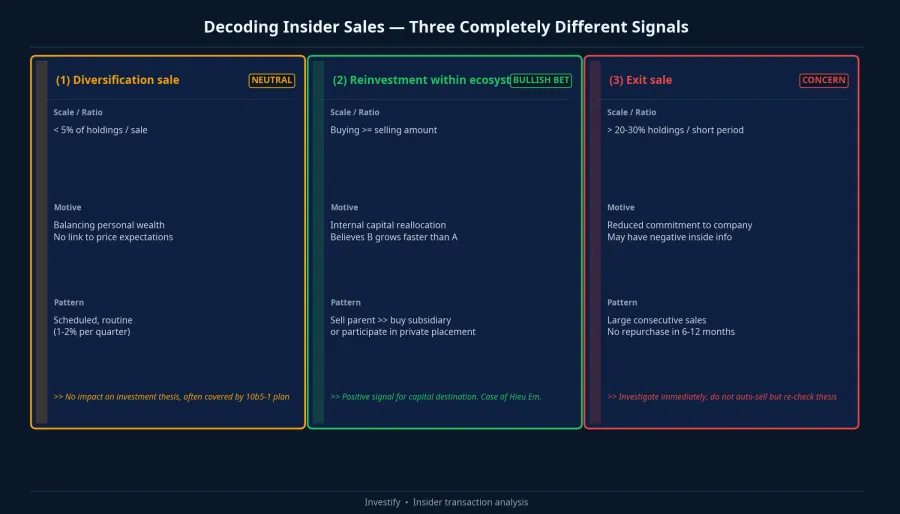
From those three questions, insider sales fall into three signal categories.
Diversification sale. An executive trims a portion of accumulated stock to rebalance personal wealth: buying a home, saving for retirement, or diversifying into other assets. The sale is typically a small fraction of total holdings, with no accompanying corporate event. Neutral signal.
Reinvestment within the ecosystem. An executive sells parent company shares to invest in a subsidiary approaching its listing, or participates in a private placement within the same corporate group. Capital does not leave the ecosystem; it moves to where the seller believes growth potential is higher.
Exit sale. An executive sells a large block of holdings, particularly near ESOP vest dates, ahead of negative developments, or alongside signals of stepping back from management. The sale is large relative to total holdings, with no clear reinvestment rationale. This is the signal that warrants genuine concern.
These three categories cannot be distinguished from a headline alone. The disclosed purpose in the regulatory filing is the critical data point. Current rules require executives to register in advance and state both the volume and the purpose of each transaction.Vietstock
The Numbers: 56.5% of Personal Holdings and VND 170 Billion
Before the transaction, Hieu Em held 3.54 million MWG shares, equivalent to approximately 0.241% of total equity.CafeF Afterward, the position shrinks to approximately 1.54 million shares (0.1%). The 2 million shares sold represent nearly 56.5% of his total personal holding. Someone selling 56.5% of their portfolio in a single transaction is not rebalancing. That scale reflects a specific commitment.
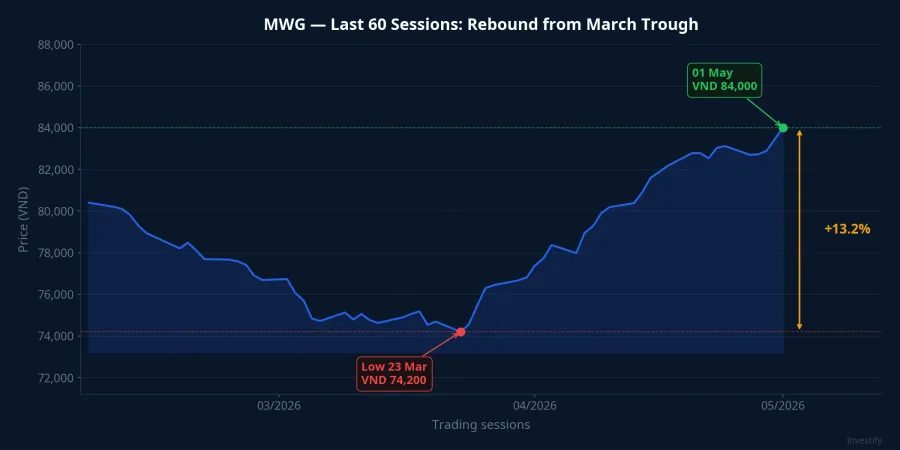
Using MWG's market price of VND 84,000 per share on 1 May as a reference, the estimated proceeds come to approximately VND 170 billion.Dantri MWG had already rallied 13.2% from its trough of VND 74,200 on 23 March before reaching VND 84,000Tinnhanhchungkhoan, meaning the sale is coming after a substantial recovery, not out of panic at the lows.
The block-trade structure is also worth noting. Because the sale is executed off-exchange rather than through the order book, it creates no additional supply pressure on MWG's market price during the 6 May to 4 June window. That is a meaningful distinction from a large on-market dump.
The DMX IPO: Context Behind the Transaction
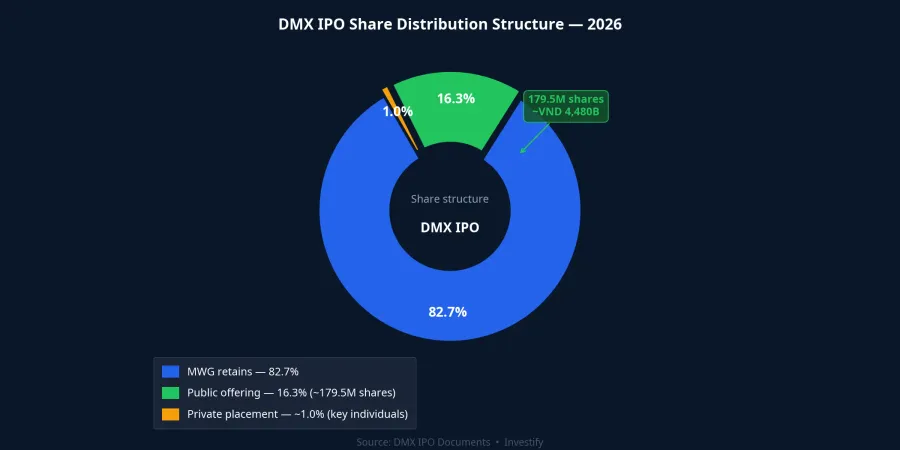
Dien May Xanh has locked in its IPO plan. The board of Mobile World approved a public offering of up to 179.5 million shares, representing approximately 16.3% of total equity, at an offering price of no less than VND 16,163 per share, a reference level anchored to audited book value for 2025.CafeF In parallel, DMX plans a private placement of approximately 1% of equity to key individuals to lock in management commitment. That is the tranche Hieu Em appears to be targeting.
The underlying business performance supports that picture. In Q1 2026, Dien May Xanh reported revenue of approximately VND 32,600 billion and net profit of approximately VND 2,206 billion, up roughly 49% year-on-year.Tinnhanhchungkhoan DMX contributed approximately 80% of the group's consolidated profit in the quarter, as Mobile World as a whole posted net profit of VND 2,758 billion, up 78% year-on-year and the highest quarterly figure in the company's history.Vietstock For the full year 2026, DMX is targeting revenue of VND 122,500 billion, net profit of VND 7,350 billion, and a projected dividend yield of 25%.
The CEO of that business selling part of his parent-company stake in order to put money into his own company's offering does not fit the exit narrative.
A Valuation Signal and the Depth of Personal Commitment
When Hieu Em sells at approximately VND 84,000 (MWG) to enter the IPO at approximately VND 16,163 (DMX), he is sending a valuation signal. The two securities have different share counts and balance sheet structures, so a direct comparison of per-share prices is not meaningful. But the directional signal has value: at the offering price approved by the board, an insider is willing to put real money in.
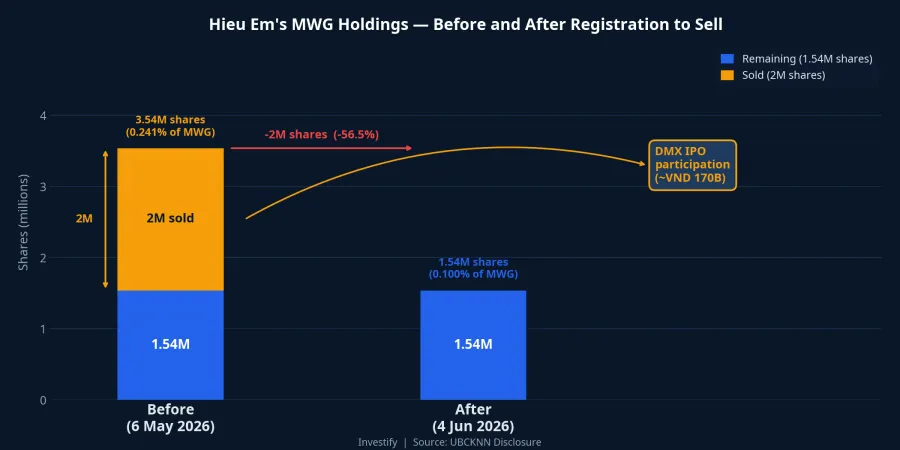
One detail stands out. In most IPOs, parent-company executives typically receive an allocation at an internal price without needing to liquidate other assets first. The fact that Hieu Em needs to sell nearly 56.5% of his personal MWG stake to fund the participation suggests a commitment that goes beyond standard allocation entitlements.
Two Alternative Explanations Worth Acknowledging
The available evidence points most strongly toward the ecosystem reinvestment interpretation, but two alternative readings cannot be fully ruled out.
First, some portion of the approximately VND 170 billion may serve personal needs unrelated to the IPO, with only part of the proceeds allocated to the offering. The regulatory filing does not require a detailed breakdown. That said, selling 56.5% of a personal equity position for purely personal diversification is an unusually large proportion and does not match typical rebalancing behavior.
Second, with MWG up 13.2% from its March trough and trading at a P/E multiple that is elevated relative to its historical average, Hieu Em may have assessed that MWG's near-term upside is limited and this is simultaneously a profit-taking event and a portfolio rotation. This cannot be fully excluded. However, if the transaction reflected a shared view among insiders that MWG is fully valued, one would typically expect multiple executives to act in the same window. Chairman Nguyen Duc Tai and other board members have not filed similar sell registrations during the same period.
Weighing the evidence, the ecosystem reinvestment interpretation has the most data support.
Three Milestones to Watch
For current MWG shareholders, the DMX IPO is not a neutral event. MWG will retain approximately 82.7% of DMX equity post-offering, meaning the bulk of DMX's valuation continues to sit inside MWG's consolidated financials. The IPO creates a standalone market price for DMX, which may help surface embedded value. It also introduces a degree of dilution risk.
The practical question is not "should I exit MWG now" but rather to monitor three milestones that will confirm or adjust the current reading. First: the actual transaction outcome after 4 June 2026, since a registration does not obligate Hieu Em to sell the full 2 million shares. Second: when DMX formally files its prospectus with the State Securities Commission. Third: the final offering price versus the VND 16,163 reference floor.
If the final offering price lands materially above the reference level, the context around this entire transaction shifts. And if Hieu Em completes the full 2 million share sale, that is the clearest confirmation of the commitment his registration declared.