

VN-Index closed last week at 1,853 points.CafeF That number, on its own, is just a weighted average — it hides more than it reveals. Vietnam's Q1/2026 earnings season is painting a far more differentiated picture: upstream oil and gas benefiting from high commodity prices, banks posting their strongest quarter-start in years, securities firms splitting into two camps by capital size, and real estate companies booking record profits while the secondary property market remains sluggish. This analysis breaks down all four sectors by the numbers that have been reported.
Upstream Oil & Gas: Your Position in the Value Chain Determines Everything
Brent closed on April 27 at $107.75/barrel, up 12.8% from April 20's close of $95.48 — and approximately 19.5% above the ~$90 range seen in early March. High commodity prices flow directly into upstream results.
PV GAS (GAS) reported pre-tax profit of VND 3,755 billion for Q1/2026, up 10% year-over-year. More telling is net revenue: VND 38,019 billion, up 48%, with dry gas and LNG revenue surging 90% to represent 55% of total revenue.DNSE GAS shares closed April 27 at VND 78,300, implying a market cap of approximately VND 188,900 billion.

The real story in the numbers isn't the 10% profit growth — it's the 48% revenue expansion. Margins were partially compressed as input costs also rose with oil prices, but the scale of the business grew substantially. More importantly: the "oil and gas" label on a stock board can mask enormous differences across the value chain. Upstream operators — gas extraction and processing — directly capture high Brent prices. Downstream distributors — retail fuel sales — face a mismatch between procurement costs (which track Brent) and selling prices (which may be regulated or lower). Treating all "oil and gas" stocks as homogeneous is one of the most common analytical errors.
Banks: The Strongest Q1 Start in Several Cycles
Vietnam's listed banks reported their best collective quarter-start in recent memory. VietinBank (CTG) estimated pre-tax profit above VND 10,000 billion for Q1/2026, up 56% year-over-year — the first time in the bank's history that a first quarter has crossed the 10,000 billion mark.Báo Pháp luật doanh nhân Total assets as of end-March grew an estimated 5.4% from end-2025, with credit outstanding up 1.7%. CTG shares closed at VND 35,000 on April 27, implying a market cap of approximately VND 271,800 billion.
VPBank reported consolidated pre-tax profit of over VND 7,900 billion, up 58% year-over-year.CafeF Techcombank posted pre-tax profit of VND 8,869 billion, up 22.5% — a record high for any quarter in the bank's history.MarketTimes
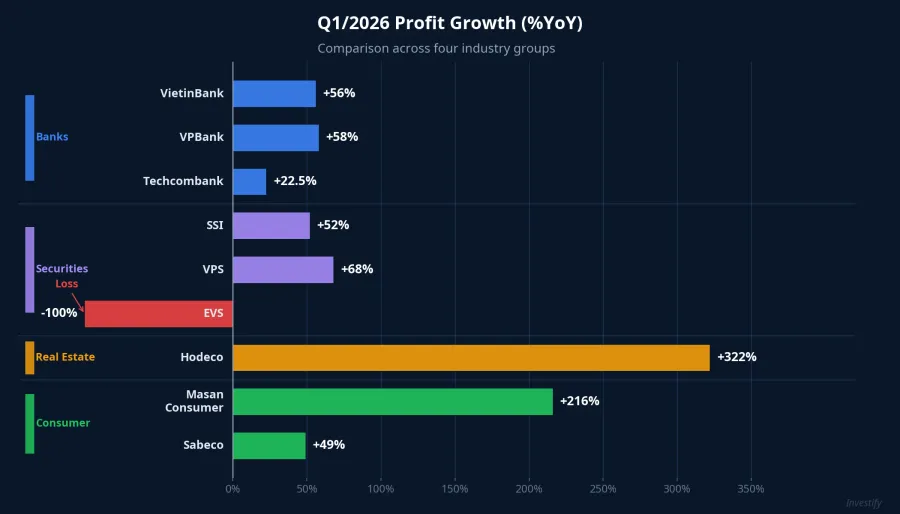
Three factors converged to produce these results. First, credit disbursement spread more evenly from the start of the year rather than concentrating in the final quarter. Second, net interest margins began expanding again after the 2024–2025 cycle of deliberately compressed spreads to sustain credit growth. Third, fee income — especially at Techcombank — contributed a rising share of total revenue. VPBank also benefited from the consumer lending ecosystem feeding into consolidated group profits. Internal dispersion within the banking sector was notably milder than in the other three groups: most listed banks reported double-digit profit growth in Q1.
Securities Firms: Charter Capital Determines Outcomes
This group shows the widest gap between the top and the bottom.
SSI led the pack with Q1/2026 pre-tax profit of VND 1,593 billion, up 52% year-over-year.VietnamBiz VPS recorded net profit after tax of VND 1,235 billion, up 68%. TCBS reported pre-tax profit of VND 1,458 billion, alongside the headline that it raised $488 million in international capital during the quarter.Vietstock At the other end: EVS reported a loss of VND 197 billion, reversing a profitable Q1 last year, citing sharp market swings from geopolitical factors that hit its proprietary trading portfolio.CafeF
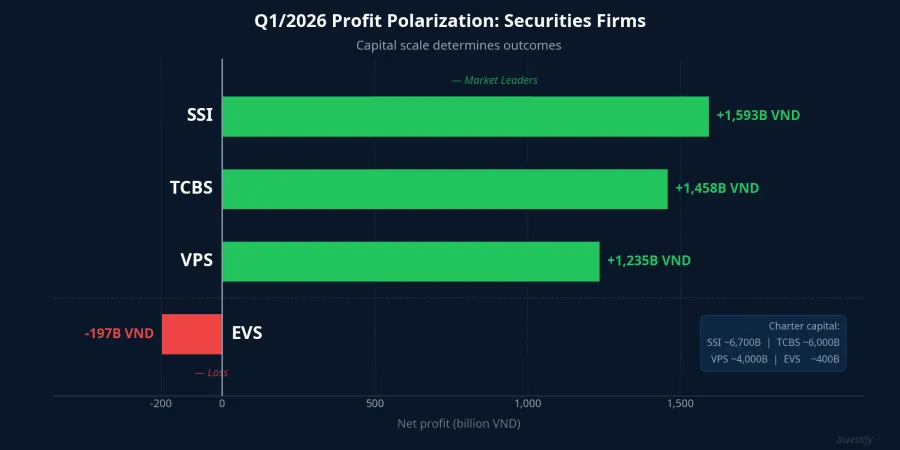
The divergence mechanism isn't management skill — it's charter capital. Large-capitalized firms — SSI at approximately VND 6,700 billion, TCBS at approximately VND 6,000 billion, VPS at approximately VND 4,000 billion — can simultaneously run meaningful margin lending books (producing stable interest income that doesn't depend on daily market direction) and maintain enough capital buffer to absorb proprietary trading losses during volatile sessions. EVS, with charter capital of approximately VND 400 billion, has neither advantage: margin lending revenue is proportionally small, and a single bad week in proprietary trading is enough to erase the quarter's profits. The takeaway: reading a securities firm's earnings requires looking at revenue composition (brokerage, prop trading, margin lending) and charter capital scale — not just the headline profit growth number.
Real Estate: Two Scorecards That Cannot Be Combined
Hodeco (HDC) was the standout performer in real estate for Q1/2026. Net revenue reached nearly VND 249 billion, 2.5 times the year-ago quarter — the highest figure in 14 consecutive quarters dating back to Q4/2022. Net profit jumped 322% to over VND 57 billion, driven by a recovering Ho Chi Minh City market and project handovers, including the launch of 340 social housing units.Vietstock

But Hodeco's result is the scorecard of a developer that successfully launched and delivered new projects — not the scorecard of the broader property market. In the same quarter, secondary market absorption in Hanoi came in well below the year-ago level, particularly in suburban areas. In Ho Chi Minh City, secondary transactions also narrowed compared to the previous quarter. Developers with new projects to sell — especially social housing and affordably priced segments — continue to generate revenue. Owners of secondary properties in the mid-to-upper price range, particularly in suburban locations, continue to face very thin liquidity. Reading a property developer's financial results and extrapolating to secondary market health is the most common allocation error retail investors make during earnings season.
Food, Beverage & Retail: Stable Recovery Across the Board
The consumer group shows the least internal dispersion of any sector this quarter — a reflection of domestic demand recovering steadily without the external-factor dependencies that drive the other three groups.
Masan Consumer reported Q1/2026 net profit after tax of VND 1,245.79 billion, up 216.59% year-over-year, on net revenue of VND 8,473 billion, up 13.1%.DNSE The triple-digit profit growth largely reflects the low base from Q1/2025, but the 13.1% revenue increase is a genuine demand signal: seasonings up 17.1%, convenience food up 14%, and personal care products up 34.2%. Sabeco reported net profit of VND 1,184.84 billion, up 49.39%.DNSE Domestic demand is recovering and spreading broadly across F&B and retail, in contrast to the more externally-dependent sectors above.
Three Frameworks for Reading This Earnings Season
Four sector groups, three analytical takeaways that investors should apply going into the remainder of the earnings season.
First: position in the value chain matters more than the sector label. Rising Brent benefits PV GAS but pressures downstream fuel distributors. The credit and interest rate recovery benefits consumer-focused banks more than those concentrated in large corporate lending. The same "banking" or "oil & gas" label can hide very large differences in actual business performance.
Second: capital scale determines winners in financial services. Large securities firms hold two simultaneous advantages: stable margin lending income that doesn't depend on daily market moves, and enough capital buffer to absorb proprietary trading drawdowns. Small firms have neither. Buying a securities stock based on the expectation of a "generally good market" without examining charter capital scale and revenue composition is a meaningful valuation risk.
Third: a property developer's financial statements do not reflect secondary market liquidity. Hodeco's profit surge does not mean the secondary apartment market has recovered. These are two entirely different scorecards — one measures a developer's project sales and handovers, the other measures the transaction-ability of existing real estate assets held by households. Conflating the two is the most common analytical error retail investors make during the property earnings season.
What to Watch in the Coming Weeks
The Q1/2026 earnings season isn't over. Three groups worth monitoring in the weeks ahead: the remaining state-owned banks (BIDV, Vietcombank) will show whether the strong credit trend is industry-wide or concentrated in private banks; mid-sized securities firms will reveal where exactly the capital threshold sits that separates clear winners from vulnerable players; and northern-region property developers will clarify how much of Hodeco's Q1 strength reflects a Ho Chi Minh City-specific tailwind versus a broader market recovery. A more complete picture will emerge over the next two weeks as the majority of listed companies complete their disclosures.