
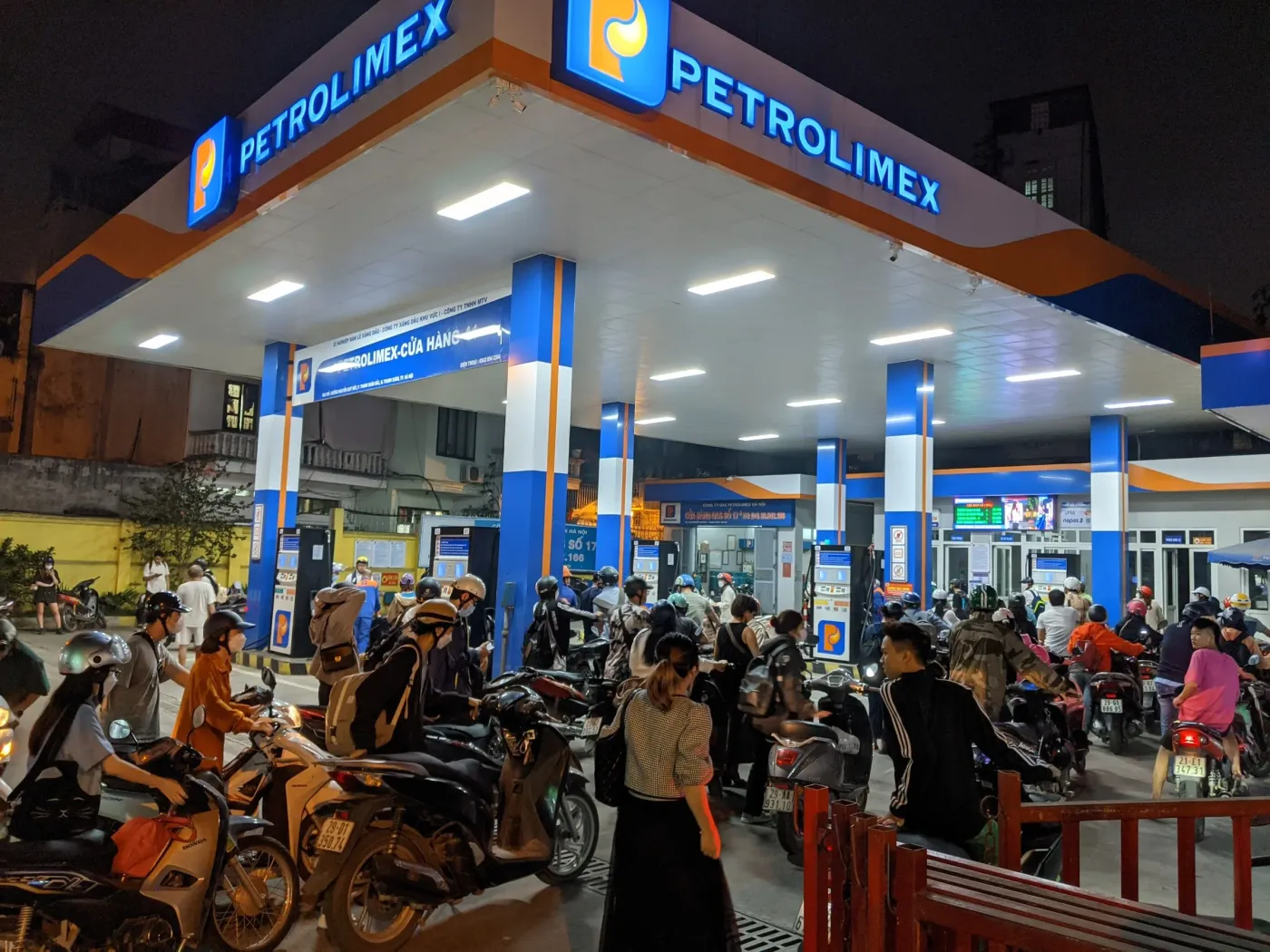

What the headlines don't spell out clearly: the policy that simultaneously zeroed out all three fuel taxes lasts only 20 days. After April 15, if the extension approval process is delayed by even a single week, RON95 gasoline prices could spike by 5,000 VND/liter from taxes alone. This is a risk the market is currently overlooking.
Three Taxes Reduced to Zero: An Unprecedented Move
On March 26, 2026, Prime Minister Phạm Minh Chính signed Decision 482/QĐ-TTg, marking the first time in history that all three fuel taxes were simultaneously reduced to zero: environmental protection tax at 0 VND/liter, special consumption tax at 0%, and fuel exempted from VAT declarations.Government Portal
The policy took effect from 24:00 on March 26 through April 15, 2026. Immediately after, RON95-III gasoline dropped by 5,625 VND/liter to 24,332 VND/liter, while E5 RON92 fell by 4,749 VND/liter to 23,326 VND/liter.Báo Đà Nẵng This was the sharpest decline in years, directly supporting transportation and logistics costs for millions of businesses.
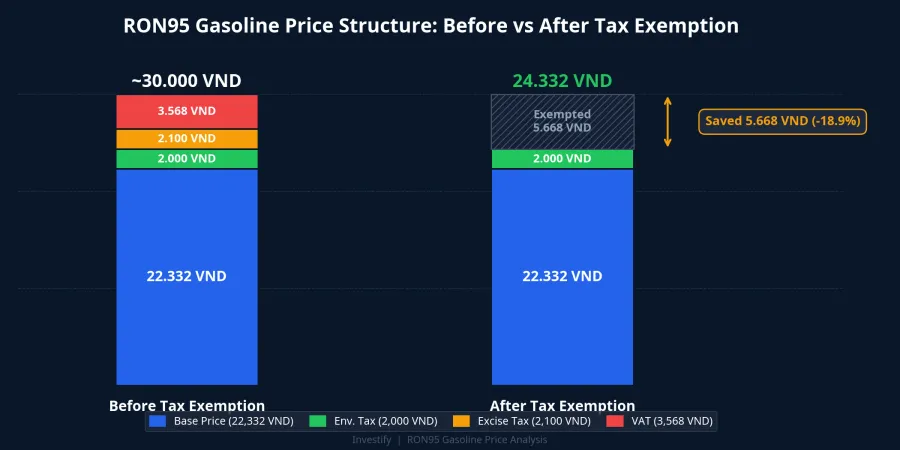
Looking at the price breakdown, the tax component that was cut accounted for nearly 19% of the previous retail price. The base price of 22,332 VND remained unchanged, but the environmental tax (2,000 VND), excise tax (2,100 VND), and VAT (3,568 VND) were all fully exempted. This means: when the policy expires, the entire 5,668 VND/liter tax burden returns all at once.
The April 15 Deadline: An Unpriced Risk
The real risk lies in the fact that this policy is purely temporary. After April 15, without a new decision, the environmental protection tax will revert to 2,000 VND/liter for gasoline and 1,000 VND/liter for diesel under Resolution 109/2025/UBTVQH15.Thư viện Pháp luật The excise tax and 8% VAT will also be reinstated.
In other words, RON95 gasoline could jump by approximately 5,000-5,600 VND/liter from taxes alone, pushing the retail price into the 29,000-30,000 VND/liter range. And that does not account for global oil volatility: Brent crude reached 109 USD/barrel on April 2, up nearly 34% in one month due to tensions at the Strait of Hormuz. The combination of returning taxes and elevated crude prices could create a double shock on domestic fuel costs.
Ministry of Finance Proposes Extension, but the Process Is Long
The Ministry of Finance has proposed extending the tax exemption from April 16 through June 30, 2026, maintaining the same scope: zero environmental tax, no VAT declarations required, and 0% excise tax.Government Portal
However, each month of extension costs the central budget approximately 7,200 billion VND in lost revenue. If extended for 2.5 months (April 16 to June 30), total budget impact is estimated at 18,000 billion VND. The proposal still requires review and approval from the National Assembly and its Standing Committee — a process that cannot be completed in just a few days. This is the risk gap investors should be watching: even if the extension is approved, a "delayed approval" scenario could temporarily push fuel prices up during 1-2 pricing adjustment periods.
The Stabilization Fund Has Nearly Run Dry
Another overlooked risk: the Fuel Price Stabilization Fund (BOG) is nearly depleted. The fund's balance dropped from approximately 5,612 billion VND at end of 2025 to just about 2,600 billion VND on March 19, 2026, after continuous disbursements of 3,000-5,000 VND/liter to suppress prices. In simple terms, the fund "burned through" over 3,000 billion VND in roughly three months.
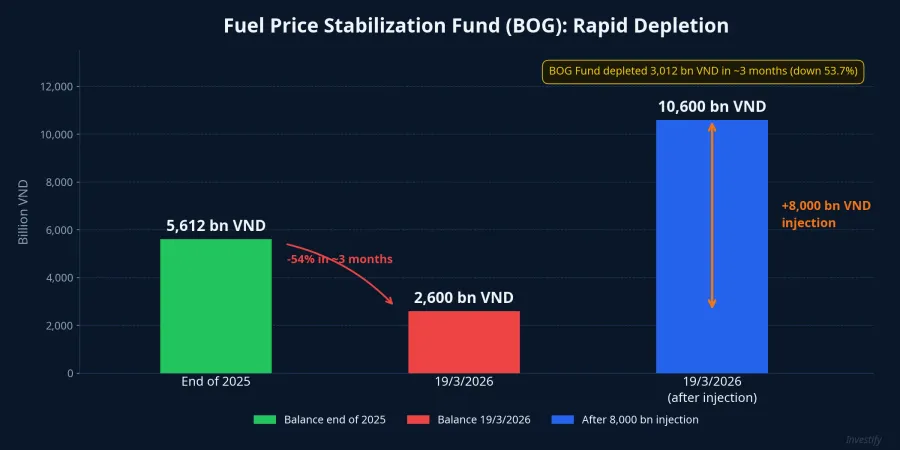
To create breathing room, the Government issued Decision 483/QĐ-TTg to temporarily advance 8,000 billion VND from the 2025 central budget surplus.Government Portal This advance must be repaid within 12 months and is managed under a transparent, independently audited framework. But at the current disbursement rate, 8,000 billion VND is only sufficient for approximately 2-3 months. If global oil prices continue to climb, the fund risks being depleted for a second time as early as Q3/2026.
Which Sectors Are at Risk, and Which Stocks Should You Watch?
Hardest-Hit Sectors if Fuel Prices Rise Again
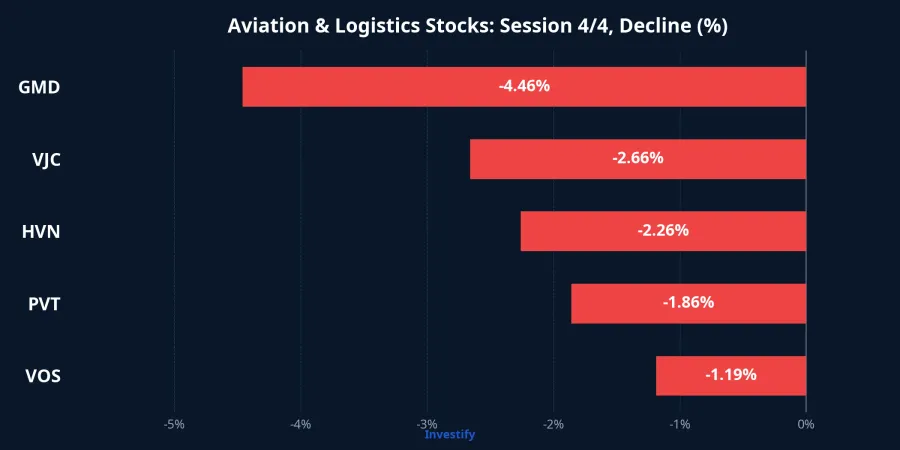
Fuel accounts for 30-40% of operating costs for airlines. VietJet Air (VJC, 161,100 VND) and Vietnam Airlines (HVN, 21,600 VND) are the two most sensitive tickers to fuel price movements. In the April 4 trading session, when Brent crude hit 109 USD, VJC declined 2.66% and HVN fell 2.26%.

Shipping and logistics stocks also face direct pressure: Gemadept (GMD, 70,700 VND) dropped the most at 4.46% on April 4, followed by PV Trans (PVT, 21,150 VND) down 1.86% and VOSCO (VOS, 12,500 VND) down 1.19%. Seafood companies that depend on cold-chain transport and fishing vessel fuel will also see their already-thin profit margins erode further.
Potential Short-Term Beneficiaries
On the other side, Binh Son Refining (BSR, 26,350 VND) could benefit from widening crack spreads as crude prices surge, although it also faces input cost pressure. Petrolimex (PLX, 40,200 VND) maintains stable margins thanks to the regulated pricing mechanism, functioning more as a distribution intermediary than bearing raw material price risk.
Three Scenarios Investors Should Prepare For
Scenario 1: Timely extension (high probability). The tax exemption is extended before April 15, fuel prices remain at current low levels. Transportation and aviation stocks continue to benefit. This is the scenario the market is pricing in, but "expectation" does not equal "certainty."
Scenario 2: A 1-2 week delay. The approval process runs over, and gasoline prices temporarily rise during 1-2 pricing adjustment periods. Transport stocks could decline 3-5% in the short term before recovering once the extension is announced.
Scenario 3: No extension. Taxes return in full, gasoline prices jump by over 5,000 VND/liter. Combined with Brent crude above 100 USD, this would be the largest cost shock for businesses since the start of the year. Aviation and logistics stocks could lose an additional 8-12% in value.
What Should Investors Monitor?
Although the probability of an extension is relatively high — the Government has demonstrated its determination to control fuel prices through a series of unprecedented measures — investors should closely watch three key milestones: the outcome of the extension proposal approval before April 15, the first fuel price adjustment period after April 15, and Brent crude price movements amid ongoing tensions at the Strait of Hormuz.
For aviation and logistics stocks, this is a period for caution rather than aggression. The policy risk may only last a few weeks, but the impact on profit margins is real and quantifiable. While awaiting the final decision, maintaining a moderate allocation and closely monitoring policy developments is the most prudent strategy.