


On September 2, 2026, Vietnam's Ministry of Finance published a list of five firms granted in-principle approval to prepare crypto asset exchanges. Look at the registered-capital column next to that list, and the natural reflex is to rank the firms by how much money they have. That reflex is exactly where the reading goes wrong, and it's worth untangling before the market builds a story on top of it.
The capital column is being read as a leaderboard
Per the Ministry's disclosure, registered capital in the five applications varies wildly: VIXEX (backed by Chứng khoán VIX) and Digital Asset Vietnam JSC both sit at VND 1,000 billion, TCEX (Techcom Exchange) at VND 101 billion, CAEX (Vietnam Prosperity Crypto Exchange) at just VND 25 billion, and SCEX, formerly LPEX, at a mere VND 6.8 billion.VTC News Set against the VND 10 trillion minimum required to actually operate, the gap looks like a canyon, and the common takeaway is that these firms are simply short of cash and the market has to wait.
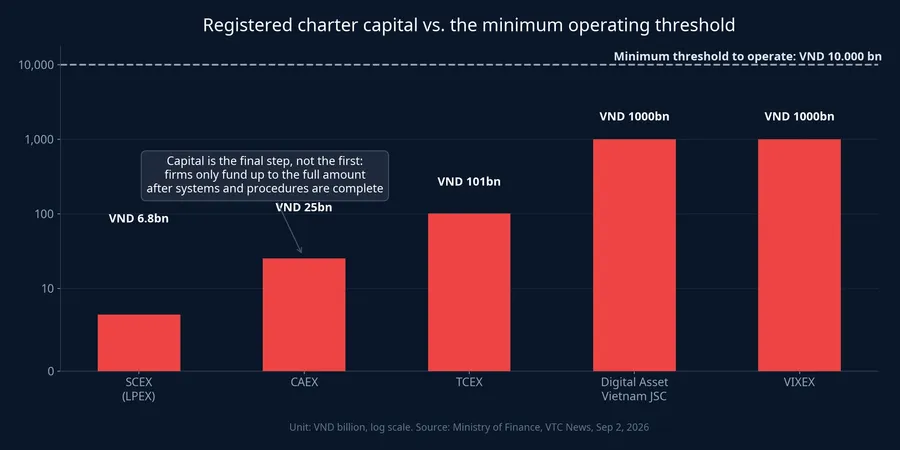
The real sequence runs the other way. Tô Trần Hòa, Deputy Head of the Crypto Asset Market Management Board at the State Securities Commission, laid out the steps a firm takes after in-principle approval: first build an information system meeting Level-4 security standards, then complete roughly ten operating procedures covering trading, settlement, fees, reporting and governance.VTC News Only after finishing all of that does a firm fund up to the full VND 10 trillion. In other words, the capital figure in the list doesn't measure who's moving faster. It only tells you whether a firm has reached the funding step yet, or chose to front-load it early.
CAEX hit its full capital target in April, and it's still waiting
This is the clearest evidence that money was never the constraint. On April 17, 2026, CAEX completed a capital raise to exactly VND 10 trillion.DNSE The resulting structure is 89.4% domestic and 10.6% foreign capital, with OKG Ventures Limited contributing VND 1,000 billion.Nhà Đầu Tư On the domestic side, VPBank Securities added VND 1,097 billion, alongside LynkiD and Future Land.Thời báo Tài chính Việt Nam
More than four months have passed since then. CAEX still hasn't received an operating license, and as of September 2, 2026, no exchange in Vietnam has one. If capital were truly the deciding factor, the market would already have its first exchange from midsummer. What the capital column doesn't tell you is where the real time is going: beyond the minimum capital, the rules also require at least 65% of registered capital to be held by institutional shareholders, over 35% held by at least two institutions from banking, securities, fund management, insurance or technology, and total foreign ownership capped at 49%.VTC News
A technical filter, not a financial one
That filter has already cost someone real money. Vietcap Securities withdrew from its own exchange plan, citing an investment requirement beyond its means, and redirected resources into a riskier but more familiar segment.Báo Đầu tư SSI and MB also chose not to enter the race.TheLEADER These are two securities firms and a bank with plenty of financial capacity, and they still pulled out. That alone is a signal: the hard part isn't scraping together VND 10 trillion, it's meeting the Level-4 information security standard and the operating procedures that come with it.

The ownership chain sits one layer from any listed company
This is where retail investors are most likely to form the wrong expectation, and where I'd flag the highest risk of a quick misread. Four of the five applications trace back to a listed entity, but almost never the name the market actually talks about.
At VIXEX, founding shareholders include FTG Vietnam at 64.5%, VIX Securities (ticker VIX) at 15%, and 3C Corporation at 20.5%.Người Quan Sát VIX's stake equals VND 150 billion. At TCEX, the direct shareholder is Techcom Securities, holding 9.9% of a VND 101 billion charter capital.CafeF That's a Techcombank subsidiary, not the listed bank itself (ticker TCB). At CAEX, the shareholder is VPBank Securities (ticker VPX on HOSE), holding around 11% after its VND 1,097 billion contribution. At Digital Asset Vietnam JSC, Sun Group holds 64%, Đổi Mới IT Services holds 35%, and Petroleum Securities (PSI) holds 1%MarketTimes, and Sun Group itself isn't listed. As for SCEX, formerly LPEX, it was renamed Sacom Crypto Asset Exchange right after Sacombank's shareholder meeting, but no disclosure to date confirms a listed entity's ownership stake there.TheLEADER
How small these stakes are next to the parent company
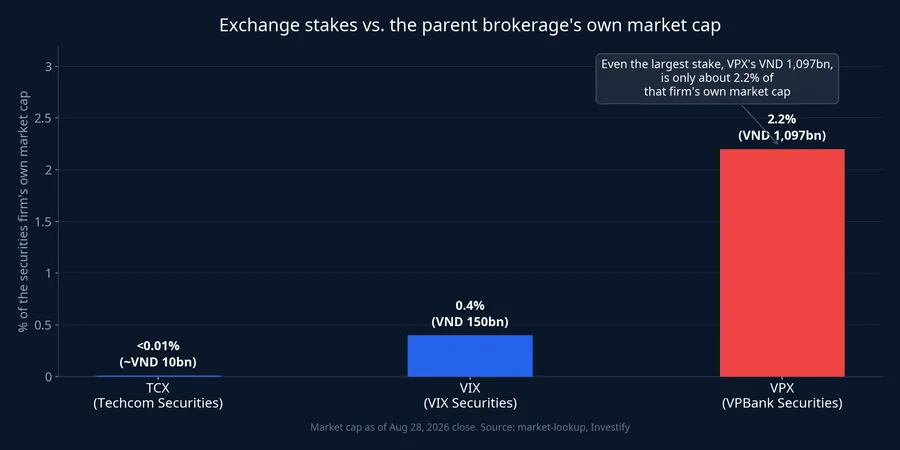
What the capital column also doesn't show is how small these stakes are relative to the firms making them. As of the August 28, 2026 close, Techcom Securities (TCX) had a market cap of VND 113.2 trillion, VPBank Securities (VPX) VND 49.2 trillion, and VIX Securities (VIX) VND 34.5 trillion. TCX's roughly VND 10 billion stake in TCEX is under 0.01% of its own market cap. VIX's VND 150 billion stake is around 0.4%. The largest of all, VPX's VND 1,097 billion, comes to only about 2.2%.
VIX has flagged plans to contribute a further VND 1,000 billion to VIXEX from an VND 11,026 billion share offering, though no disclosure has confirmed that contribution has actually happened.Báo Đầu tư Even if completed, the weighting stays at the level of a speculative bet, not a revenue pillar. For TCX, VPX, VIX and PSI shares, the current financial exposure to these exchanges is far too small on its own to move the earnings picture. The reasonable read at this stage is to treat it as an unpriced long-dated option, not a 2026 profit driver.
Where the real risk sits: retail investors' wallets
While the listed stocks carry only a small, indirect exposure, individual investors trading crypto assets face a much more direct risk. Decree 284/2026 on administrative penalties in the crypto asset sector took effect on September 1, 2026.VietNamNet Organizations providing or advertising crypto asset services without a license face fines of VND 180 to 200 million. Domestic investors trading outside an organization licensed by the Ministry of Finance face fines of VND 30 to 50 million.
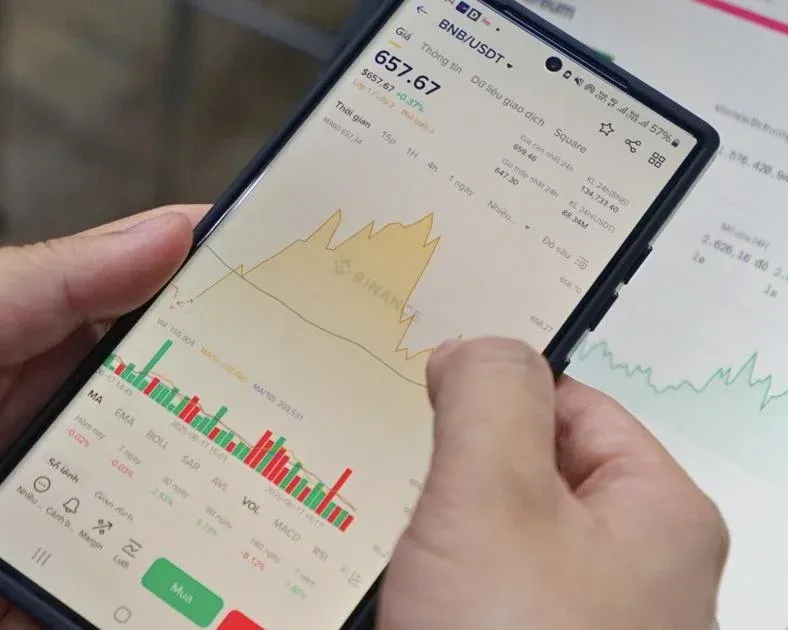
One point that's easy to miss in the coverage: for individual investors, the decree doesn't apply immediately. Under Resolution 05, there's a six-month transition period before the first exchange is licensed.VTC News So the date worth watching isn't September 1, which has already passed, but the day the first license is actually issued. The group affected is sizeable: Vietnam has an estimated 21.2 million adults who own or use digital assets, the second-highest count globally, and crypto inflows into Vietnam reached USD 220 billion in 2025, up 55% year over year and third in the Asia-Pacific region.VTC News
It's also worth being precise about which assets are covered. The pilot phase targets crypto assets tied to real-world assets, and it excludes securities and any digital form of fiat currency.VTC News The categories mentioned include agricultural commodities such as pepper, cashew and coffee, rental income from real estate, and wind and solar energy projects with stable cash flow. This is not a venue for trading the crypto assets familiar from international platforms, like Bitcoin or Ethereum.
Signals worth watching
Given this sequence of conditions, the tell that an exchange is about to launch won't be another capital-raise announcement. Funding is the last step, and firms only call for capital once the technical work is done. Two earlier signals matter more: a Level-4 information security certificate issued by the police, and the Ministry of Finance's final round of consultation with the Ministry of Public Security and the State Bank of Vietnam.
Until the first license is issued, every revenue projection tied to crypto assets at the securities firms involved remains an assumption, and every individual crypto trade outside the licensed framework still carries real legal risk. The question worth tracking over the coming weeks isn't which firm raises capital next, but whether the first Level-4 security certificate has been issued yet.