


On the morning of August 22, world gold prices broke above USD 4,604/oz, up roughly USD 90 in a single day.Thời báo Tài chính Việt Nam SJC gold bars in Vietnam also edged up to VND 144-147 million per tael. But the more notable shift is in the gap between those two numbers: converted at the world price, SJC's sell price is now just about VND 1.2 million per tael higher, the thinnest premium in years.Thời báo Tài chính Việt Nam
For gold buyers, this is a structural shift in what actually costs money. For years, the single biggest cost of buying gold bars in Vietnam was the premium over the world price. That premium has all but disappeared. What remains — and is now the largest cost — is the spread between what a shop pays to buy gold and what it charges to sell it.

The world rally got absorbed entirely by domestic prices
The past month makes this unusually clear. On July 16, world gold traded at USD 3,976.18/oz while SJC gold bars sold for VND 148.2 million per tael. By the August 21 session, world gold had climbed to USD 4,580.22/oz, up 15.2% from mid-July. Over the same window, SJC's sell price actually fell to VND 147.0 million per tael, below where it stood a month earlier.
In other words, the entire 15.2% rally in world gold got absorbed by the shrinking domestic premium instead of flowing into the pockets of anyone holding SJC bars.
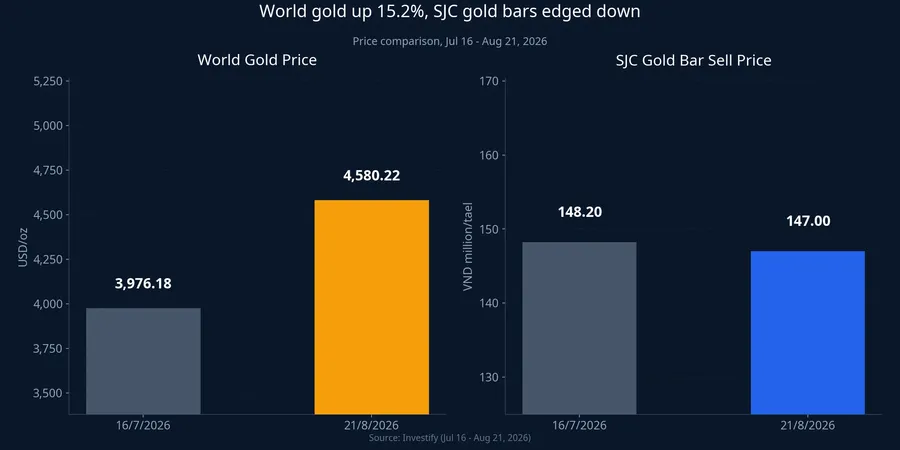
The math for a real buyer: anyone who paid VND 148.2 million for a tael of SJC gold on July 16 would only get VND 144.0 million back if they sold on August 21. That's a loss of VND 4.2 million per tael, or 2.83% of capital, during the sharpest gold rally of the year. Buyers of SJC gold rings that same day fared no better: the sell price was VND 145.2 million, and shops were only buying back at VND 140.5 million on August 21, a loss of VND 4.7 million per tael.
Why the gap closed
No single cause explains this. At least three forces are at work, and the evidence supports each to a different degree.
The first is adjustment speed. World gold prices moved fast through August, while domestic listed prices lagged well behind. This is the force visible directly in the price data, and it explains most of the recent narrowing.
The second is demand. Media reports note that foot traffic at gold shops has dropped sharply compared with the queues seen in early 2026, when the SJC-world gap sat in the VND 15-20 million range.Dân Trí
The third is supply. Decree 232/2025/NĐ-CP, effective October 10, 2025, ended the state monopoly on gold bar production and moved to conditional licensing for qualifying businesses and commercial banks.Chính phủ This one needs a cautious read: the gap did not narrow the moment the decree took effect. It stayed wide through late 2025 and the first half of 2026, only compressing sharply from June through August 2026. The decree built the medium-term framework; the recent narrowing has come mostly from the first two forces.
Gold bars vs gold rings: two numbers that decide
With the world-price premium now thin, comparing Vietnam's two most common physical gold products comes down to just two criteria that actually matter.
Entry price versus the world price. In the August 21 session, 99.99% SJC gold rings sold for VND 145.0 million per tael, VND 2.0 million cheaper than gold bars. Converted at the world price of USD 4,580.22/oz and an exchange rate of VND 26,092/USD, gold rings track the world price more closely than gold bars do. Rings are nearly a mirror of world price; bars still carry a thin brand premium.
The buy-sell spread. This is what buyers lose the instant they walk out the door, before the price even moves. SJC gold bars are quoted at VND 144.0-147.0 million per tael, a VND 3.0 million spread, or 2.04% of the sell price. Gold rings are quoted at VND 140.5-145.0 million, a VND 4.5 million spread, or 3.10%. The gap between the two spreads is VND 1.5 million per tael, in favor of gold bars.
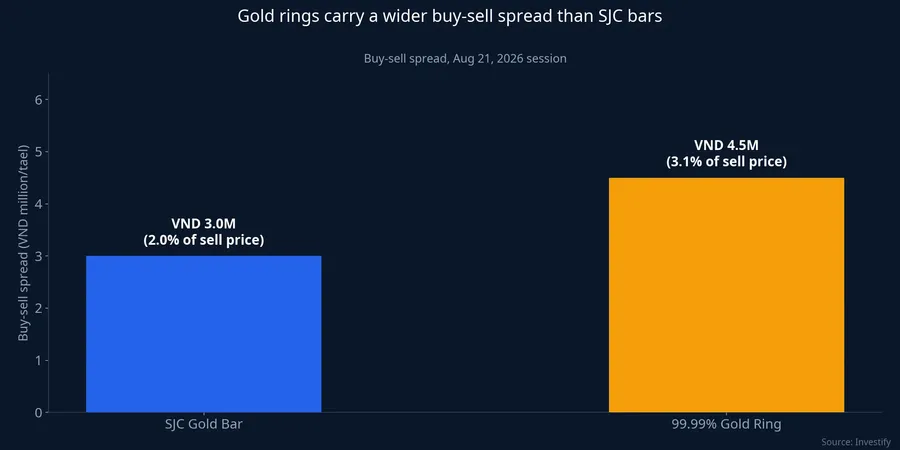
Put side by side, the two criteria pull in opposite directions. Gold rings offer a cheaper entry and track the world price more closely. Gold bars cost VND 1.5 million less to round-trip through a buy-then-sell cycle. Anyone trading in and out over a few months should weight the buy-sell spread more heavily, which favors gold bars. Anyone holding for years should weight world-price tracking more heavily, since the spread cost gets diluted over time. That favors gold rings.
One thing first-time buyers often miss: both products only break even once the gold price rises enough to cover the buy-sell spread: 2.04% for gold bars, 3.10% for gold rings. Buying today and selling next week is close to a guaranteed loss, even if the gold price ticks up in between.
The third channel is still closed to individual investors
Many people ask about gold fund certificates or gold ETFs, a channel that would let investors track the world gold price without holding physical metal. As of today, no such product is licensed in Vietnam. The State Securities Commission is studying and proposing a gold ETF framework for 2026, alongside amendments to Circular 98/2020 on fund operations, since the current circular has no provisions for this kind of product.Doanh Nhân Sài Gòn Per Bùi Hoàng Hải, Vice Chairman of the State Securities Commission, this is one of the priority tasks under direction from the Government and the Ministry of Finance, aimed at creating a way to participate in the gold market without holding physical gold.VnExpress
This is still at the research and proposal stage, not an issued regulation. Individual investors looking to access gold today still have just two legal domestic options: gold bars and gold rings, and any single-day transaction of VND 20 million or more must go through a bank account under Decree 232/2025.
Online gold trading platforms offering leverage remain unlicensed. On August 8, 2026, the Government Inspectorate recommended studying a roadmap for a national gold exchange and building mechanisms to handle speculation and market manipulation.Vietstock That is a recommendation, not an operating exchange.

The risk the gap widens again
The current VND 1.2 million gap is not a locked-in equilibrium. It's the result of cooling demand and eased supply, and both can reverse.
Raw gold supply still depends on the pace of import licensing, even though Decree 232/2025 opened the door for qualifying businesses and banks. If supply doesn't keep up while world prices keep hitting new highs and buyers return, the gap could widen again just as it did earlier this year.
In the opposite direction, if world gold prices correct downward, the domestic premium is now too thin to cushion the fall. Previously, the VND 15-20 million premium acted as a buffer keeping domestic prices from tracking the world price down. That buffer is nearly gone. Domestic gold prices will now respond to world prices much faster than in past years, in both directions.
Three numbers worth watching
For anyone weighing a gold purchase, the monitoring framework comes down to three markers.
First, the gap between SJC's sell price and the converted world price. If it widens back past VND 5 million per tael, that signals domestic supply is tightening again, and buying gold bars goes back to paying a brand premium.
Second, the buy-sell spread at the counter. VND 3.0 million for gold bars and VND 4.5 million for gold rings has been the baseline in recent weeks. Shops tend to widen this spread during volatile periods, and buyers absorb the full cost.
Third, the legal progress of the gold ETF and the national gold exchange. If either product actually launches, the cost structure of gold investing in Vietnam changes again, in favor of small buyers.
Gold remains a trusted safe haven for many Vietnamese households, and this is a rare stretch where domestic buyers are paying close to the world price. But the lesson from mid-July buyers still holds: a rising world gold price does not automatically mean domestic gold holders are making money.