


The $135 offer price was the simplest anchor in the SpaceX listing. Yet on July 15, the stock briefly fell to $132.28 before closing at $135.27. Recovering a few cents above the offer price does not erase the intraday break: buyers and sellers were willing to transact below the number that had come to symbolize the IPO.Reuters
Put simply, an IPO price is the result of a particular share sale, while a public-market price is the outcome of shifting supply and demand. The two are psychologically connected, but one does not guarantee the other. The lesson from SpaceX is not that a return to the IPO price makes a stock safe. It is that investors need to be clear about what they are comparing.

What an IPO price actually tells investors
The IPO price is the level at which the company and its underwriters sell shares in the initial offering. Buyers at that price are typically eligible institutions or investors who received allocations, not every retail investor able to place an order once trading begins. After the listing, new buyers face a price set by live buy orders, sell orders, and expectations at that moment.
That is why calling $135 the market's universal cost basis is wrong from the outset. Some holders received shares at the offer price, some bought above it, and others may have sold short or bought later. The same level can be break-even for one group, a loss for another, and merely a chart reference for someone who has never owned the shares.
The more important issue is anchoring. A round, widely repeated number from an IPO day can become a mental boundary. When the stock approaches or crosses it, market reactions may be larger than the modest numerical move itself. But a psychological reaction does not turn the level into mandatory support.
One session is not a verdict on value
The chart places three disclosed points in one view: the offer price, the July 15 intraday low, and the closing price. It shows that the shares recovered from their low, while also showing that the IPO level was genuinely tested. Neither observation should be selected to confirm a pre-existing view.
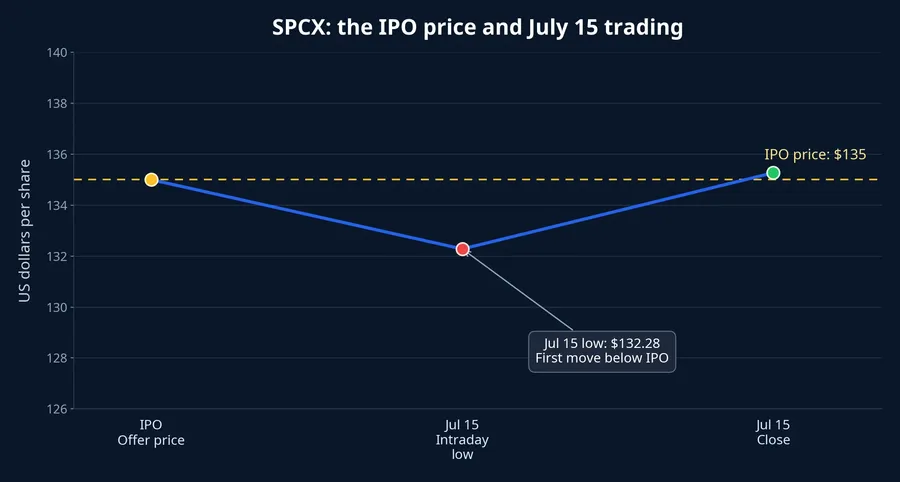
The move to $132.28 and close at $135.27 can have several readings. One is that buying interest emerged below the IPO level. Another is that selling pressure was not strong enough to hold the shares down through the close. A single session cannot establish $135 as support, nor can it prove that a longer decline has begun.
This is where new investors often confuse price with value. Price is the current transaction level. Value is an assessment of future cash generation, execution risk, and the discount rate the market is prepared to apply. A move below the IPO price proves only that the trading price changed. It takes much more evidence to reach a conclusion about value.
Why post-IPO expectations can reverse
High-profile listings often arrive with a very large story. For SpaceX, that story includes reusable rockets, satellite networks, infrastructure for artificial intelligence, and markets that still lie ahead. Part of the post-IPO price therefore reflects outcomes not yet delivered. As initial excitement cools, the market returns to familiar questions: how quickly revenue grows, how large the capital needs are, and when new projects convert into cash flow.
It would be too strong to assign the entire July 15 move to one cause where the reporting does not establish causation. Profit-taking, renewed valuation scrutiny, index-related trading, and broader sentiment toward growth stocks can all coexist. What the evidence clearly supports is that the market is retesting very high expectations, rather than automatically treating the IPO price as a floor.Reuters
This distinction matters because it avoids a rushed inference: a falling stock does not necessarily mean that a company has produced one decisive piece of bad news. A share price can fall when earlier expectations were simply too high. Conversely, good news may not lift a stock when that news was already reflected in the price. Investing in a high-growth company always involves judging the gap between a promise and the delivered result.
Two tests: finances and execution
Over the next several weeks, the useful question is not whether SpaceX can hold $135 in every session. The more important question is what its first post-listing report says about revenue, costs, funding needs, and the ability to convert ambition into cash flow. One clear report will not determine the share price, but it will give the market a firmer basis for adjusting expectations.
On the operating side, Starship remains a key variable. The thirteenth test flight was scheduled no earlier than July 16 after the Federal Aviation Administration completed its review of the previous mishap; it is a technology test, not an earnings report.Space.com A smooth test could reduce some technical execution risk, but it would not answer questions about cash generation or a fair valuation.

These two tests should be kept separate. Technical progress makes the long-term story more credible. Financial discipline shows what funds that story and for how long. An analysis focused only on rockets misses the cost base; one focused only on a quarter's figures can miss the value of reducing technology risk. For a high-growth company, the market tends to value both at once.
How to read a break below the IPO price
Rather than treating the IPO price as a buy or sell signal, turn it into a set of checks. First, who was actually able to buy at the offer price, and how large was that allocation relative to post-listing trading? Second, what assumptions about growth and profitability are embedded in the current price? Third, which upcoming events can provide new data to test those assumptions?
For SpaceX, the watch list should center on its first post-listing report, funding requirements, Starship progress, and any change in the supply of shares available for trading. Those variables can change the market's view of the gap between ambition and execution. One day's closing price is a snapshot; these variables shape the story across many quarters.
The conclusion is straightforward: moving below the IPO price does not automatically make SpaceX a bargain, just as trading above it was never a warranty. The thesis is that the market is moving from a psychological marker to a process that demands evidence. $135 is worth watching as a reference. Financial reporting and execution progress are the signals most likely to confirm or change the picture.