
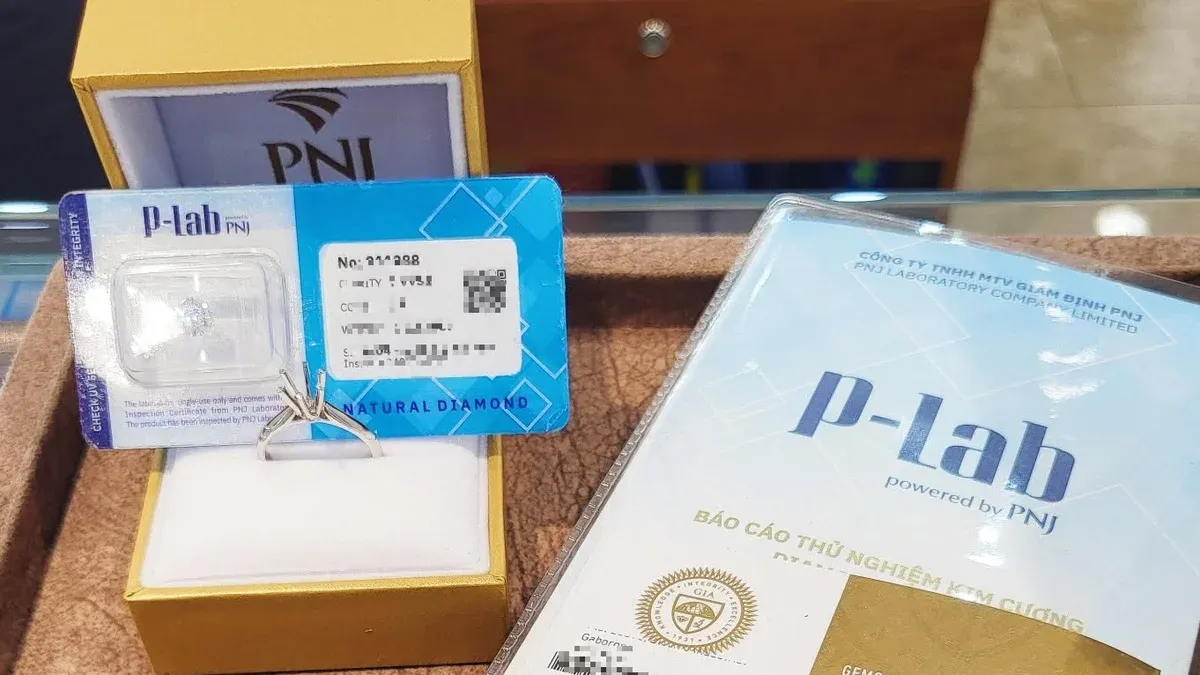

News that a P-Lab appraisal employee has been prosecuted has placed PNJ under a harsh spotlight. The real risk is in how that news is read: treating an individual, a subsidiary and a parent company as one party takes investors beyond the evidence. But using separate legal status to dismiss every concern would miss the risk already in view: confidence in the appraisal operation.
At 11:29 a.m. on July 15, PNJ traded at VND 43,900, down 6.40% during the morning session. The market move signals that investors are demanding a larger discount for uncertainty; it is not a finding by a prosecuting authority. The decline can reflect concerns about legal exposure, possible service disruption, brand damage and the broader market. The useful question is therefore not what the price says about guilt, but what public information actually establishes.
The publicly identified party is an individual
Based on information from Thanh Hoa Provincial Police reported by Thanh Nien, investigators prosecuted and detained additional accused individuals in a smuggling investigation. The group includes an appraisal employee of PNJ Laboratory Company Limited, commonly known as P-Lab.Thanh Niên VietnamBiz reported that the prosecution decision was issued on July 12 and became widely public on July 14.VietnamBiz
That distinction is the first one worth preserving. Public reporting identifies an individual as prosecuted; it does not identify PNJ or the P-Lab legal entity as an accused party. The accurate formulation is that there is no public information showing that PNJ or P-Lab has been prosecuted, not that the companies are certainly free of responsibility. The investigation remains ongoing, and new information could change the assessment. What has not been disclosed, however, cannot responsibly be filled with a reading of the ticker tape.

The presumption of innocence is not a technical footnote. Article 13 of Vietnam’s Criminal Procedure Code provides that an accused person is presumed innocent until guilt is proved under the legal process and a conviction becomes legally effective.Luật Việt Nam “Prosecuted” and “guilty” are not interchangeable descriptions. For shareholders, this linguistic discipline matters because a misleading headline can turn a risk that requires monitoring into a conclusion unsupported by evidence.
Three risks that should not be collapsed
P-Lab is a wholly owned PNJ subsidiary. PNJ has described it as an independent legal entity with charter capital of VND 10 billion.Mirae AssetZnews Full ownership explains why the P-Lab name can directly affect how the market views PNJ. It does not erase the subsidiary’s separate legal status, nor does it automatically turn an employee’s conduct into the will of the parent company.
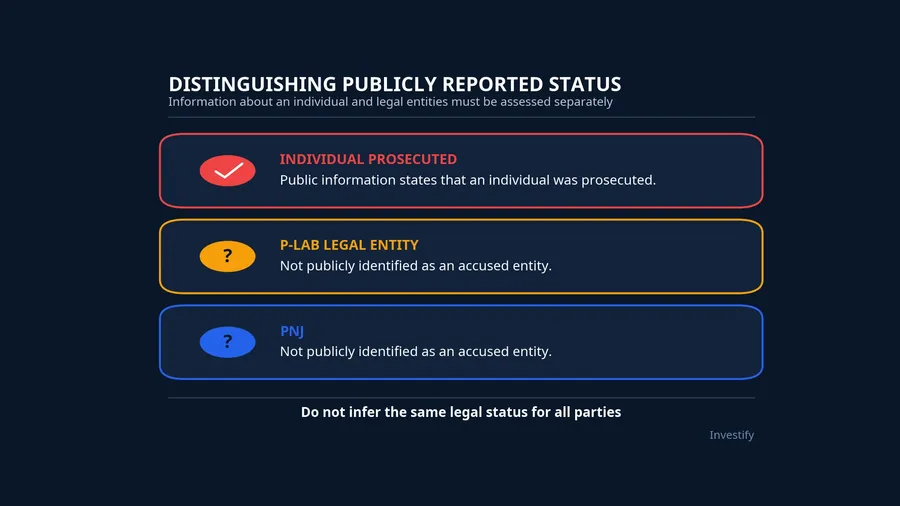
The first layer is criminal-procedure risk. Vietnamese law permits criminal liability for commercial legal entities in statutory cases, including smuggling, but that liability does not arise automatically because an employee is under investigation.Ministry of Justice Investigators would need to establish whether an act was performed in the entity’s name, for its benefit, or with its direction or approval. The public information now available does not answer those questions.
The second layer is operational risk. An employee working in appraisal can require a company to determine the scope of affected records, procedures and services even where the legal entity has not been identified as an accused party. The key questions are which step the employee participated in, which data and certificates can be traced, and whether a review could delay services or add costs. Without specific answers, investors cannot translate the event into an effect on revenue or profit.
The third layer is trust, and it is the clearest risk already visible. A diamond certificate has value because customers believe its stated attributes match the stone and its issuance process is reliable. The appearance of another appraiser in reporting on the investigation does not prove organisational wrongdoing. It does, however, raise the standard that internal controls and disclosure must meet. That is the difference between having no legal conclusion and having no economic consequence.
A stock price is not a verdict

PNJ’s morning decline on July 15 cannot establish that the market has determined criminal liability for the company. A share price is where probabilities are priced continuously, often before a final finding and sometimes too aggressively when information is incomplete. In this case, investors may be considering weaker diamond sales, higher complaint-resolution or review costs, damage to the brand, or a valuation that requires a wider margin of safety.
Those are risk hypotheses, not proof of the sole cause of the price move. The VN-Index was also down 0.87% during the same morning session. It would therefore be inaccurate to attribute PNJ’s entire decline to the P-Lab news. Two propositions need to remain separate: the price action shows that investors are paying attention to uncertainty; it does not show that uncertainty has become a realised loss or a legal conclusion.
Evidence that could change the assessment
What a brief disclosure does not settle is that the quality of the response after new developments matters more than repeating a broad reassurance. The first valuable item is a PNJ disclosure after the July 14 development: what the company knows, what it is reviewing and when it will update the market. A statement that operations remain normal describes a current state; it does not itself define the scope of the matter.
The market then needs verifiable data: the scope of conduct identified by investigators, the number of certificates or files requiring review, the independent-control mechanism at P-Lab and operating indicators such as complaints, returns or diamond sales. Each answers a different question. Collapsing them into a conclusion now would remove precisely what investors need: the ability to distinguish an event, its impact and an inference.
This framework is especially useful for new investors. Legal proceedings, operations and market valuation move on different clocks. A disclosure may clarify the formal status of a party without telling the market how many certificates must be reviewed; a normal trading day may say little about whether customers continue to rely on the service. Conversely, a temporary price recovery would not settle either issue. Treating each new fact as evidence for its own question prevents a headline from being promoted into a blanket verdict.
The practical monitoring list is therefore narrow. Watch for a dated PNJ update that defines the review scope, for statements that identify the legal status of each relevant entity, and for subsequent operating indicators that make the commercial effect observable. The absence of a public detail should be recorded as an information gap, not silently converted into proof for either the optimistic or pessimistic case. That distinction protects readers from both panic and misplaced reassurance.
The present conclusion is necessarily conditional. There is no public basis for calling PNJ or the P-Lab legal entity prosecuted, yet it is no longer persuasive to call the issue merely private to one individual, because confidence in appraisal services and the quality of controls have become business variables. This thesis changes only with new procedural information or concrete operating data: follow the evidence rather than allowing one trading session to write the missing part of the record.