

GIL hit its daily floor in the morning session of July 13, trading at VND 9,910 per share at about 11:18 after falling 6.58% on July 10. This was more than a reaction to an adverse headline. The market was repricing a possibility that had carried substantial expectations: Gilimex's roughly USD 840 million claim against Amazon has now been dismissed with prejudice at the district-court level.
The distinction matters. Gilimex says it will appeal, but an appeal does not turn USD 840 million into an asset or receivable. In valuation terms, the claim now faces at least two layers of uncertainty: whether an appellate court changes the procedural ruling, and, if it does, whether Gilimex can prove liability and damages on the merits. For newer investors, separating those two questions helps avoid treating a legal right as cash.
The ruling changed the case's status
On July 9, the court granted Amazon's sanctions motion and dismissed the entire case with prejudice; it also denied Gilimex's sanctions motion against Amazon. Reports on the ruling indicate that its focus was the reliability of the evidentiary record, not a full trial deciding whether Amazon breached its supply obligations.Znews
That outcome is materially different from a claim merely awaiting trial. A dismissal with prejudice at this level prevents Gilimex from bringing the same case again in the district court. In its July 13 disclosure, the company said the ruling did not determine whether Amazon had breached its obligations because the case ended before a merits trial.VietnamBiz It is a procedural outcome with immediate valuation consequences, even though it is not a merits finding on the commercial dispute.

That difference should shape how the number is read. USD 840 million was the amount Gilimex sought in an amended complaint, not an amount recognized by a court. The economic value of litigation depends on the probability of success, time to recovery, pursuit costs and enforceability together. After the July 9 ruling, both the odds and the timetable of a favorable path have worsened.
Why the evidence record is central
Published accounts say the court cited Gilimex's submission of more than 90 fabricated documents and considered irregularities involving an order worth approximately USD 69 million. The court concluded that excluding only some evidence or dismissing only some claims would not cure the impact on the proceeding as a whole.Người Quan Sát
Put simply, this is not a moment to add the disputed materials directly to the company's value. Materials discussed in the case were worth roughly USD 68 million, but that is only one part of the story. It does not become a receivable when the court has questioned the evidentiary foundation of the wider case.Znews
The operating relationship with Amazon had once been highly significant: Amazon orders accounted for as much as 80% of Gilimex revenue in 2021. That dependency helps explain why lower post-pandemic demand affected the company's production capacity, workforce and materials.Tuổi Trẻ News Yet historic dependency does not itself prove present-day damages. One is a question about commercial harm; the other is a question about proving that harm in court.

What an appeal could change
In its July 13 statement, Gilimex said it would continue legal procedures, including its right to appeal, to protect the interests of the company and its shareholders. Public information currently stops at that statement: there is no disclosed evidence that an appeal has been filed, accepted by the appellate court or assigned a hearing timetable.VietnamBiz
If a valid appeal is filed, the next argument would address whether the district court erred in its assessment of evidence, imposition of sanctions or dismissal of the entire action. It is not an automatic retrial. The appellate court could affirm, modify or vacate the decision and send the matter back for reconsideration, depending on the record and the legal grounds it accepts. None of those procedural routes, by itself, establishes the amount of recoverable damages.
Even the most favorable near-term appeal outcome would only restore an opportunity to argue. To create value from the claim, Gilimex would still need to overcome the adverse procedural decision and then prove liability, damages and collectability. Including USD 840 million as a certain component of GIL's valuation now would skip every condition in that sequence.
GIL is reflecting lower expectations
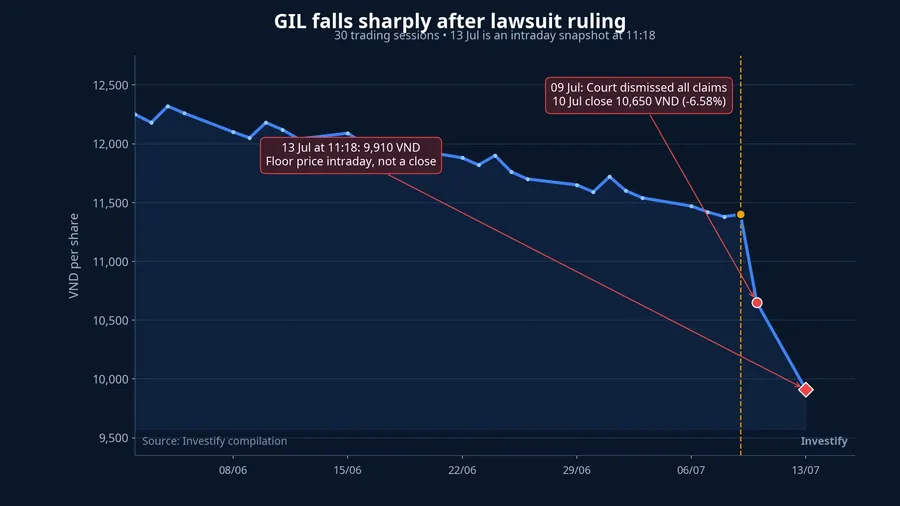
In the morning session of July 13, GIL was at its floor price of VND 9,910 per share, down 6.95% from the reference price. On July 10, the stock closed at VND 10,650, down 6.58%, on matched volume of 935,300 shares. The July 13 figures are an intraday snapshot, not a closing price.
The VN-Index was also down 25.60 points, or 1.40%, at the same time, so broader sentiment may have amplified selling pressure. However, GIL recorded two sharp declines immediately after the ruling and the appeal statement. That timing makes the legal news the strongest explanation for the stock-specific reaction, while still not assigning every sell order to a single cause.
The numbers do not necessarily say Gilimex's operating business has no value. What the market is adjusting first is the expected value attached to the lawsuit, while adding an unquantified risk from Amazon's potential claim for attorneys' fees and costs. The court allowed Amazon to file that request by August 10; no amount has yet been determined by the court.Znews
Valuation must return to cash generation
With the lawsuit no longer a dependable anchor, the remaining valuation case rests on manufacturing operations and industrial-park projects. The next business report needs to answer whether Gilimex has secured replacement customers, whether margins have changed, and whether projects are generating cash on schedule. Without sufficiently clear disclosure, inventory on the balance sheet should not be assumed to be money recoverable from Amazon.

That is what the USD 840 million figure can obscure. Legal expectations may create a compelling narrative, but durable corporate value still comes from orders, operating efficiency, working capital and cash flow. Investors should therefore distinguish a contingent legal possibility from the operating evidence that supports a continuing business. A favorable appellate decision, if one emerges, would be new information to reassess. It is not an assumption that should be booked into enterprise value today.
The base case is therefore clear: after the July 9 ruling, the lawsuit should be treated as a legal right with very high uncertainty, not as a certain shareholder asset. A filed appeal would be a procedural milestone, not proof that recovery has become probable or that damages will be collected. The items to monitor are Amazon's potential cost filing by August 10, specific disclosure on any appeal and Gilimex's next operating report. These milestones clarify process and operating performance, not an automatic recovery value. Until a legal decision actually changes the current status, GIL's valuation needs to stand on the core business.