

Volkswagen, BMW and Mercedes-Benz used to offer a reassuring shorthand: long history, respected engineering and a badge buyers were willing to pay more for. China is forcing a more practical reading of that formula. Reputation is not an automatic shield for market share when customers change the way they assess a car.
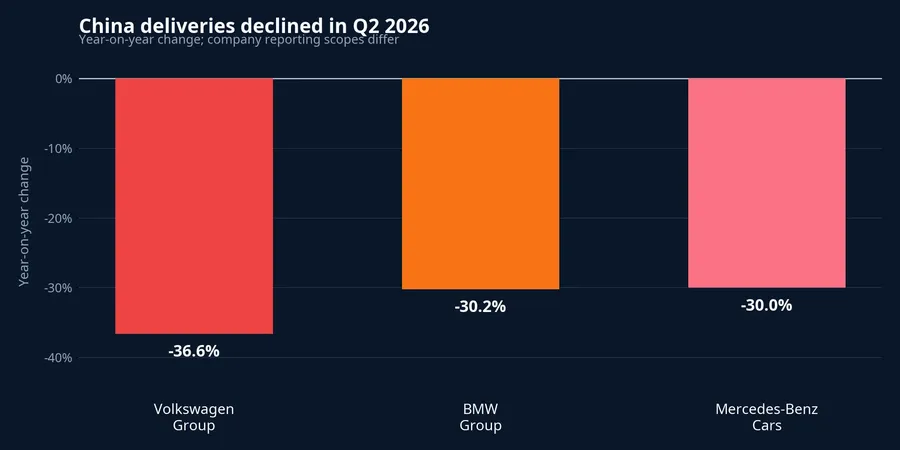
The pressure was visible in the second quarter of 2026. Volkswagen Group delivered 424,300 vehicles in China, down 36.6% year on year; BMW Group deliveries fell 30.2%; Mercedes-Benz Cars declined 30.0% to 98,600 vehicles.Volkswagen Euronext Anadolu These are not perfectly like-for-like disclosures: Volkswagen and BMW report on a group basis, while Mercedes-Benz separates passenger cars. The figures should not rank who is in the worst position. They do, however, flag a common stress point in a market that matters enormously to all three.

For a new investor, the important lesson is that one weak quarter does not prove a brand has weakened. The useful question is whether a company is falling with the market or losing customers faster than the market itself. That distinction separates a cyclical setback from an eroding competitive advantage.
The cycle explains part of the decline
It would be unfair to attribute every drop to fading appeal for German cars. Domestic passenger-car sales in China fell 24.0% year on year in the first half of 2026 to nearly 8.3 million vehicles. Property-sector weakness, pressure on household budgets and an industry-wide price war can all lead buyers to postpone a purchase.AP
Volkswagen offers a helpful example of why context matters. Its first-half China deliveries fell 25.9% to 973,000 vehicles, broadly near the contraction in the domestic passenger-car market, although the two reporting scopes are not identical.Volkswagen Put simply, if an entire neighbourhood is cutting spending, a shop selling less does not automatically mean it has lost its regular customers.
That analogy only goes so far. Volkswagen's Q2 decline was much steeper than its first-half result, and all three German brands recorded large drops within the same observable window. A single number cannot establish causation. It does put the right question on the table: are these companies retaining relative appeal while overall demand is weak?
Buyers are judging cars by new criteria
German cars built their traditional advantage on combustion-engine engineering, driving feel, fit and finish, and accumulated trust. Those qualities still matter at the top end. Mercedes-Benz says it remains the leader in China among vehicles priced above RMB 1 million.Mercedes-Benz That is evidence that the badge has not disappeared from the buying decision.
Across much of the market, however, the scorecard has changed. Buyers care about price, digital cockpits, driver-assistance functions, connectivity and whether a vehicle gains features after delivery. A domestic electric-vehicle maker may package those functions at a lower price and update its software more quickly. In that setting, heritage may still create goodwill, but it no longer automatically justifies a price premium.
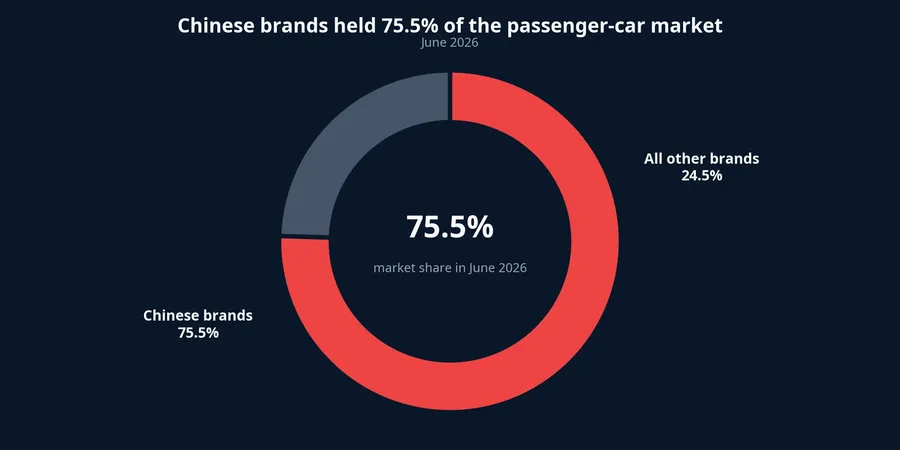
June market-share data shows the scale of the shift. Chinese brands sold 1.812 million passenger vehicles, up 6.2% year on year, and held 75.5% of the market, 8.2 percentage points more than a year earlier.CNEVPost This does not mean every domestic maker is equally strong, nor does it establish how much share any one German company lost. It does show that the competitive challenge comes from a large group of scaled rivals, not merely a handful of inexpensive models.
Corporate responses are data too
When judging a competitive advantage, do not only listen to management's plans. Ask what problem the plan is trying to fix. Volkswagen plans to reduce its model range by as much as half to lower complexity.AP Mercedes-Benz plans to bring an artificial-intelligence cockpit and new driver-assistance systems to almost its entire range within the next 6 to 12 months.Mercedes-Benz
These are plans, not delivered outcomes. They indicate that the companies see digital experience and product speed as key battlegrounds. There are also alternative explanations for weak sales, including broad demand, industry incentives and product-launch timing. A strategy reset should therefore not be treated as proof that an advantage is already gone. The test is what happens after new products reach customers.
That distinction is especially important when an investor encounters a persuasive corporate narrative. Simplifying a product line can improve cost control and make launches easier to manage. Adding software and assistance features can improve the product proposition. Neither initiative, by itself, tells us whether buyers will switch back, whether discounts will be required, or whether the resulting sales will be profitable. The evidence must come from subsequent market share, realised prices and margins rather than from the announcement.
A practical framework for new investors
A brand is like a store of customer trust. A company can draw on that store only if people still choose its product, accept its price and return when they buy again. To examine this, put the numbers side by side rather than relying on a delivery headline.
Start with market share. If sales fall roughly in line with the market and share holds, the cycle has considerable explanatory power. If sales underperform the market for several periods while comparable rivals grow, the next work is to investigate product fit, pricing or distribution.
Use a series rather than one isolated reading. Quarterly figures can move with inventory, model transitions or promotions. A repeated pattern across several reporting periods is more informative because it separates noise from a sustained loss of relevance.
Then look at pricing power. A company with a durable brand usually does not need ever-larger incentives to preserve volume. Compare average selling price, automotive margin and deliveries together. A price cut can lift volume for a while, but if margins deteriorate over time, more revenue may not create more value.
Third, check whether innovation produces outcomes. The number of announced models or advertised features is an input. Orders, feature usage, customer satisfaction and post-launch market share reveal whether the product actually fits demand. Finally, watch customer retention. Promotions can purchase a transaction; they cannot easily purchase the next buying decision years later.
Reputation is a hypothesis to test
The central conclusion is straightforward: in China, German automotive brands remain valuable assets, but they are no longer immutable advantages. Broad demand weakness explains a meaningful part of the weak numbers, so declaring the whole German auto industry defeated would be premature. Yet rising domestic share, changing purchase criteria and the companies' own product adjustments make this a structural test as well.
Rather than treating a historic name as a ready-made answer, investors should wait for the next rounds of evidence on market share, average selling prices, margins and repeat customers. These indicators apply far beyond autos. They are a practical way to test any company that relies on past reputation in a fast-changing market.