


From 14 July, Vietnam Airlines' HVN shares will no longer be subject to trading restrictions. That is positive in a very practical sense: holders will be able to place orders during HOSE's normal trading hours instead of operating in a narrower window. It would be a mistake, however, to treat that decision as a blanket certificate of financial health.
Think of it this way: opening the door wider for buying and selling does not repair every part of the house. HVN is leaving trading restrictions while remaining under warning status because of accumulated losses. Both changes take effect on 14 July, but they answer different questions.CafeF
What changes on the trading screen?
Trading restrictions do not erase a shareholder's ownership. The shares remain in the account; what narrows is the time or method of trading allowed by the exchange. With fewer opportunities to submit orders, buyers and sellers have less time to meet, particularly when fresh information arrives during a session.
HOSE's Decision 593/QD-SGDHCM, issued on 10 July, states that Vietnam Airlines had remedied the cause of the restriction. From the effective date, HVN returns to HOSE's normal trading schedule. The immediate benefit is greater control: shareholders have more time to place, amend, or cancel orders as market conditions change.CafeF
That may make transactions easier and support liquidity. “May” matters here. Liquidity only improves when there are more willing buyers and sellers at prices both sides accept. A longer trading window creates the conditions for trading; it does not manufacture demand or corporate earnings.

Warning status is a different layer of information
At the same time, HOSE is moving HVN from control status to warning status from 14 July. DNSE, citing HOSE, reported that Vietnam Airlines' consolidated equity and after-tax profit were no longer negative in the audited financial statements, while the auditor issued an unqualified opinion. That is why the level of supervision was eased, not removed entirely.DNSE
The remaining issue is accumulated losses. When a company has recorded substantial losses over several years, new profit must first make up for the deficit accumulated in earlier periods. A profitable period and a return to positive equity are meaningful recovery signals, but neither means the balance sheet has been cleared on every measure.
This distinction is especially useful for new investors. Leaving trading restrictions describes how the shares can trade. Remaining under warning describes a financial condition that still warrants attention. A stock can become easier to transact while its issuer still needs time to work through the legacy of earlier losses.
What do the financial figures show?
At the end of 2025, Vietnam Airlines reported consolidated equity of VND 6,730 billion, ending its negative-equity position. The same report said the carrier had remained profitable in both 2024 and 2025. Those figures provide the basis for the move from control to warning status.VietnamBiz
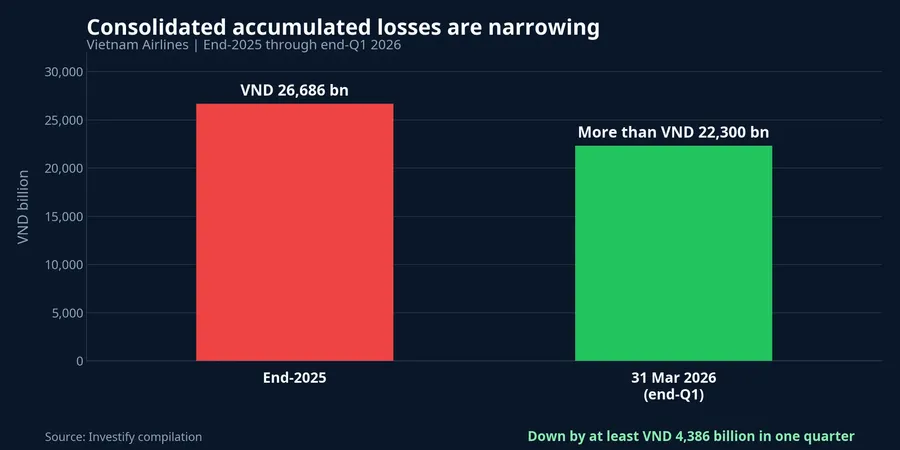
Yet consolidated accumulated losses were still VND 26,686 billion at end-2025. As of 31 March 2026, they stood at more than VND 22,300 billion. The decline indicates that newer profits are gradually offsetting earlier losses. Because the source says “more than,” it should not be turned into false precision. The remaining balance is still large enough for warning status to be more than a label on a price screen.VietnamBizDNSE
The key is the pace as well as the direction. Accumulated losses have narrowed, which is an improvement. The next question is whether profits are durable enough to keep narrowing them through future quarters. That answer will come from operating results and the cost environment, not from the removal of trading restrictions.
Fuel can change the picture quickly
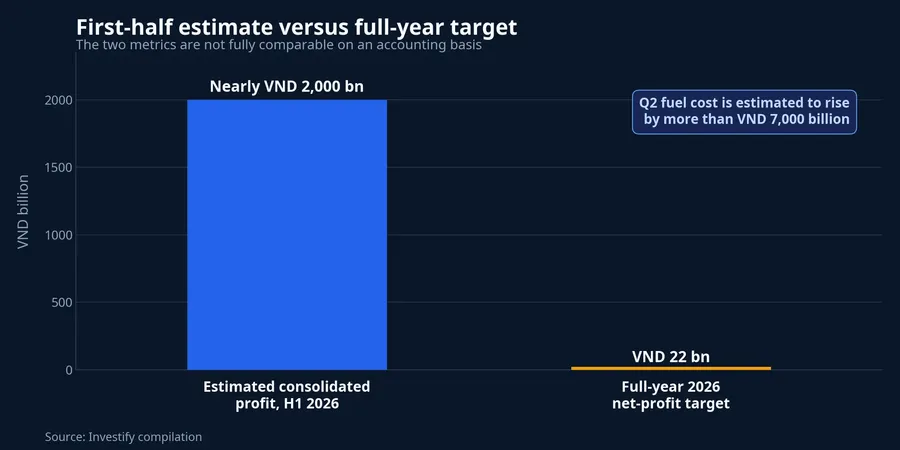
Vietnam Airlines estimates that fuel costs in Q2 2026 could rise by more than VND 7,000 billion, potentially producing a loss of approximately VND 2,000 billion for the quarter. It estimates consolidated profit for the first half at nearly VND 2,000 billion, against a full-year after-tax-profit target of VND 22 billion, based on an assumed second-half fuel price of approximately USD 120 a barrel.VietnamBiz
The two profit measures are not fully comparable on an accounting basis, so they should not be mechanically subtracted to infer a quarterly result. Still, the gap makes one point clear: fuel movements can absorb an airline's operating gains quickly. Fuel is not the only possible driver. Exchange rates, passenger demand, airfares, and execution can also affect results, and the available evidence does not establish each factor's contribution.
Do not attribute every price move to one decision
On 10 July, HVN closed at VND 25,400 per share, down 0.59%, with more than 1 million shares matched.VietnamBiz The new trading status may influence expectations about convenience and liquidity, but there is no basis for assigning all post-14 July price movement to that single decision.
HVN's price can also reflect profit expectations, fuel costs, exchange rates, broader market sentiment, and the stock's own supply and demand. One investor may see reduced trading friction; another may focus on accumulated losses and fuel exposure. The market is where those assessments meet, not a one-cause, one-result calculation.
For a new investor, separating these layers makes the announcement easier to read. The first layer is mechanics: when and how freely can the share be traded? The second is compliance and financial status: has the exchange reduced, maintained, or removed its warning? The third is business performance: is the airline earning enough, consistently enough, to reduce the old loss balance? Those are related questions, but they should not be collapsed into one headline.
This distinction also avoids a common shortcut in market commentary. A change in trading status can alter the pool of potential orders and the ease of execution. It does not by itself establish that revenue will rise, costs will fall, or a valuation is justified. Conversely, warning status is not a forecast that every current quarter must be loss-making. It is a signal to keep the underlying financial conditions in view while interpreting the share's market activity.

Conclusion: real progress, unfinished test
The central conclusion is straightforward. HOSE's removal of HVN from trading restrictions is real progress: shareholders regain a fuller trading window, and the company has remedied the cause of the restriction. The move from control to warning status also indicates that its capital base has improved.
It does not change the fact that Vietnam Airlines still carries accumulated losses and remains highly sensitive to fuel costs. In the coming reporting periods, the useful signals will be whether accumulated losses continue to narrow, whether profits can be sustained, and whether fuel assumptions change materially. Those data points will distinguish an improvement in trading mechanics from a corporate recovery that is genuinely complete.
That is the disciplined way to read HVN on 14 July. The trading gate is opening wider, which matters to existing and prospective shareholders. The financial recovery remains a separate, longer process. The next earnings releases, rather than the status change alone, will show how far that process has actually progressed.