
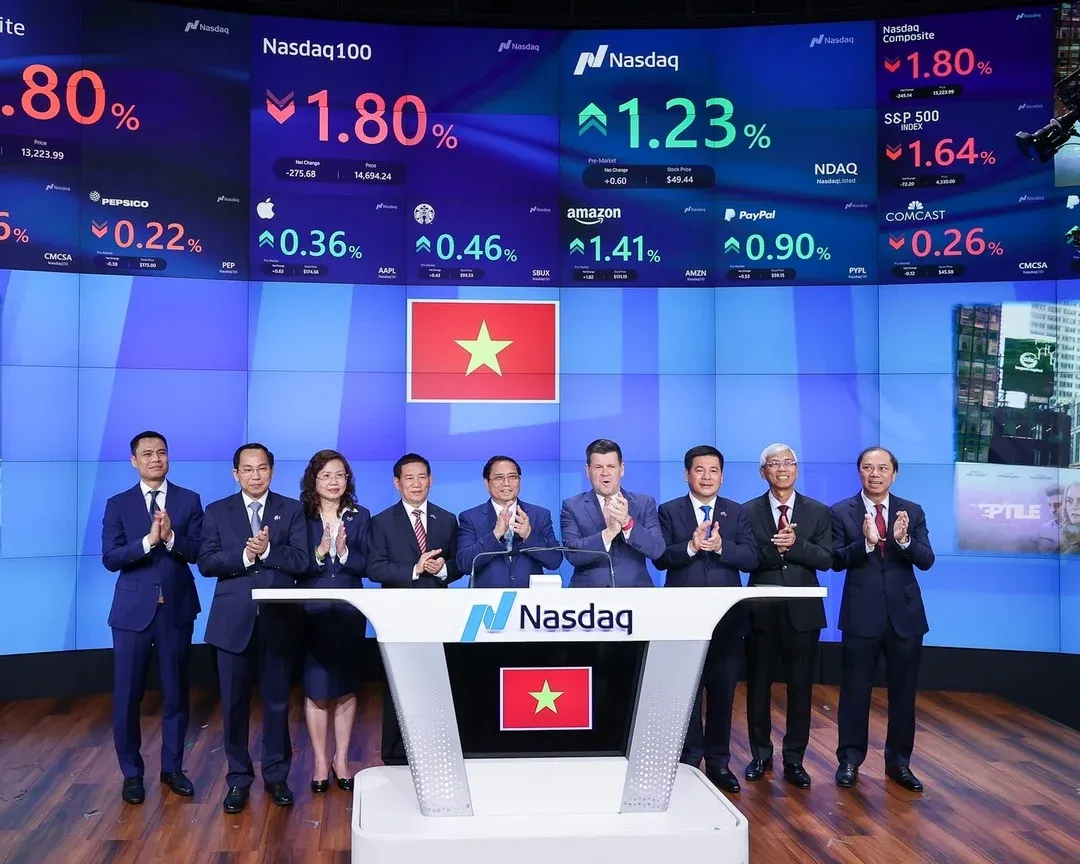

If you only looked at the scoreboard on July 9, 2026, the message seemed simple: Nasdaq was green again, so risk appetite must be coming back. That reading is understandable, but it only captures the surface. The more important point is that the rebound was driven by easing pressure from oil and Treasury yields, while the underlying risk profile of US tech stocks remained unusually unstable.APLA Times
That distinction matters because a rebound session is not the same thing as normalization. Markets can bounce quickly once a macro headwind fades. A real return to stability takes more than one green close: volatility needs to cool, the leadership group needs to stop repricing itself every few hours, and the advance has to hold across multiple sessions rather than one relief rally.
What actually powered Wall Street's rebound
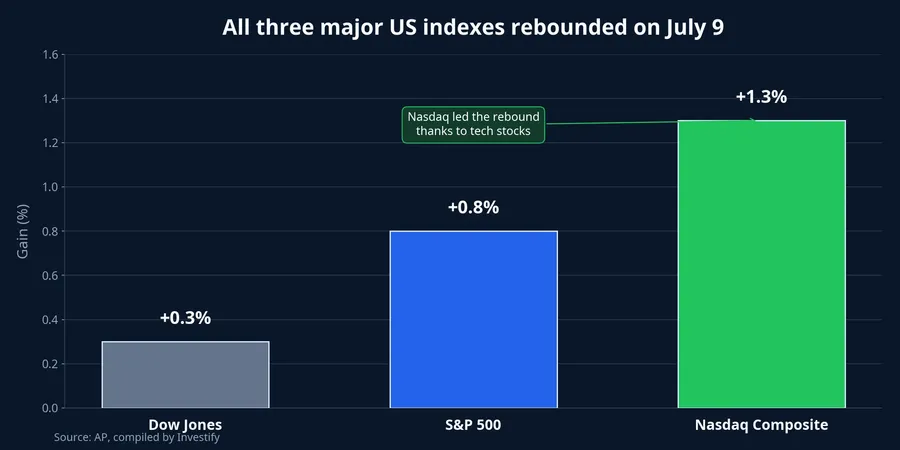
All three major US indexes finished higher on July 9. The S&P 500 rose 0.8%, the Dow Jones Industrial Average gained 0.3%, and the Nasdaq Composite climbed 1.3%. Nasdaq also added 336.24 points to close at 26,206.89, which tells you the strongest buying came back into the tech-heavy part of the market.APMarketWatch
The short-term trigger was straightforward. Brent crude fell 2.2% to USD 76.30 a barrel, while the US 10-year Treasury yield eased from 4.56% to 4.54%. For growth stocks, even a modest retreat in yields can matter because it softens the discount rate being applied to future cash flows.LA Times
That is a useful reminder for newer investors: markets do not rise for the same reason every time. Sometimes stocks move up because profit expectations improve. Sometimes, as on July 9, 2026, they move up because a macro pressure point suddenly eases. Those are not equivalent types of strength, and they should not be read as equally durable.
Why Nasdaq outperformed the rest
Semiconductor names played an obvious role in the move. MarketWatch reported broad strength in chips, while the AP report carried by the LA Times said Micron Technology rose 4.5% and SK Hynix gained 5.3% in Seoul. When key links in the artificial-intelligence supply chain bounce, the Nasdaq Composite usually reacts more forcefully than the broader market.MarketWatchLA Times
The mechanism is intuitive. Once the market gets temporary relief from oil and rates, the first place money often returns is the group with the strongest long-duration growth story. Right now that still means technology, and especially semiconductors. So Nasdaq leading the rebound is not mysterious at all.
But that same concentration of expectations is also why the group does not calm down easily. The more a market segment is supported by a powerful long-term narrative, the more sensitive it becomes to small shifts in yields, energy prices, valuation assumptions, and crowd psychology. That is why “Nasdaq closed green” is not the same thing as “tech risk is now under control.”
Volatility data says the stress is still there
The most revealing layer sits below the headline indexes. Fortune, citing Bloomberg data on July 7, 2026, said the Cboe NDX volatility index, which tracks options costs tied to the Nasdaq 100, was near 27. The spread versus the VIX for the S&P 500 was the widest since 2002, meaning the market was still pricing tech-specific turbulence well above what it expected for the broader market.Fortune
That matters because it shows how institutional money is protecting itself. When investors are willing to pay a much higher premium to hedge Nasdaq 100 exposure than broader equity exposure, the message is clear: they do not think the volatility episode is over yet. They may be willing to buy the dip, but they are still paying up for insurance.
Fortune also said the Nasdaq 100 had logged six consecutive sessions with moves of more than 1% in either direction, the longest such stretch since August 2024. Its 30-day realized volatility had climbed to 29.7, the highest level since the tariff shock a year earlier. A market can rise sharply in one session and still remain structurally unstable if the sessions around it continue to swing that hard.Fortune
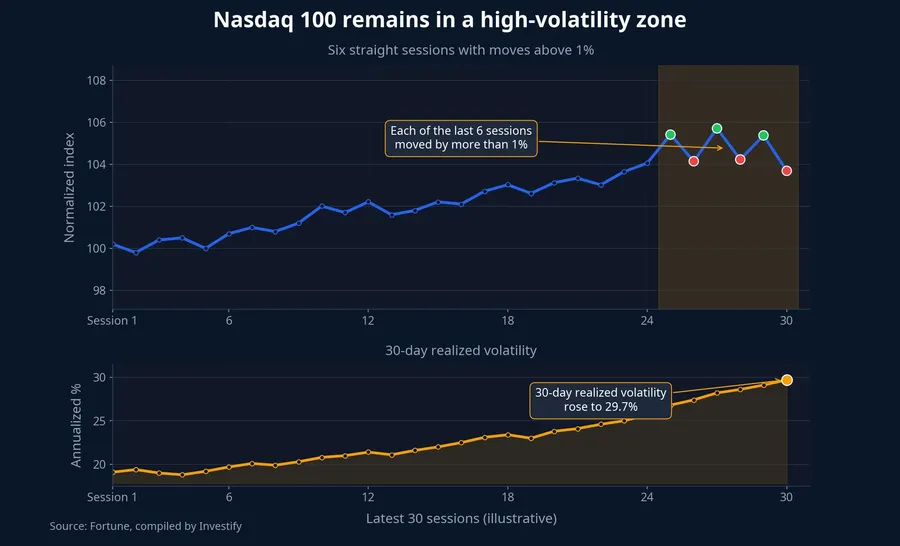
One rebound is not the same as normalization
There are at least two plausible explanations for why US tech is still swinging so hard. One is crowded positioning in the artificial-intelligence trade, where even a small change in yields or sentiment can trigger a fast repricing. The other is a deeper debate about how quickly massive spending on data centers and chips will turn into real, durable profits.Fortune
The current evidence leans more toward the first explanation, but not strongly enough to assign precise weights between the two. That is exactly why investors need discipline here. “The market feels less tense today” and “risk has sustainably come down” can sound almost identical emotionally, while meaning very different things in practice.
This distinction becomes even more important when you remember that the Nasdaq 100 had already risen about 30% since late March 2026 before entering its current stretch of turbulence. After a run like that, elevated volatility is rarely random noise. More often, it signals a market that is re-arguing the right valuation for its leadership group.Fortune
How Vietnamese retail investors should read the signal
For investors in Vietnam, a green Nasdaq still matters because US equities often shape risk sentiment across Asia before the local open. A strong Wall Street close can reduce short-term pressure on the next morning's session, especially for technology-linked names, exporters, or anything sensitive to global appetite for risk.
But drawing a straight line from Nasdaq to the VN-Index is still a leap too far. Internal market data shows the VN-Index closed July 9 at 1,840.70, down 0.70%, with 91 gainers and 203 decliners. When local breadth still leans that clearly negative, a green US tape should be treated as a sentiment input, not as proof that domestic money flow has already turned.
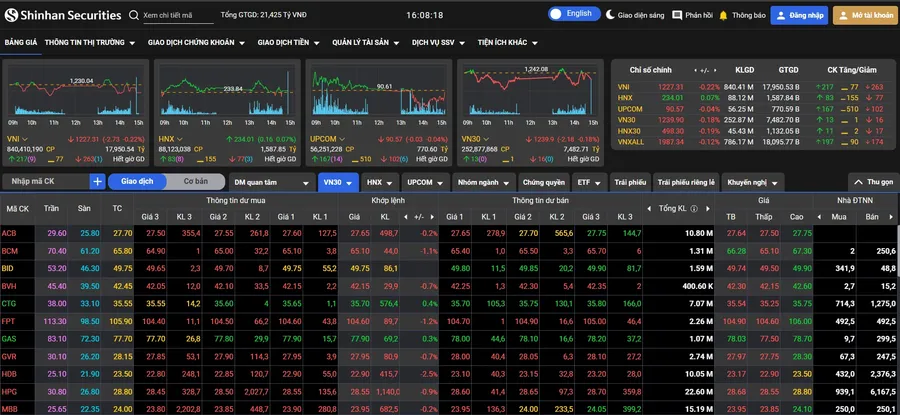
The cleaner framework is to split the signal into two layers. First comes the global macro layer: does oil keep easing, do US yields stay calmer, and does the broader US market hold its rebound. Second comes the quality layer inside tech itself: does Nasdaq 100 volatility actually cool over several sessions, and do hedging costs begin to come down.
If US indexes keep rising for a few more sessions while Nasdaq 100 volatility fades, that would be a more credible sign that risk appetite is normalizing. If the market only produces occasional green closes while tech keeps whipping around, newer investors face a familiar trap: buying into relief before the underlying instability has really cleared.
The most coherent conclusion is this: the July 9, 2026 rebound eased immediate pressure on Wall Street, but it did not confirm that US technology stocks were back in a stable regime. For Vietnamese investors, a green Nasdaq is a useful short-term sentiment marker. It is not enough on its own. The signals that matter next are Nasdaq 100 volatility, the path of US yields, and whether Vietnam's own market breadth actually improves in the sessions ahead.