


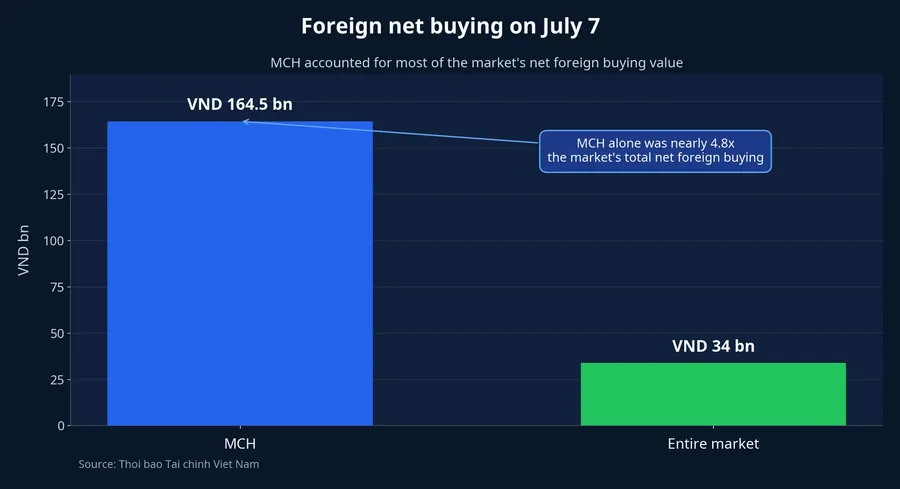
The July 7 session produced the kind of headline that can quickly pull newer investors into excitement: MCH was the single biggest foreign net-buying stock on the market, with VND 164.5 billion in net buying, equal to 1.26 million shares.Thời báo Tài chính Việt Nam If that is the only line you read, it is easy to jump to the conclusion that large money has already endorsed a fresh bullish story for the stock.
But the market is rarely that clean. In the very session where foreign investors bought MCH most aggressively, the stock still closed at VND 137,600 per share, down 1.01%, even as trading volume climbed above 16.14 million shares. Over the same session, the VN-Index ended at 1,848.25 points, up 0.26%. Read that way, the more important signal is not that MCH attracted heavy buying, but that the buying still did not produce a convincing price breakout.

That distinction matters for how newer investors should frame the story. Foreign net buying is a real fact. But a real fact is not the same thing as a complete conclusion that the stock will keep moving higher. When price does not move in lockstep with flow, the next step is to ask where that flow came from, how long it may last, and whether it reflects a reassessment of the business or something more mechanical.
Why MCH is suddenly central to the VN30 conversation
The basic mechanism is straightforward. VN30 matters because a range of ETFs track it. When the basket changes, those funds have to buy the stocks being added and sell the ones being removed so their portfolios remain aligned with the benchmark. That is a technical requirement of fund management, not necessarily a fresh vote of confidence in corporate fundamentals.
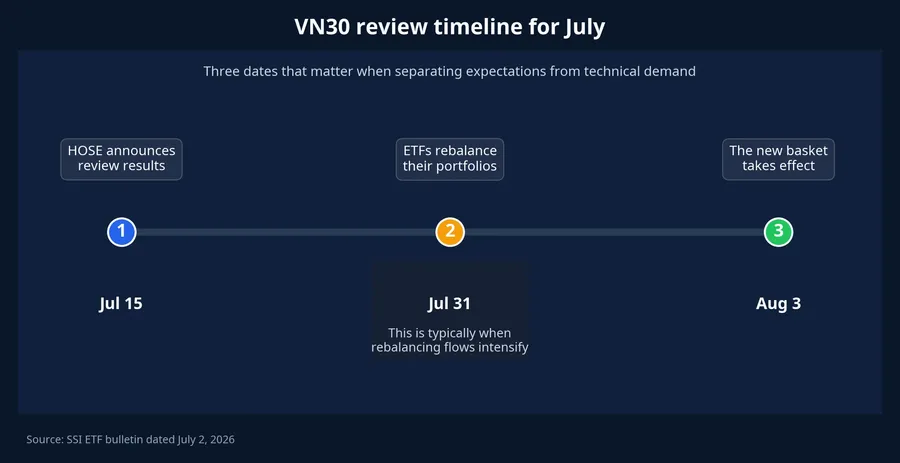
According to SSI's ETF bulletin published on July 2, the review results are expected to be announced on July 15, ETF portfolios are due to rebalance on July 31, and the new basket takes effect on August 3.SSI More importantly, MCH appears in both of SSI's scenarios for additions to VN30. SSI also estimates that MCH could see the largest buying demand among potential entrants, at roughly 3 million shares.SSI
Once that framework is in place, the strong foreign buying in MCH looks far less random. If the market assigns a high probability to MCH joining VN30, two layers of capital can show up before the official decision. One is active money trying to move ahead of the ETFs. The other is positioning by institutions that know the rebalancing window is approaching and want to prepare early.
The discipline point is not to turn “high probability” into “certainty.” SSI's note is still scenario-based, while the official basket must come from HOSE. For retail investors, that is a crucial difference. A forecast can shape positioning in advance, but a forecast is not the same as an event that has already happened.
Technical demand is not the same thing as a business thesis
Many newer investors instinctively read foreign buying as “smart money.” That instinct is not entirely wrong, but it can still lead to a misread. Foreign flow is not one thing. Some of it reflects long-term views on growth, margins, or valuation. Some of it is simply portfolio maintenance driven by index rules.
In MCH's case, the stronger evidence currently points to the second interpretation. The timing matters, because the flow arrives just before the VN30 review window. Price action matters too. If this were a broad and forceful re-rating of the business itself, a session with net buying that large would usually produce a cleaner upside response. The fact that the stock still slipped suggests sellers were still present, or that the market did not yet see this flow as enough to justify an immediate repricing.
That does not mean MCH lacks a longer-term corporate story. It simply means the July 7 session does not provide enough evidence to say that foreign buying reflects a new judgment on the company's fundamentals. Until more evidence appears, the more defensible reading is that this is primarily an index-review trade.
Three signals worth watching before the official review
The first signal is whether buying remains concentrated in MCH alone. If foreign demand keeps flowing mainly into MCH over the next few sessions without spreading across other large-cap names, that would reinforce the case for a review-related positioning trade. If the flow broadens across large-cap or consumer names, then the market may be expressing something wider about sector appetite or risk tolerance.
The second signal is the quality of liquidity on the order book. A large headline volume number does not settle the issue by itself. Newer investors need to distinguish between regular matched orders and block-like or organization-driven activity that does not necessarily represent broad follow-through demand. In practical terms, volume only becomes confirming evidence when the bid stays visible on screen rather than living only in the end-of-day total.
The third signal is how price behaves as July 15 approaches. Stocks expected to enter an index often rise before the announcement because the market has already priced in part of the expected fund demand. Once the official result arrives, the more important question is no longer whether MCH made it in, but how much price reaction is still left after expectations have been accumulated in advance.
That is exactly where newer investors are most vulnerable to chasing. A headline that matches expectations does not necessarily create fresh upside if the crowd has already paid for it. In many cases, the release date narrows the surprise factor rather than expands it, because the market stops asking whether the news is “good” and starts asking whether it is better than what was already embedded in price.
Separate confirmed facts from the market's scenario layer
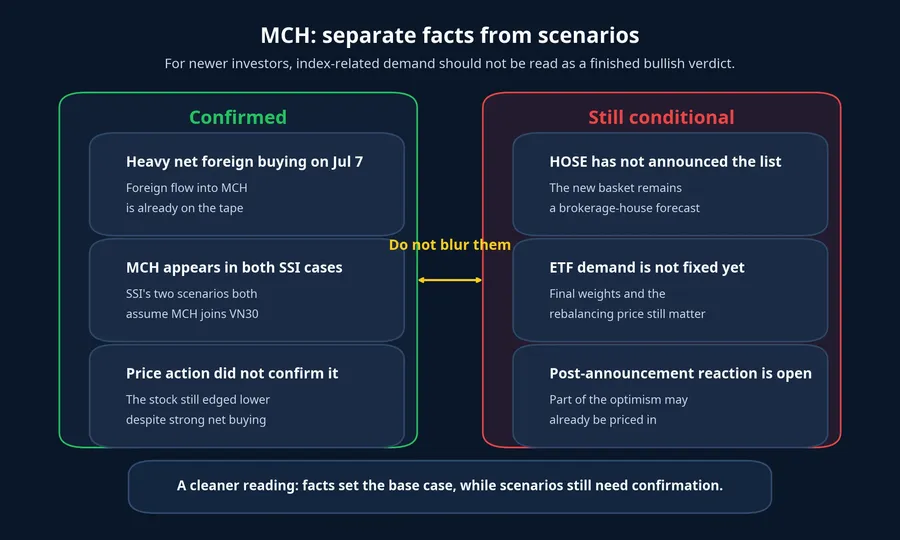
The current evidence does let us say a few things clearly. MCH is one of the market's focal points ahead of the VN30 review. Foreign investors did buy the stock heavily on July 7.Thời báo Tài chính Việt Nam SSI also included MCH in both of its addition scenarios for the index.SSI Those belong in the bucket of confirmed facts.
The things the market tends to say too early belong in a different bucket. HOSE has not yet published the official basket. The amount ETFs would ultimately need to buy still depends on final weights and the price at the time of rebalancing. Most importantly, the post-announcement price response remains open because some of the optimism may already be priced in.
For a newer investor, this setup is a little like showing up at a train station with the timetable already in hand. Knowing the train schedule is useful, but it does not guarantee that arriving at the platform will automatically produce a profitable trade. If too many passengers are already waiting, the best seats may have been taken long before the train arrives.
Conclusion: for now, this is mainly an index-rebalancing story
The cleanest thesis today is that MCH is attracting attention mainly because of its probability of joining VN30 and the technical demand tied to that possibility, not because the market has already settled on a new fundamental bull case for the company. The foreign flow is real, but it fits an index-rebalancing narrative better than a completed re-rating.
What could change that reading is a specific set of signals: HOSE's official basket on July 15, the stock's price reaction after the announcement, and the quality of liquidity as ETFs move toward end-of-month rebalancing. If those pieces line up, the story could become something broader than a technical trade. Until then, the more disciplined approach is to keep facts and expectations clearly separated rather than treating one strong foreign-flow session as a final verdict.