
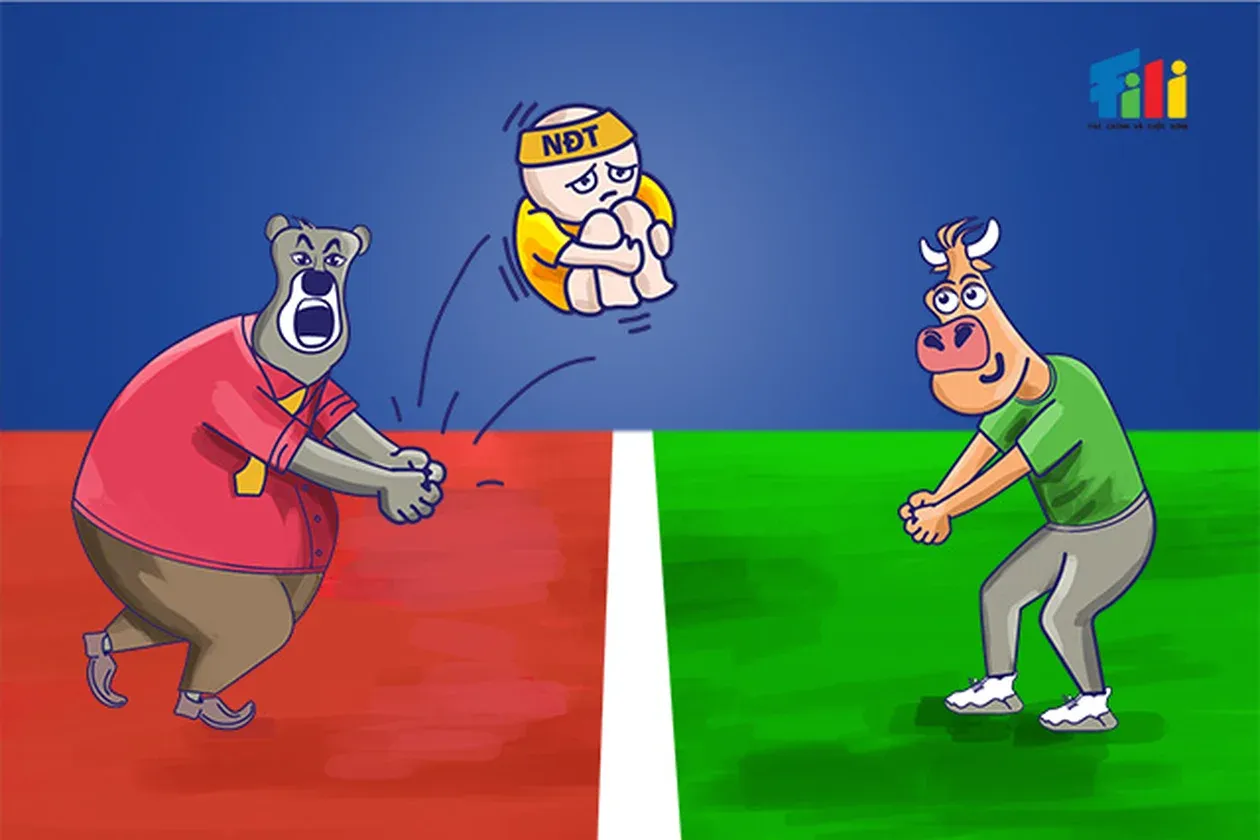

A move below 1,830 on the morning of July 7 does not automatically mean VN-Index has broken down. The more useful question is how money reacts once the index slips under that band: do buyers pull it back above support, or does selling pressure keep spreading across the board.
Put simply, one sharp drop does not settle the whole trend. What matters more is how the market behaves in the second half of the day, because that is usually when you learn whether sellers are forcing liquidation or whether buyers are still willing to absorb supply. For first-time investors, that distinction matters far more than trying to call the exact intraday bottom.
What the 1,830 area is really telling investors
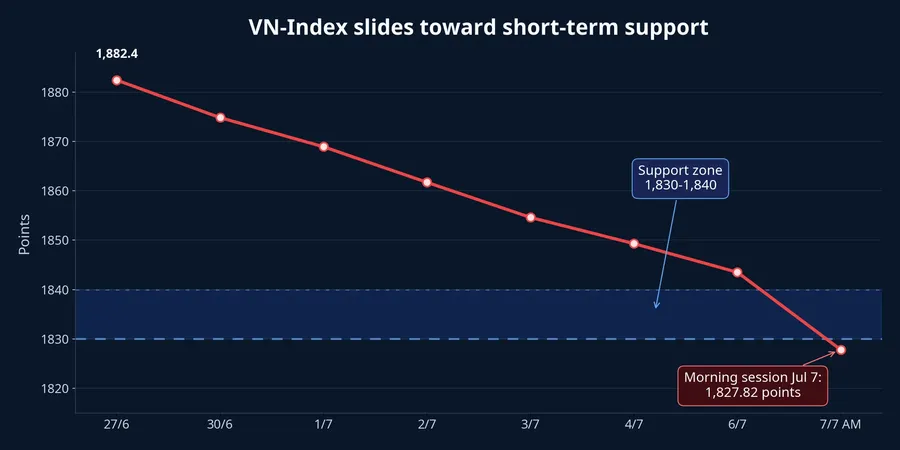
By the end of the morning session, VN-Index stood at 1,827.82 points, down 15.68 points, or 0.85%. That put the index below the 1,830-1,840 range that several brokerages have been treating as short-term support.VietstockVietstock
This weakness did not come out of nowhere. In the previous session on July 6, VN-Index had already dropped 18.58 points to 1,843.50, a sign that profit-taking and defensive positioning had started to build before the latest morning sell-off.Vietstock
That is why 1,830 should not be treated as a magical trigger. It is better understood as a test zone. If the market can recover above it by the close, investors can still argue that the morning move was a short-lived deleveraging wave. If it cannot, the conversation changes from a technical shakeout to a broader loss of footing.
Do not watch the index alone
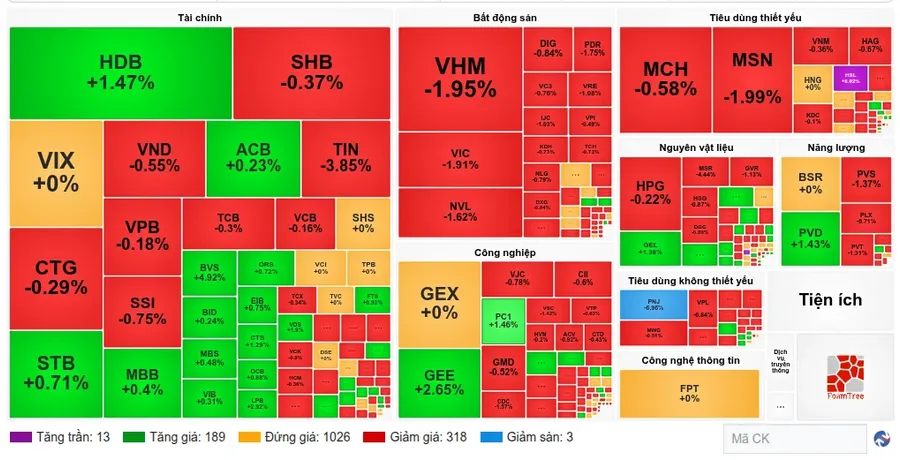
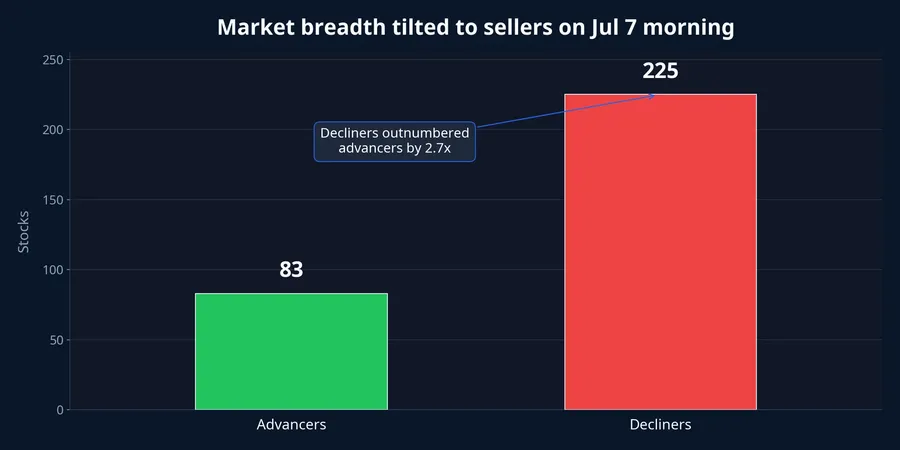
One of the easiest mistakes for beginners is to see the benchmark fall and assume every part of the market is deteriorating in the same way. The breadth data says otherwise. In the morning session, only 83 stocks were advancing while 225 were declining, with trading volume reaching 219,388,387 shares. That alone suggests selling was no longer concentrated in just a handful of names.Vietstock
Vietstock also reported that around 10:30 a.m., the market had nearly 290 decliners against more than 200 gainers, while weakness spread across real estate, consumer staples, oil and gas, and industrial stocks. In other words, the real signal was not the index point loss by itself. It was the fact that selling had widened beyond a narrow group of heavyweights.Vietstock
That matters because many retail losses do not come from a single large benchmark move. They come from mistaking a broad distribution session for a quick dip-buying opportunity. When breadth deteriorates this quickly, the feeling that “my stock has already fallen enough” is usually emotion, not confirmation.
Is every pocket of the market breaking down
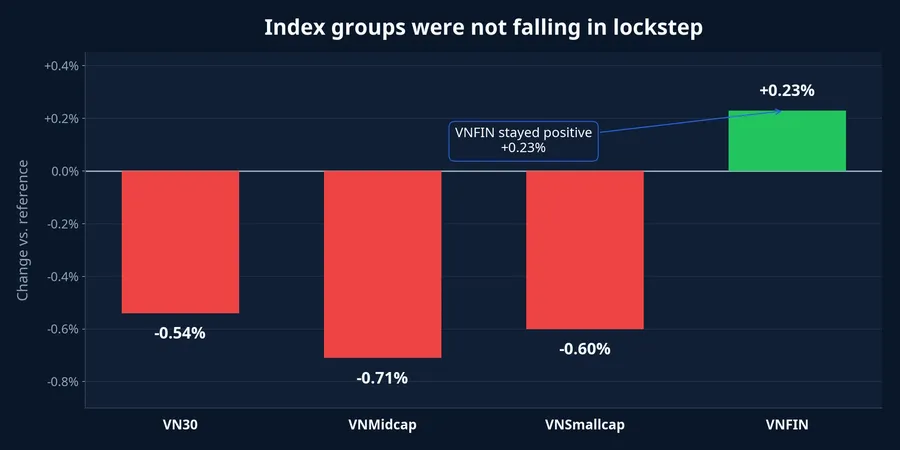
Not yet. Internal data shows VN30 was down 0.54%, VNMidcap fell 0.71%, VNSmallcap lost 0.60%, while VNFIN still managed to gain 0.23% in the same morning session. The takeaway is that selling pressure was broadening, but the market was not moving in total lockstep.Vietstock
This is exactly where new investors tend to overstate the damage. A nearly 16-point drop in VN-Index can feel like a market-wide liquidation event. But if the financial index is still slightly positive, the cleaner reading is that the market is under stress and becoming more selective, not yet entering a full panic phase.
That difference changes how a portfolio should be managed. A genuine panic session usually comes with synchronized losses across groups, rising volume driven by forced selling, and very few short-term hiding places. The morning of July 7 did not show all of those conditions. It showed heavy pressure, but it also left room for buyers to prove they are still there later in the day.
The less negative scenario: reclaim support
The more constructive scenario is straightforward. VN-Index returns to the 1,830-1,840 area in the afternoon and holds that ground into the close. Vietstock's July 7 brokerage roundup shows several firms still treating that band as short-term support, while also advising investors not to rush into higher exposure before money flow stabilizes.Vietstock
In that same roundup, Yuanta Vietnam was cited as saying that if the index can hold 1,830, VN-Index may recover and trade within a 1,830-1,885 range this week. The important word there is “if.” That is a conditional scenario, not confirmation that the market has already found a bottom.Vietstock
For beginners, the key signal in this scenario is not a brief green spike. The stronger sign would be the index reclaiming support while breadth stops worsening, meaning decliners stop expanding and mid- and small-cap stocks stabilize. If that happens, the morning slide can still be read as a short deleveraging phase after several choppy sessions rather than the start of a deeper slide.
The weaker scenario: a new support test comes into view
The bigger risk is that the index fails to recover 1,830, breadth deteriorates further, and selling continues to spread beyond the largest names. At that point, the move stops looking like a temporary dip below support and starts to look like a broader search for a lower equilibrium.
The day’s published market commentary is fairly consistent on that risk. VOV cited CSI as saying the July 6 drop had already sent a negative signal and could pull VN-Index toward a test of 1,820 during the July 7 session. Meanwhile, Vietstock’s roundup of VCBS and SHS views pointed to 1,800 as the next support area if the 1,830-1,840 band is clearly broken.VOVVietstock
Tuổi Trẻ also cited TPS as saying the current pullback still looks more like supply-demand rebalancing than a full reversal, but that 1,800 remains an important medium-term support zone if selling pressure keeps intensifying. The right takeaway is not that the market is doomed. It is that the window for self-stabilization narrows quickly if the afternoon session fails to improve both the index level and overall breadth.Tuổi Trẻ
What new investors should watch instead of guessing the bottom
First, watch where the market closes relative to 1,830-1,840. A brief dip below support followed by a recovery is very different from spending the entire afternoon under that zone. Both moves may include time below 1,830, but one shows buyers stepping in while the other shows they are waiting for lower prices.
Second, watch breadth into the close. If VN-Index recovers mainly because a few large caps bounce while decliners still dominate, the market base remains weak. On the other hand, even if the benchmark does not erase the full loss, a narrower list of decliners and a calmer tape in mid- and small-cap stocks would be a meaningfully better signal.
Third, watch leverage pressure. When multiple brokerages emphasize cutting margin and waiting rather than adding exposure, the core message is not to abandon the market at any cost. It is to reduce the part of the portfolio that can be forced into action if the weaker scenario plays out. Cash investors can wait for clearer confirmation. Margin users usually have less time because even a modest move can turn into forced decision-making.
Bottom line: the afternoon session is a test of demand quality
The most defensible conclusion right now is that the market has not provided enough evidence to declare a short-term bottom, but it also has not yet confirmed that a deeper correction is fully underway. That is why the rest of the July 7 session should be treated as a test of buying quality around the 1,830-1,840 zone, not as a contest to guess the precise low.
Three signals matter most into the close: whether VN-Index can reclaim support, whether breadth stops worsening, and whether mid- and small-cap stocks continue to absorb broad-based selling. If all three improve together, the morning drop is more likely to prove a short deleveraging wave. If they all deteriorate, 1,820 and then 1,800 become the next levels the market may have to test.VOVVietstock