


Vinhomes has set August 7, 2026 as the record date for a 1-for-1 stock dividend. In plain terms, every shareholder who owns 1 VHM share will receive 1 additional share.Vinhomes For newer investors, this is exactly the kind of headline that can create the wrong first impression: the account will show more shares, so it must mean more money.
That is not how the mechanics work. A stock dividend first changes capital structure and share count. It does not create fresh cash for shareholders on the record date. You get more shares, but the reference price is adjusted to reflect that the same corporate pie is now split into more pieces. That is the first thing to understand before moving on to market sentiment or the index impact.
What actually changes on the record date
According to the company filing, the ratio is 1-for-1, meaning every existing share receives one new share.Vinhomes Báo Mới, citing Mekong Asean, reported that Vinhomes plans to issue more than 4.1 billion shares; if completed, charter capital would rise from more than VND 41,074 billion to roughly VND 82,148 billion.Baomoi Read quickly, that can sound like an automatic transfer of value to shareholders.
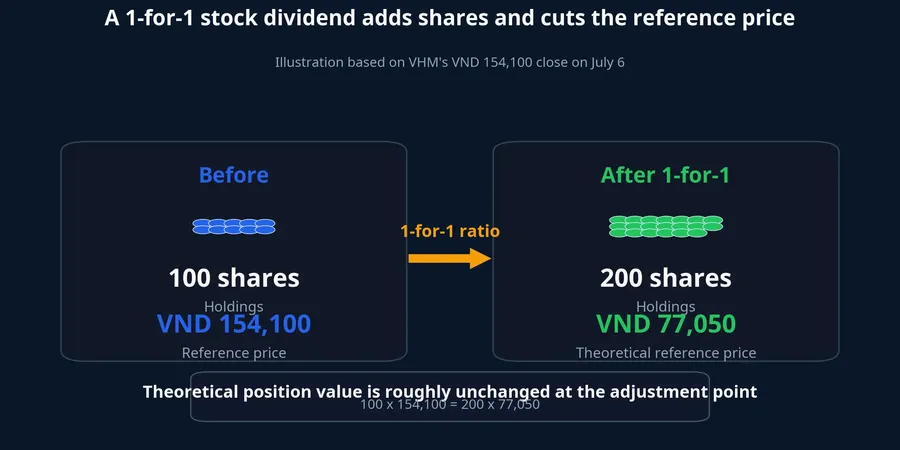
But on an exchange, a bigger share count cannot be separated from the price adjustment. Using VHM's July 6 close of VND 154,100 per share as a simple illustration, a 1-for-1 distribution would imply a theoretical post-adjustment reference price of about VND 77,050 per share. The math is straightforward: if the share count doubles, the theoretical price per share is halved before live market supply and demand take over.
That means a brokerage account may look more crowded with shares, while each share represents a smaller slice of the company. If you held 100 shares at VND 154,100 before the adjustment, you would mechanically move to 200 shares around VND 77,050 after it. The starting theoretical value is broadly unchanged. Only after that point does the market decide whether the stock deserves to trade higher or lower.
Why more shares do not automatically mean more wealth
The easiest way to think about a stock dividend is to imagine a cake being cut into more slices. The plate holds more pieces, but the cake itself is not suddenly larger just because the knife made an extra cut. New investors often get tripped up because the screen makes the bigger share count obvious, while the price adjustment gets treated like a minor technical detail. In reality, that technical detail is what determines whether you are richer or just looking at a different unit count.
This is where stock dividends and cash dividends diverge. With cash, the company pays out real money and shareholders receive real money. Báo Mới reported that Vinhomes had also finalized a 60% cash dividend, equivalent to VND 6,000 per share, with payment expected on July 22, 2026.Baomoi That is tangible value arriving in the account. A stock dividend is different. It is a re-denomination of ownership into a larger number of smaller units.
So when someone says, "Buy before the record date and you get free extra shares," the missing second half of the sentence matters: "and the price is adjusted to reflect that right." Without that second half, newer investors can end up buying a gift-box narrative. Any real upside still depends on future earnings growth, or on the market being willing to pay a richer valuation after the share count expands sharply.
What happens to EPS after the issuance
Another change, less visible than the share count but more important for long-term investors, is EPS. Once a company issues a very large number of new shares, the denominator used to calculate earnings per share expands. If absolute profit does not rise in step, EPS is diluted. That does not automatically make the event negative, but it does force investors to re-read valuation metrics instead of carrying forward old assumptions.
This is where many first-time investors miss the bridge between a technical event and business value. A 1-for-1 distribution can make the stock feel more exciting for a few sessions, but it does not create revenue, shorten the sales cycle, or lift profit on its own. After the share count rises, the market eventually circles back to the real question: can Vinhomes generate enough profit for the benefit attached to each share not to become meaningfully thinner?
Put simply, after the adjustment, investors should spend less time asking, "How many more shares did I receive?" and more time asking, "How much future earning power does each share now represent?" The second question feels less thrilling, but it is the one that keeps you from chasing a short burst of enthusiasm triggered by a prettier number on the screen.
Why the story can still move attention around VN-Index
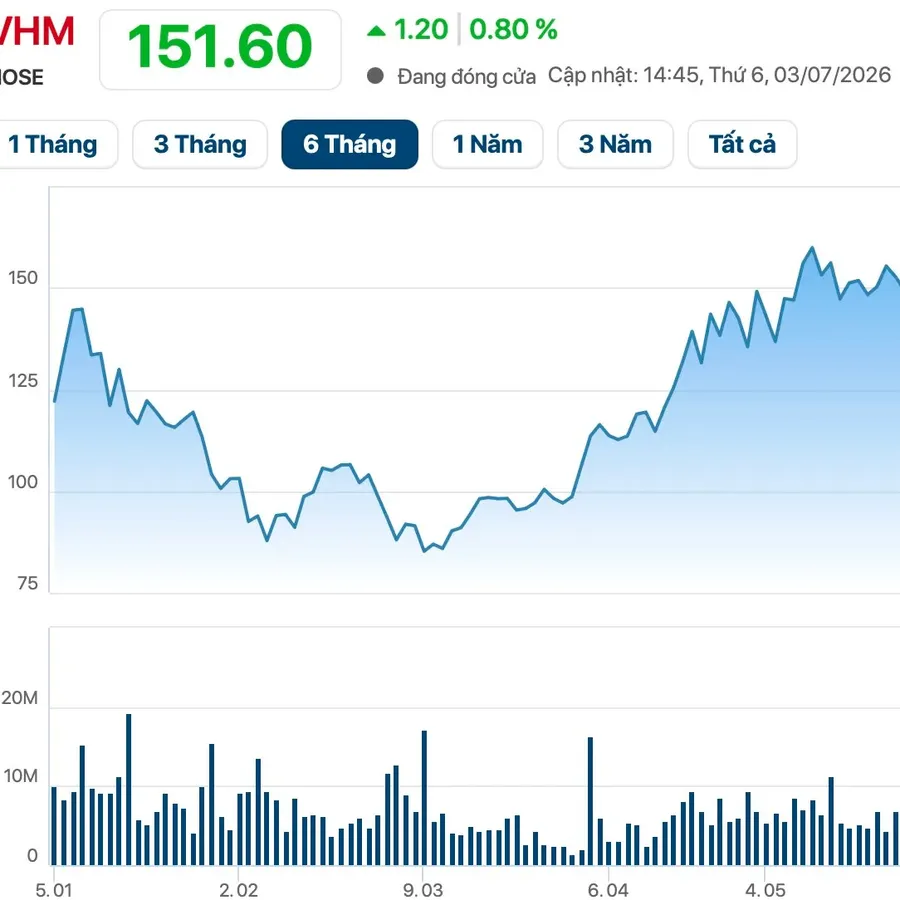
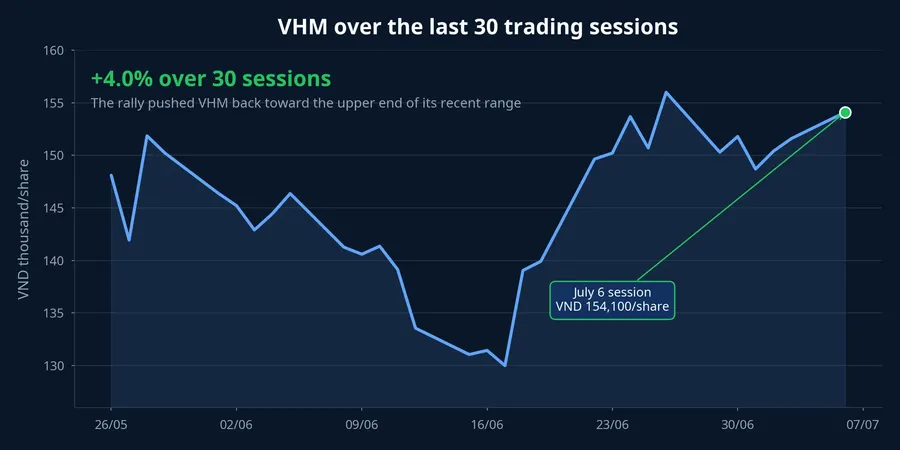
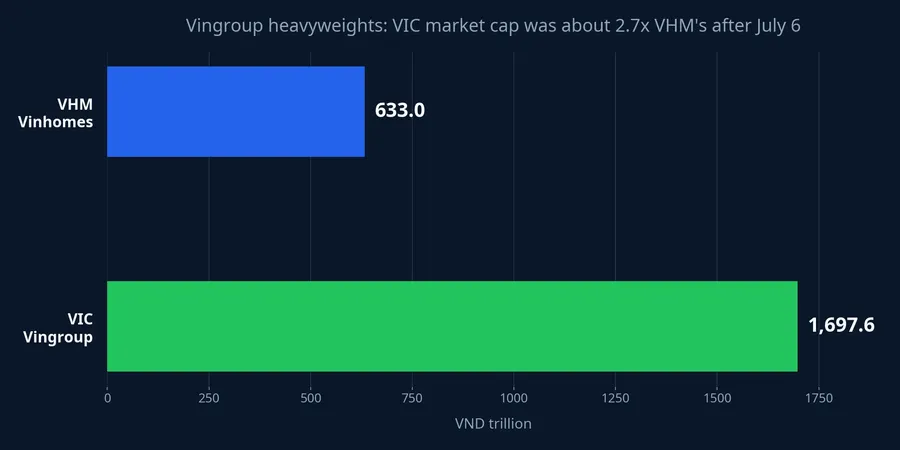
If a stock dividend does not make shareholders instantly richer, why can the market still react strongly to VHM? The answer is scale. VHM closed July 6 at VND 154,100 per share after a 1.65% gain, giving it a market capitalization of roughly VND 633,000 billion. At the same time, VIC's market capitalization stood near VND 1,697,600 billion. When stocks of that size command attention, it is natural for index sentiment to follow.
Still, it helps to separate the story into two layers. The first layer is shareholder mechanics, where the adjusted price and EPS need to be read correctly. The second layer is trading psychology, where large-cap names attract outsized attention because they can shape expectations for VN-Index. VHM's stock dividend can become a catalyst for that second layer, especially when investors are looking for a clearly timed narrative around leadership stocks.
But the larger VHM is, the more careful newer investors should be with the "blue-chip therefore it must be right" reflex. A strong session in VHM or VIC can make the tape look healthier even when the broader market is not improving to the same degree. In other words, the sentiment effect on the index is real, but it does not replace the underlying questions of business quality, cash flow, or intrinsic value.
In what order should a newer investor read this news
The cleanest order is mechanism first, valuation second, market reaction third. Start by defining the event correctly: this is a 1-for-1 stock dividend with an August 7, 2026 record date.Vinhomes Then reset your price expectations by remembering that the post-adjustment reference price will no longer be the VND 154,100 area if you are looking only at the split mechanism.
The next step is to revisit the earnings story. If, after the capital increase, the company still sustains sales momentum, revenue recognition, and margins, the market may accept the new capital structure without treating it as a negative dilution event. If operating results fail to keep pace with the expanded share base, the initial excitement of "more shares" will give way to the harder question of whether capital is being turned into earnings efficiently.
Only then does the money-flow response matter. Here, newer investors do not need to predict too much. It is enough to watch whether attention around VHM spreads across other large caps, and whether a green VN-Index is being carried by a few heavyweights or by a wider improvement in breadth. The same positive headline means something very different if participation is broad than if enthusiasm stays concentrated in one large-cap cluster.
Conclusion
VHM's 1-for-1 stock dividend matters because it changes how investors should read both shareholder rights and the behavior of heavyweight index components. But the central thesis does not change: a stock dividend increases the number of shares, while durable shareholder value still depends on future earnings and on the price the market is willing to pay after the adjustment.
For newer investors, this is a useful test of how to read market news. If you only see the extra share count, you are reading the surface. If you also read the adjusted price, the EPS reset, and VHM's role in market flows, you are much closer to the substance of the event. The next signals worth tracking are the price response after the record date and whether business results are strong enough to offset the dilution effect.